
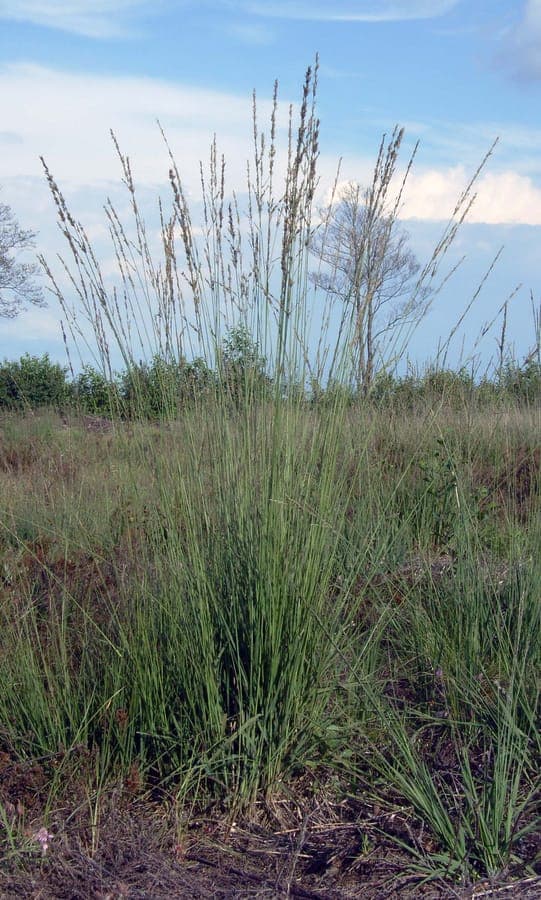
Elke Freese / CC BY-SA 3.0, via Wikimedia Commons
Molinia caerulea: complete guide
Molinia caerulea
¿Quieres ver Molinia caerulea: complete guide en tu jardín?
1 minuto, sin tarjeta de crédito
Overview
Molinia caerulea, commonly known as purple moor grass, stiff sedge, or moor grass, is a remarkable ornamental grass celebrated for its elegant, arching growth form and spectacular autumn transformation. This grass belongs to the Poaceae family and naturally occurs throughout Europe to Kazakhstan and the Mediterranean region. With its delicate, blue-purple panicles (flower spikes) appearing from July through September, Molinia caerulea forms the heart of sophisticated grass borders. Gardenworld.app recognizes this grass as essential for creating movement, lightness, and seasonal interest in contemporary garden designs.
The plant grows in loose, upright tufts reaching 60-80 centimetres in height, with flowering stems extending to 120 centimetres in some selections. The plant produces over 100 delicate panicles per tuft. Autumn colour transitions from subtle greens and purples through brilliant golds to deep bronze-browns, depending on cultivar and weather conditions. The plant is deciduous, dying back completely in December.
Appearance & Bloom Cycle
Molinia caerulea establishes itself as a loose, open tuft of extremely fine foliage. Individual leaves measure only 3-5 millimetres wide with an elegant, oval cross-section. This delicate leaf structure creates the plant's characteristic 'cloud-like' appearance that persists throughout the growing season. The overall plant form is naturally upright yet gracefully arching, particularly evident when bearing flowers.
Flowering panicles emerge on long, slender stems from June onwards, reaching peak production in July and August. The panicles are 15-25 centimetres long with densely packed, tiny florets creating airy, billowing effect. Individual panicles are greenish-purple initially, gradually ripening to golden, bronze-silver tones. When massed, hundreds of panicles create a spectacular effect that catches light and movement.
Autumn colour transformation begins in September and reaches full intensity by October-November. Different cultivars display varying colour ranges: 'Moorhexe' and 'Karl Foerster' transition to pale gold, whilst 'Skyracer' and 'Transparent' develop deep brown-purple tones. The plant retains its architectural interest well into December.
Ideal Location
Molinia caerulea performs optimally in full sun to partial shade, requiring 4-8 hours of direct sunlight daily. While the plant tolerates shade, it becomes less dense and compact. Windy locations are acceptable - indeed, wind enhances the elegant, swaying form. The plant thrives in exposed positions that would challenge other grasses.
In landscape design, this grass excels in borders, prairie-style planting schemes, and as specimens. Plant in groups of 3-5 with 50-80 centimetre spacing for maximum impact. The fine texture provides stunning contrast against heavier, shrubby plants. In small gardens, even a single large specimen delivers significant visual presence. The plant suits sustainable, ecologically sensitive designs due to its value for insects and minimal maintenance requirements.
Molinia works exceptionally well in naturalistic, contemporary borders where movement and seasonal interest drive the design.
Soil Requirements
Molinia caerulea performs optimally on moderately moist, well-draining soil with pH 5.0-7.0 (acidic to neutral). Remarkably, the plant grows equally well on dry, impoverished soils where growth remains more compact. The plant demonstrates excellent tolerance of nutrient-poor conditions; indeed, heavily fertilized soils promote weak growth and diminish autumn colour.
Sandy and gravelly soils suit the plant perfectly provided some organic matter is present. Heavy clay soils require amendment with grit or coarse sand (20-30% by volume) to improve drainage. Once established, Molinia demonstrates remarkable self-sufficiency and requires no supplemental feeding after the second season.
The plant's resilience in marginal soils makes it invaluable for challenging garden locations. Gardenworld.app recommends soil preparation at planting time, but thereafter minimal intervention.
Diseño gratis
¿Quieres ver Molinia caerulea: complete guide en tu jardín? Crea un diseño gratis ahora.
Watering
Molinia caerulea requires moderate watering, particularly during establishment. Water regularly after planting (first 4-6 weeks), especially during dry periods. Once established, the plant tolerates considerable drought. Paradoxically, Molinia performs better on slightly dry soil than in continuously wet conditions.
During the growing season (April-September), monitor soil moisture regularly, particularly in sunny locations. When dry spells exceed three weeks without rain, water deeply twice weekly. Excessive watering should be avoided as it promotes root rot. As growth decelerates in autumn, reduce watering frequency. Winter watering is unnecessary in temperate climates unless extreme drought occurs.
A 2-3 centimetre mulch layer aids moisture retention, particularly on sandy soils. The plant's native habitat - moorland and wet grassland - demonstrates its adaptability across a broad moisture spectrum.
Pruning
Molinia caerulea requires minimal pruning. The plant is clean-dying, meaning dead foliage naturally sheds and readily separates. In early January, use a stiff rake or pruning machine to remove dead material. Alternatively, cut the plant back to 5 centimetres, removing all dead tissue at once.
Young plants (1-2 years old) need not be aggressively pruned as they form their characteristic shape naturally. Avoid pruning during spring and early summer when growth tissues are expanding; cutting during this period damages developing foliage. Summer pruning is unnecessary.
Maintenance Calendar
January: Use stiff rake or pruning machine to remove dead material. Cut back to 5 centimetres ground level. Clear surrounding debris.
February-March: Monitor for pests (rare). Begin watering as temperatures exceed 10°C. No feeding required.
April-May: Vigorous foliage emergence. Maintain moderate moisture. Allow plant to develop natural form without intervention.
June-July: Panicle emergence begins. Continued flowering production. Water during dry spells. Peak ornamental period commences.
August-September: Autumn colour transition begins. Panicles ripen to golden tones. Reduce watering frequency; plant requires less moisture as growth slows.
October-November: Autumn colour reaches full intensity. Enjoy spectacular effect. No maintenance required beyond appreciation.
December: Plant dries down completely. Pruning may occur in late December or be deferred to January.
Winter Hardiness
Molinia caerulea demonstrates excellent hardiness to USDA zone 4 (winter minimums approximately -30°C). Throughout the Netherlands, Belgium, and Germany, the plant is completely hardy without protection. The plant withdraws completely below ground in autumn; deep root systems ensure winter survival in all normal conditions.
Late spring frosts occasionally damage emerging growth, but this rarely proves serious. Snow cover during winter provides useful insulation but remains unnecessary for survival. In warmer regions where winter minimums rarely fall below -5°C, Molinia grows virtually unimpeded.
Ice damage is improbable given the plant's flexibility and autumn dieback.
Companion Planting
Molinia caerulea combines beautifully within summer-flowering perennial borders. Excellent combinations include Rudbeckia species (black-eyed Susans) for yellow-orange contrast, and Echinacea (coneflower) for purple tones. Sedums and other succulents create interesting height variations.
Delicate Astilbe (false spirea) and Tiarella provide feathery foliage partners. Fine grasses like Festuca glauca and Carex oshimensis 'Evergold' offer textural variation. Flowering perennials including Phlox, Ligularia, and Helenium provide colourful backdrops. In smaller gardens, pair Molinia with single accent plants like roses or larger Miscanthus cultivars.
The plant's fine structure contrasts beautifully against architectural foliage forms. Asters in August-September extend seasonal colour continuity. Gardenworld.app recommends Molinia groupings of 3-5 specimens with regular spacing for maximum visual impact.
Closing
Molinia caerulea represents an endless source of visual delight and movement in gardens. Its slender architecture, breathtaking autumn transformation, and minimal maintenance requirements make it essential for sophisticated garden design. Whether creating prairie-inspired borders, seeking shade-tolerant grasses, or simply adding movement and seasonal interest, Molinia caerulea delivers. With guidance from Gardenworld.app, this grass becomes the foundation for gardens that respond to seasons and provide year-round structural interest. Readily available at garden centres in numerous cultivars, Molinia caerulea awaits integration into your landscape vision.
¿Quieres ver Molinia caerulea: complete guide en tu jardín? Crea un diseño gratis ahora.
Sube una foto, elige un estilo y obtén un diseño fotorrealista con lista de plantas en menos de un minuto.
Más de 10.000 jardines diseñados
Sin tarjeta de crédito


Plantas similares
Sporobolus pungens: complete guide
Sporobolus pungens
Sporobolus pungens is a stoloniferous Mediterranean coastal grass with outstanding salt and drought tolerance, perfect for seaside and dry gardens.
Mediterranean aegilops: complete guide
Aegilops biuncialis
Everything about Aegilops biuncialis, a Mediterranean annual grass with ornamental spikes and outstanding drought tolerance for dry gardens.
Silver bluestem: complete guide
Bothriochloa saccharoides
Full guide to Bothriochloa saccharoides (silver bluestem): site, soil, watering, winter hardiness, pruning, and garden companions.