
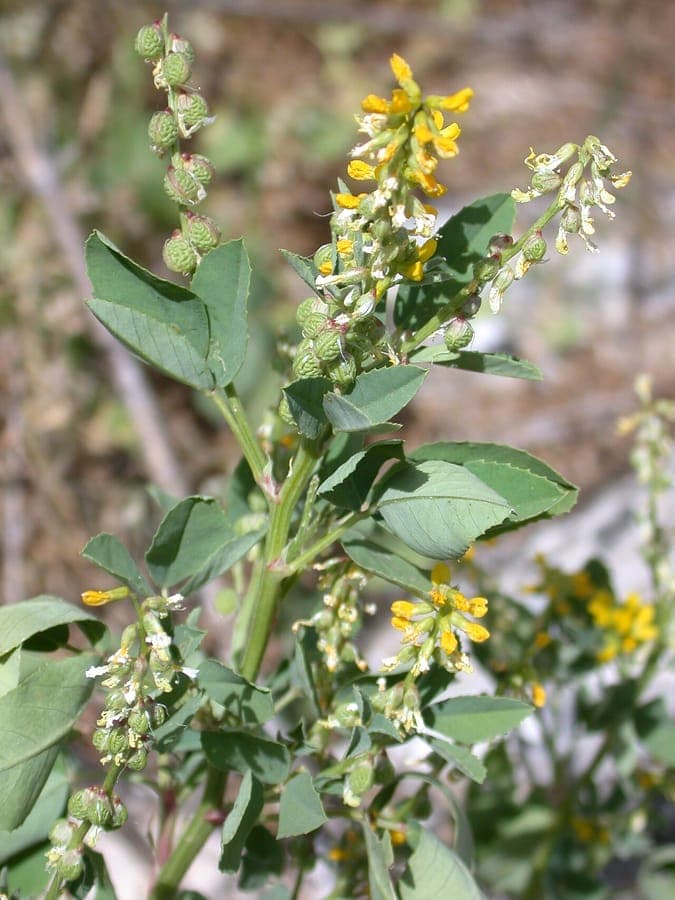
Gideon Pisanty (Gidip) / CC BY 3.0, via Wikimedia Commons
Melilotus italicus: complete guide
Melilotus italicus
¿Quieres ver Melilotus italicus: complete guide en tu jardín?
1 minuto, sin tarjeta de crédito
Overview
Melilotus italicus, known as Italian Melilot or Mélilot d'Italie, is an elegant and fragrant Mediterranean legume distinguished by its sweetly scented, tiny clustered flowers. This member of the Fabaceae family thrives in warm climates, bringing aromatic value and ecological benefit to any sunny garden.
This plant develops into a graceful shrub with green foliage and tall, slender flower spikes. While not invasive despite self-seeding readily, it becomes a sustainable, naturally-renewing element. Melilotus italicus thrives in dry, sun-filled locations and demands minimal maintenance once established.
Its primary value lies in its fragrance - the flowers emit a pleasant, honey-like aroma that attracts pollinators. Simultaneously, it captures atmospheric nitrogen, enriching soil naturally.
Appearance and Bloom
Melilotus italicus grows 30-80 centimeters tall, depending on growing conditions. The plant forms graceful, stylized foliage with the characteristic trifoliate leaflets of legumes. Flowers appear in long, spiraling spikes of tiny golden-yellow blossoms.
The flowers are unusually beautiful and fragrant, with a subtle honey-like aroma attracting numerous insects. When dried, flowers retain their fragrance, making them suitable for dried flower arrangements.
Blooming extends from May through August in southern Europe, extending to October in milder climates. The plant attracts abundant bees and other pollinating insects.
Ideal Location
Melilotus italicus flourishes in full sunlight. Position it where it receives at least six to eight hours of direct sun daily. It grows well on slopes and open areas where sunlight is plentiful.
While it tolerates partial shade, full sun is ideal for maximum flowering. In deep shade, bloom significantly decreases. Avoid very windy locations where softer stems may bend.
The plant suits borders, dry areas and informal gardens. In container culture it also thrives.
Soil
Melilotus italicus prefers well-draining soils, ideally sandy or loamy types. While it grows in poor-nutrient soils, it performs better in moderately fertile grounds. It tolerates alkaline soil types well.
Ensure adequate drainage; waterlogging damages roots. In heavy clay, add sand and compost. A neutral to slightly alkaline pH (7.0-8.0) is optimal.
Once established, the plant requires virtually no feeding thanks to its nitrogen-fixation ability.
Diseño gratis
¿Quieres ver Melilotus italicus: complete guide en tu jardín? Crea un diseño gratis ahora.
Watering
Once established, Melilotus italicus is reasonably drought-tolerant. During the growing season, regular watering assists, especially when young and blooming. Avoid excessive water as it may be susceptible to root rot.
In semiarid climates it thrives on natural rainfall alone. During very dry periods, occasional watering helps. Avoid standing water.
Once well-established, the plant largely becomes self-sufficient through natural rainfall.
Pruning
Melilotus italicus requires minimal pruning. Remove spent flowers after bloom to prevent self-seeding, or leave them for natural seed spread.
If you prefer a more compact form, you can cut back young shoots after flowering. The plant can also grow to full height.
Remove damaged or dead branches in late spring. Generally, active pruning is unnecessary.
Maintenance Calendar
March-April: Check drainage and prepare planting site. Add compost around roots if desired.
May-June: Blooming begins. Enjoy golden flower spikes. Water when dry.
July-August: Peak flowering. Fragrant flowers attract numerous insects. Remove spent flowers if preventing self-seeding.
September-October: Seed ripening. Plant begins declining. Let seed fall naturally or harvest for next season.
November-February: Winter dormancy. Plant can be left to itself.
Winter Hardiness
Melilotus italicus tolerates temperatures to approximately -2 to -5 degrees Celsius. It grows reliably in USDA zones 9 to 11. In cold areas, plant as an annual or protect containers indoors during frost.
In Mediterranean regions it's very cold-hardy. In colder climates, mulch the base during frost periods.
Companion Plants
Melilotus italicus pairs well with:
- Other Mediterranean flowering plants
- Stipa and other ornamental grasses
- Lavender (Lavandula)
- Rock roses (Cistus)
- Roses and herbaceous plants
Closing Thoughts
Melilotus italicus is a charming addition to warm, sunny gardens. With its fragrant yellow flowers and sustainable character, it brings elegance and insect nourishment. Plant it in full sun and drained soil, and it will flower reliably for years.
For UK gardeners, check specialist Mediterranean plant suppliers or Thompson and Morgan for seeds or plants.
¿Quieres ver Melilotus italicus: complete guide en tu jardín? Crea un diseño gratis ahora.
Sube una foto, elige un estilo y obtén un diseño fotorrealista con lista de plantas en menos de un minuto.
Más de 10.000 jardines diseñados
Sin tarjeta de crédito


Plantas similares
Tall Silky Lupine: complete guide
Lupinus elatus
Tall silky lupine is a fast-growing Californian perennial with silvery foliage and blue-purple flower spikes, ideal for a prairie-style garden.
Garfield Lupine: complete guide
Lupinus garfieldensis
The Garfield lupine is a rare, fast-growing American perennial for alkaline, dry grassland gardens, with striking blue flower spikes.
Lupinus elegans: complete guide
Lupinus elegans
Lupinus elegans, the elegant lupine, is a spectacular blooming plant from Mexico with blue flower spikes. Care, cultivation and garden use.