
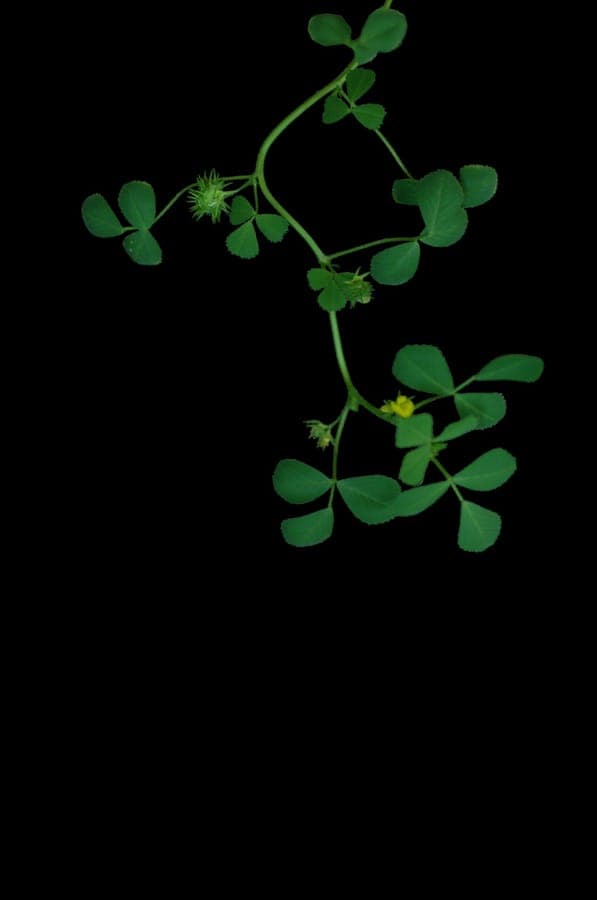
Ninjatacoshell / CC BY-SA 3.0, via Wikimedia Commons
Barrel medic (Medicago truncatula): complete guide
Medicago truncatula
¿Quieres ver Barrel medic (Medicago truncatula): complete guide en tu jardín?
1 minuto, sin tarjeta de crédito
Overview
Barrel medic (Medicago truncatula) is a fascinating plant from the Fabaceae family, native to the Mediterranean region to Iraq. This medick species is especially known for its characteristic barrel-shaped seed pods - a botanical rarity that draws much attention. The plant is scientifically interesting and serves as a genetic source for agricultural research.
In gardens, barrel medic is valued for its distinctive seed structures, elegant growth and ecological benefits as a nitrogen-fixer. The plant goes beyond what many medick species do, and its seed pods are truly exceptional. This makes it a favorite choice for botany enthusiasts and wildflower garden lovers.
Appearance and Bloom
Barrel medic grows as a compact to moderately growing herbaceous plant, usually 20 to 50 cm tall. The trifoliate leaves are small to medium in size, gray-green to deep green. The plant has an elegant, low-maintenance growth habit.
Yellow flowers appear in April-May in small clusters. These flowers are small but distinctly yellow and attract pollinators. After pollination, the characteristic barrel-shaped seed pods form - compact, cylindrical with truncated, distinctive ends.
These barrel-shaped seed capsules are truly unique. They are compact, striking and often wrinkled. Their shape distinctly suggests a barrel or ton - hence the name. They remain decorative through fall and winter.
Ideal Location
Barrel medic thrives best in full sunlight. At least seven to nine hours of direct sun is ideal. In more northern climates, light afternoon shade may be acceptable.
The plant tolerates windy conditions well, though very strong wind can hinder growth. An open, airy location is favorable. In heavily shaded locations (less than 5 hours sun), flowering will disappoint.
The plant prefers locations where full spring sunshine is available - ideal in stone or gravel situations with minimal shading.
Soil
Barrel medic requires well-draining soil. Sandy to light clay, neutral to alkaline pH (7.0 to 7.5) is favorable. The plant tolerates drought well, but can also grow in moderately moister soil than many other medick species.
Organic matter can be moderately added. A mixture of garden or potting soil with sand or gravel (50:50 to 60:40) works well. Heavy clay soils should be improved with sand and gravel additions.
The plant grows well in nutrient-poor soils. Heavy fertilization can promote unwanted foliage growth. No pre-fertilization needed.
Diseño gratis
¿Quieres ver Barrel medic (Medicago truncatula): complete guide en tu jardín? Crea un diseño gratis ahora.
Watering
Barrel medic is drought-tolerant once established. During the first growth period (4-6 weeks), keep lightly moist regularly. Then reduce significantly.
During growth (May-September), water when soil feels dry, but avoid waterlogged conditions. In natural rainfall areas, supplemental water usually not needed.
During very dry periods (longer than 3 weeks without rain), provide supplemental water. Excessive watering harms the plant and promotes diseases.
Pruning
Minimal pruning required. After flowering (June-July), wilted flowers can be gently removed, but barrel-shaped seed pods are too fascinating to remove.
When plant becomes overgrown, light pruning in May/June improves shape. Avoid aggressive cutting. Keep seed pods intact for botanical interest.
In autumn, dead stems can be removed. Many gardeners retain seed pods for fall/winter decoration and botanical study.
Maintenance Calendar
March-May: Direct seed sowing or seedling transplantation. Well-prepared sandy soil.
May-August: Regular checks for flowering. Minimal watering. Enjoy seed pod formation.
September-October: Allow seed pods to dry for decoration. Photography for botanical collection.
November-February: Remove dead material. Winter protection in cold regions.
Winter Hardiness
Barrel medic is moderately winter-hardy. In Mediterranean climates (Spain, Italy, southern France), it survives winters outdoors without protection. In more northern regions (Netherlands, Germany, Belgium), protection is recommended.
At temperatures below -5C, plants may suffer. Mulch coverage with 10-15 cm of fallen leaves helps. In very cold areas (regularly below -15C), grow in pots and overwinter in a greenhouse.
Established plants are more winter-hardy than young seedlings.
Companion Plants
Barrel medic combines well with other Mediterranean Fabaceae species: red clover, white clover, other medicago species. This combination creates an authentic wildflower mix.
In Mediterranean gardens, pairs nicely with silver-gray plants: lavender, santoline, artemisia. Yellow flowers harmonize beautifully with blue and purple partners.
Highly suitable for botanical gardens where plants are valued for interest. Ask for seed where self-seeding is possible - this species spreads naturally.
Conclusion
Barrel medic is a special choice for gardeners who love botanical curiosities. The characteristic barrel-shaped seed pods make it unique and fascinating. With well-drained soil and minimal care, it thrives beautifully. Available from plant suppliers.
Find seed at garden centers. German garden enthusiasts find it at quality retailers under "Gestutzter Schneckenklee".
¿Quieres ver Barrel medic (Medicago truncatula): complete guide en tu jardín? Crea un diseño gratis ahora.
Sube una foto, elige un estilo y obtén un diseño fotorrealista con lista de plantas en menos de un minuto.
Más de 10.000 jardines diseñados
Sin tarjeta de crédito


Plantas similares
Tall Silky Lupine: complete guide
Lupinus elatus
Tall silky lupine is a fast-growing Californian perennial with silvery foliage and blue-purple flower spikes, ideal for a prairie-style garden.
Garfield Lupine: complete guide
Lupinus garfieldensis
The Garfield lupine is a rare, fast-growing American perennial for alkaline, dry grassland gardens, with striking blue flower spikes.
Lupinus elegans: complete guide
Lupinus elegans
Lupinus elegans, the elegant lupine, is a spectacular blooming plant from Mexico with blue flower spikes. Care, cultivation and garden use.