
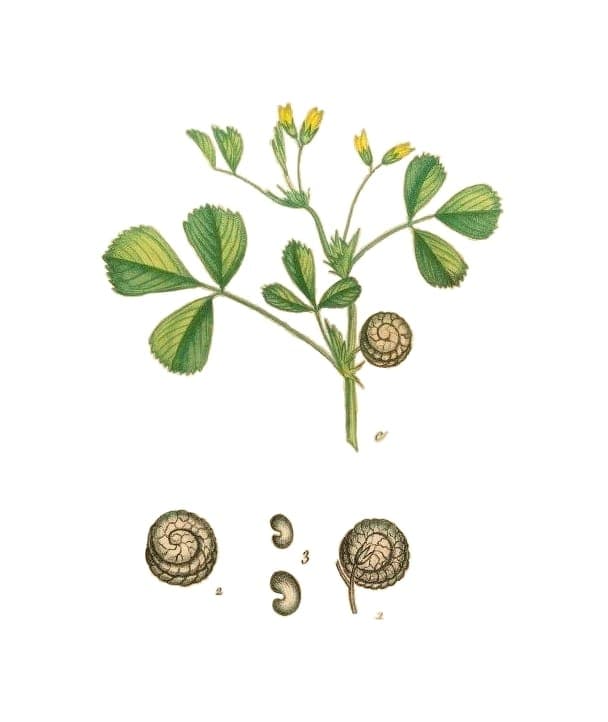
Medicago_species_3-La_flore_et_la_pomone_françaises_(clean).jpg: *Medicago_species_3-La_flore_et_la_pomone_francaises.jpg: Jean Henri Jaume Saint-Hilaire derivative work: Ninjatacoshell (talk) derivative work: Ninjatacoshell (talk) / Public domain, via Wikimedia Commons
Medicago rugosa: complete guide
Medicago rugosa
¿Quieres ver Medicago rugosa: complete guide en tu jardín?
1 minuto, sin tarjeta de crédito
Overview
Medicago rugosa, commonly known as gama medic or wrinkled medick, is a compact herbaceous legume from Mediterranean regions. This plant is particularly valuable as a forage crop and for erosion control in dry areas. The name refers to the characteristic wrinkled structure of the seed pods.
Appearance and bloom
The plant reaches 30-50 centimeters tall and forms an extremely compact, dense growth. The leaves are standard trifoliate. Small yellow to orange-yellow flowers appear in short clusters from April to May. The seed pods are highly characteristic with deep ribs and circular pattern.
Ideal location
Medicago rugosa grows in full sun with at least 5-6 hours of direct sunlight. The plant tolerates moderately windy conditions well. Partial shade is acceptable but less ideal for forage value.
Soil
Well-drained, lightly alkaline soil is favorable (pH 7.0-7.5). Poor soils are tolerated well due to nitrogen fixation. Waterlogged soils can lead to root rot.
Diseño gratis
¿Quieres ver Medicago rugosa: complete guide en tu jardín? Crea un diseño gratis ahora.
Watering
Once established, Medicago rugosa is extremely drought-resistant. Water regularly during the first growing season. Thereafter natural rainfall and sporadic water during dry periods suffice.
Pruning
Pruning is unnecessary. If you harvest the crop for forage, it regrows well after cutting and can be mowed multiple times.
Maintenance calendar
April-May: Blooming, minimal maintenance. May-June: Seed formation begins. June-August: Seeds mature, no watering. August-September: Seed harvest, plant dies back. October-March: Dormant seed pods remain on plant.
Winter hardiness
Medicago rugosa is perennial in warm climates but annual in cold areas. Tolerates temperature drops to approximately -5 degrees Celsius.
Companion plants
Perfect in grassland mixes with other legumes. Combine with wild grasses for a complete forage mix.
Closing thoughts
Medicago rugosa offers forage value, erosion control, and low maintenance. Ideal for sustainable agriculture and natural landscapes. Seed packets available. Learn more about forage crops on gardenworld.app. Plan your sustainable garden on gardenworld.app.
¿Quieres ver Medicago rugosa: complete guide en tu jardín? Crea un diseño gratis ahora.
Sube una foto, elige un estilo y obtén un diseño fotorrealista con lista de plantas en menos de un minuto.
Más de 10.000 jardines diseñados
Sin tarjeta de crédito


Plantas similares
Tall Silky Lupine: complete guide
Lupinus elatus
Tall silky lupine is a fast-growing Californian perennial with silvery foliage and blue-purple flower spikes, ideal for a prairie-style garden.
Garfield Lupine: complete guide
Lupinus garfieldensis
The Garfield lupine is a rare, fast-growing American perennial for alkaline, dry grassland gardens, with striking blue flower spikes.
Lupinus elegans: complete guide
Lupinus elegans
Lupinus elegans, the elegant lupine, is a spectacular blooming plant from Mexico with blue flower spikes. Care, cultivation and garden use.