
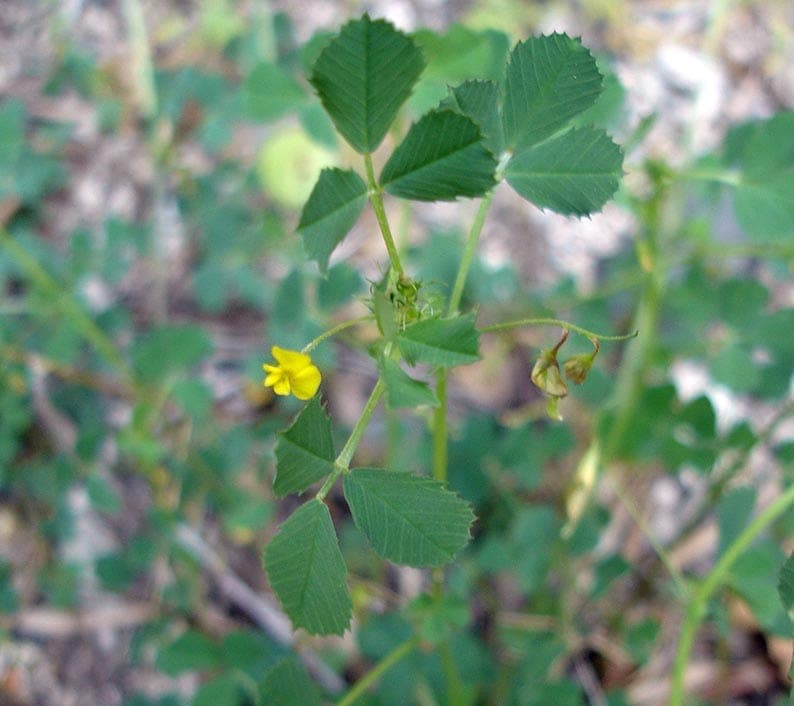
Wikimedia Commons / CC BY-SA 3.0, via Wikimedia Commons
Burless clover (Medicago orbicularis): complete guide
Medicago orbicularis
¿Quieres ver Burless clover (Medicago orbicularis): complete guide en tu jardín?
1 minuto, sin tarjeta de crédito
Overview
Burless clover (Medicago orbicularis) is an elegant plant from the Fabaceae family, native to the Mediterranean region extending to West Himalaya and Ethiopia. The plant is especially known for its characteristic disc-shaped seed pods that resemble "buttons" or "wheels." This medick species is important for soil erosion control and serves as a valuable nitrogen-fixer in natural ecosystems.
In gardens, this plant is valued for its elegant growth, fine leaves and interesting seed fruit. The flowers are small but distinctly yellow and appear between April and May. This makes burless clover ideal for low-maintenance wildflower beds and Mediterranean gardens.
Appearance and Bloom
Burless clover grows as a compact, herbaceous plant with fine, trifoliate leaves in a gray-green tint. The foliage is delicately textured and gives the plant an airy, graceful appearance. Plants typically reach 20 to 40 cm in height.
Yellow flowers appear in dense clusters during April and May. After pollination, the characteristic disc-shaped seed pods form - unique among medicago species. These flat, round "buttons" are often wrinkled or toothed at the edges, creating a decorative effect.
The seed pods form a natural ornamental detail that remains decorative even after drying. Many gardeners deliberately retain these seed structures on plants for fall and winter interest.
Ideal Location
Burless clover thrives optimally in full sunlight. At least eight hours of direct daily sun is recommended, though the plant can also grow in lightly shaded conditions. In more northern climates, light afternoon shade can actually be beneficial.
The plant is moderately wind-tolerant and thrives in open, airy locations. However, avoid very windy exposed sites where flowering may be insufficient. A sheltered but sunny spot is ideal.
In very shaded locations (less than four hours direct sun), flowering will disappoint and growth will slow.
Soil
Burless clover requires well-draining soil. Sandy to light clay with neutral to alkaline pH (7.0 to 7.5) is favorable. The plant tolerates drought better than excess moisture, so drainage is critical.
Organic matter addition in moderate amounts improves soil structure without promoting water retention. A mixture of 50% garden or potting soil, 30% sand and 20% compost is ideal.
The plant also thrives in nutrient-poor soils, so heavy fertilization is unnecessary. Indeed, excessive nitrogen can promote unwanted foliage growth at the expense of flowers.
Diseño gratis
¿Quieres ver Burless clover (Medicago orbicularis): complete guide en tu jardín? Crea un diseño gratis ahora.
Watering
Burless clover is drought-tolerant but less exceptional than medicago marina. During growth (May-September), water regularly when soil feels dry, but avoid waterlogged conditions.
In the first season after sowing or transplanting, keep lightly moist until well-established (4-6 weeks). Afterward, reduce significantly. In normal rainfall periods, supplemental water is usually unnecessary.
During very dry periods (longer than 3 weeks without rain), provide supplemental watering. Excessive watering leads to fungal problems.
Pruning
Minimal pruning required. After flowering (July), wilted flowers can be gently removed, though the seed pods are interesting enough to retain.
When the plant becomes overgrown, light pruning in May improves shape. Avoid aggressive cutting. The natural flowering habit is most attractive.
In autumn (October-November), damaged stems can be removed. Many gardeners retain seed pods for winter season interest.
Maintenance Calendar
March-May: Direct seed sowing or seedling transplantation. Sow directly in ground. No pre-fertilization needed.
June-September: Regular checks for insects and flowering progress. Minimal watering. Enjoy the modified flowers.
October-November: Allow seed pods to dry for decoration. Remove dead plant material.
December-February: Protect young plants in very cold regions with mulch.
Winter Hardiness
Burless clover is moderately winter-hardy. In Mediterranean climates (Spain, Italy, southern France), it survives winters without protection. In more northern regions (Netherlands, Germany, Belgium), protection is recommended.
At temperatures below -3C, plants may suffer. Mulch coverage with 10 cm of fallen leaves or tiles helps. In very cold areas (regularly below -10C), it's better to grow in pots and overwinter indoors.
The plant is often frost-resistant when established, especially if encouraged in previous years.
Companion Plants
Burless clover works well in wildflower beds with other Fabaceae species. Red clover, white clover, and other medick species create cohesion.
In Mediterranean gardens, it combines nicely with silver and gray-green plants like lavender, santoline, and artemisia. The small yellow flowers harmonize beautifully with purple and blue bloomers.
Less suited for formal gardens but perfect in cottage-style and wildflower settings. Spread for self-seeding and dense coverage.
Conclusion
Burless clover is an interesting plant for those who appreciate botanical curiosities. The characteristic seed pods make it both educational and decorative. With minimal care, it thrives in dry, well-draining locations. Available from plant suppliers in all regions via gardenworld.app.
Find seed at garden centers. Ask for "Burless clover" or "Medicago orbicularis". German garden enthusiasts can search for "Scheiben-Schneckenklee" at OBI and Hornbach.
¿Quieres ver Burless clover (Medicago orbicularis): complete guide en tu jardín? Crea un diseño gratis ahora.
Sube una foto, elige un estilo y obtén un diseño fotorrealista con lista de plantas en menos de un minuto.
Más de 10.000 jardines diseñados
Sin tarjeta de crédito


Plantas similares
Tall Silky Lupine: complete guide
Lupinus elatus
Tall silky lupine is a fast-growing Californian perennial with silvery foliage and blue-purple flower spikes, ideal for a prairie-style garden.
Garfield Lupine: complete guide
Lupinus garfieldensis
The Garfield lupine is a rare, fast-growing American perennial for alkaline, dry grassland gardens, with striking blue flower spikes.
Lupinus elegans: complete guide
Lupinus elegans
Lupinus elegans, the elegant lupine, is a spectacular blooming plant from Mexico with blue flower spikes. Care, cultivation and garden use.