
Wikimedia Commons / CC BY-SA 3.0, via Wikimedia Commons
Sea medick (Medicago marina): complete guide
Medicago marina
¿Quieres ver Sea medick (Medicago marina): complete guide en tu jardín?
1 minuto, sin tarjeta de crédito
Overview
Sea medick (Medicago marina) is a unique coastal plant originating from the Mediterranean, the Canary Islands, and regions extending to the Caucasus. This Fabaceae member is renowned for its remarkable salt tolerance and ability to thrive in harsh coastal climates. The plant plays an important ecological role as a nitrogen-fixer, enriching soils and providing nutrients for coastal wildlife.
In gardens and landscape applications, sea medick is valued for its resilience and ability to stabilize marginal lands with minimal maintenance. The plant is recognizable by its compact growth habit and vibrant yellow flowers that appear from April through June.
Appearance and Bloom
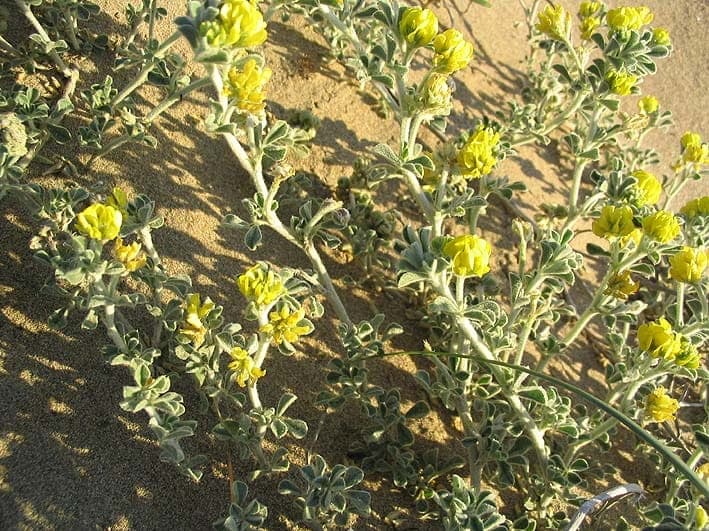
Sea medick grows as a compact, low-growing plant with fine trifoliate leaves characteristic of the Medicago genus. The foliage displays a light gray-green tint and remains small to medium in size, an adaptation to harsh sea winds and dry sandy soils.
The flowers are small but distinctly yellow, appearing in dense clusters. These floral spikes attract pollinators and bloom for three consecutive months (April to June), ensuring prolonged color in coastal gardens. After pollination, characteristic small seed pods with a typical spiral structure develop, facilitating natural seed dispersal.
Plant height typically remains under 30 cm, making it an excellent low-growing ground cover for stone and gravel arrangements.
Ideal Location
Sea medick thrives in full sunlight. Minimum eight hours of direct daily sun is ideal, though the plant can also grow in lightly shaded conditions. Its light requirements reflect evolutionary adaptation to coastal habitats where natural shade is scarce.
In locations where strong sea winds occur, sea medick displays its full potential. The plant tolerates windy conditions better than many other garden plants. This makes it perfect for gardens near the coast, on rooftops, or in other exposed locations.
In partial shade, sea medick can survive but will produce fewer flowers and may develop thinner growth. When selecting locations, aim for at least six to eight hours of direct sunshine daily for optimal growth and flowering.
Soil
Sea medick requires well-draining, preferably sandy or gravelly soil. In nature, it grows on coastal sand beaches and rocky terraces where water does not accumulate. Heavy clay soils cause root rot, so soil improvement is essential in heavier soil types.
The pH can range from neutral to alkaline (pH 7.0 to 7.5). This higher pH reflects the plant's natural Mediterranean limestone-rich coastal environment. Organic matter can be added, but only in moderate amounts to prevent excessive water retention.
Soil should be mineral-rich but not necessarily high in organic matter. Indeed, heavy fertilization can promote unwanted foliage growth at the expense of flowers. Light spring fertilization is sufficient for healthy development.
Diseño gratis
¿Quieres ver Sea medick (Medicago marina): complete guide en tu jardín? Crea un diseño gratis ahora.
Watering
Sea medick is extremely drought-tolerant once established. Its deep root system allows water uptake from lower soil layers. During the growing season (May-September), water when prolonged drought occurs, but avoid waterlogged, wet conditions.
During the first growing period (first 4-6 weeks), maintain lightly moist soil until the root system is well-established. Afterward, reduce watering significantly to minimal levels - natural rainfall usually suffices.
Even in Mediterranean gardens with very little rainfall, this plant survives well. Excessive watering can be harmful and leads to fungal diseases. The rule is: better too dry than too wet.
Pruning
Sea medick requires minimal pruning. After flowering (around early July), wilted flowers can be gently removed to keep the plant neat. This sometimes stimulates repeat flowering, though this is not guaranteed.
When the plant becomes abnormally dense or uncontrolled, light pruning in May can maintain compactness. Avoid aggressive cutting as this can damage the plant. The natural growth habit is best respected.
In autumn (October-November), dead or damaged stems can be removed. This requires care, as the plant itself can be relatively fragile under strong winds.
Maintenance Calendar
March-May: Soil preparation, direct seeding or transplantation of young plants. Light mineral fertilizer application.
June-September: Regular inspection for pollinators, minimal watering. Remove spent flowers. Check for pest problems.
October-November: Clean up dead plant material, prepare soil for the coming season.
December-February: Winter dormancy. Mulch plants in very cold regions (below -5C).
Winter Hardiness
Sea medick is moderately winter-hardy. In Mediterranean and Atlantic climate zones (Spain, Italy, southern France), it survives winters outdoors without protection. In more northern regions (Netherlands, Germany, Belgium), protection is required.
At temperatures below -5C, plants may freeze. In these cold regions, grow plants in containers and overwinter in a cold frame or protected location. Mulch coverage of 10-15 cm with tiles or fallen leaves helps in marginal cases.
In very cold regions (temperatures below -15C regularly), sea medick is better overwintered in a greenhouse and replanted in May.
Companion Plants
Sea medick combines excellently with other coastal flora: sheep's broom (Cytisus maritimus), sea wormwood (Artemisia maritima), and maritime plantain (Plantago maritima). This combination creates an authentic coastal garden.
In gravel gardens, sea medick pairs nicely with gray-green herbaceous companions like lavender, santoline, and hardy rock plants. The yellow flowers harmonize well with purple and white-flowering neighbors.
Avoid plant companions requiring abundant water or heavy feeding. Sea medick is best in dry, lightly populated niches.
Conclusion
Sea medick is a valuable plant for gardens in coastal areas and other dry locations. Its resilience, compact growth, and striking blooms make it a worthwhile choice. With minimal care and proper site selection, this medick will provide years of garden enjoyment. Available from plant nurseries in all four countries via gardenworld.app.
Find seeds and young plants at garden centers. Ask for varieties specifically grown for coastal applications. For enthusiasts, the same varieties are available under the name "Sea medick" at quality retailers across all regions.
¿Quieres ver Sea medick (Medicago marina): complete guide en tu jardín? Crea un diseño gratis ahora.
Sube una foto, elige un estilo y obtén un diseño fotorrealista con lista de plantas en menos de un minuto.
Más de 10.000 jardines diseñados
Sin tarjeta de crédito


Plantas similares
Tall Silky Lupine: complete guide
Lupinus elatus
Tall silky lupine is a fast-growing Californian perennial with silvery foliage and blue-purple flower spikes, ideal for a prairie-style garden.
Garfield Lupine: complete guide
Lupinus garfieldensis
The Garfield lupine is a rare, fast-growing American perennial for alkaline, dry grassland gardens, with striking blue flower spikes.
Lupinus elegans: complete guide
Lupinus elegans
Lupinus elegans, the elegant lupine, is a spectacular blooming plant from Mexico with blue flower spikes. Care, cultivation and garden use.