
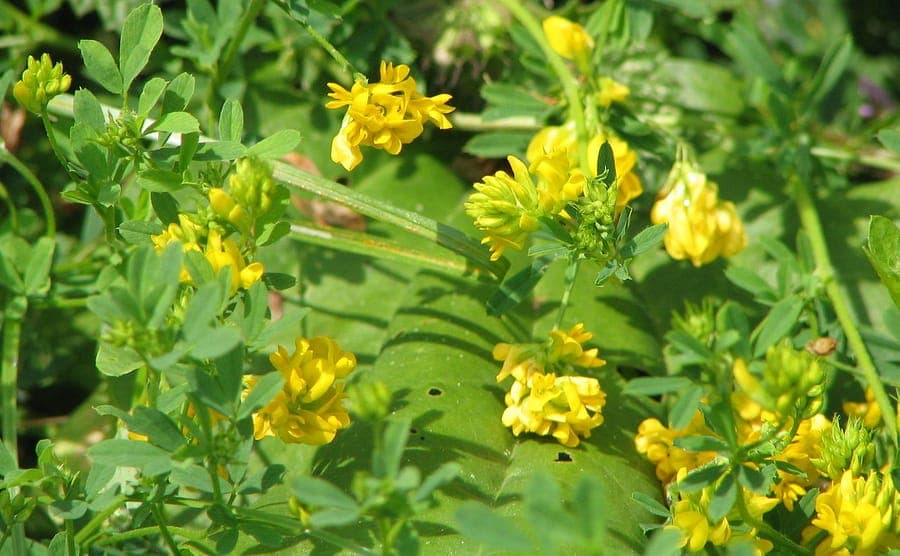
No machine-readable author provided. Bogdan assumed (based on copyright claims). / CC BY-SA 3.0, via Wikimedia Commons
Sickle Medick (Medicago falcata): complete guide
Medicago falcata
¿Quieres ver Sickle Medick (Medicago falcata): complete guide en tu jardín?
1 minuto, sin tarjeta de crédito
Overview
Sickle medick, scientifically Medicago falcata, is an excellent perennial fodder plant and soil improver originating from Asia, extending from eastern Europe through Mongolia to the Indian subcontinent. The plant derives its name 'falcata' from the characteristic sickle-shaped seed pods – an almost unmistakable identifying feature. This undervalued crop offers substantial benefits for sustainable agriculture and has received far less attention than common alfalfa, though in many respects it equals or even surpasses it.
Sickle medick differs fundamentally from common alfalfa in preferring drier conditions and requiring less intensive management. This makes it particularly suited to water-limited regions and integration into semi-arid systems. The plant fixes nitrogen symbiotically and can add more than 150 kilograms of nitrogen per hectare annually to soils, making it invaluable for organic farming programs. Additionally, its fodder value for cattle, sheep, and horses is impressive, with high protein and energy content, especially when dried.
Appearance and Bloom Cycle
Sickle medick grows to approximately 30 to 80 centimeters tall, with strong stems and feathery compound foliage. The plant forms an open, non-compact growth habit, with stems winding past one another. Foliage is distinctly green, lacking the gray hairiness some related medick species possess. Leaves are larger than many other clover species, giving the plant a fuller appearance.
The flowers represent one of sickle medick's defining characteristics: they are golden-yellow to orange-yellow, distinctly different from the purple flowers of common alfalfa. Flowers appear in loose, open clusters from May through October, with peak flowering in June-July. Each individual flower cluster contains numerous florets, creating an extended, attractive blooming period. Following pollination, characteristic half-circular or very lightly curved seed pods form – literally small 'sickles' – filled with seed and highly recognizable.
Ideal Location
Sickle medick performs optimally in sunny locations receiving at least six hours of direct daily sunlight. The plant tolerates dry conditions better than common alfalfa and thrives in climates with lower annual rainfall. In northern Europe, it functions equally well with regular moisture. The plant feels most at home in open, well-ventilated growing positions without excessive shade.
Wind tolerance is excellent; sickle medick grows well in windy areas and open fields. Strong stems don't bend easily and the plant stands robustly against environmental stress.
Soil Requirements
Sickle medick accepts a broad soil spectrum, from sandy to clay, provided drainage exists. Ideal pH ranges from neutral to slightly alkaline (6.5-7.5), though it also succeeds in slightly acidic terrain. The plant prefers soils not prone to waterlogging; it handles drier soils better than common alfalfa.
The plant is non-critical regarding nutrients because it produces its own nitrogen through fixation. Plantings following previous grain crops prove ideal, as soil is then well-prepared. No specialized fertilization is required.
Diseño gratis
¿Quieres ver Sickle Medick (Medicago falcata): complete guide en tu jardín? Crea un diseño gratis ahora.
Watering
Once established, sickle medick exhibits excellent drought tolerance. This is one of its greatest advantages. Young plants (first four weeks) require more regular watering, but once root-established, they can endure extended dry periods with minimal yield loss. In temperate zones, the plant typically manages with natural rainfall, though supplemental watering during warm summers stimulates growth.
Water is especially important during establishment and early growth season. Thereafter, established plants can survive months without supplemental water in moderate climates.
Maintenance Requirements
Sickle medick is exceptionally low-maintenance. As a permanent crop, it requires minimal inputs. No pruning or fertilization necessary. The plant grows autonomously and stabilizes quickly. In pastures, it can be managed perennially with simple rotational grazing.
Weed control may be needed in the first season, but once well-established, sickle medick suppresses weeds through dense coverage. For fodder harvest, one can graze or mow, with best nutritive value achieved near bloom stage.
Maintenance Calendar
April-May: Seed sowing, minimal preparation. June-July: First growth; grazing or cutting can begin in first year. July-October: Growth, flowering, seed formation. October-November: Plant material prepares for winter. November-March: Winter dormancy, minimal maintenance. April onwards: New growth cycle begins.
Winter Hardiness
Sickle medick is perennial and extremely winter-hardy. The plant tolerates severe winters and frosts down to minus 15 degrees Celsius, making it perfect for northern climates. This is a major advantage over annual crops: you plant once and enjoy harvests for years. In well-drained soils, sickle medick can produce for ten to fifteen years or longer without replanting.
Companion Planting and Agricultural Value
Sickle medick works excellently in mixed pastures with grasses and other clover species. It's also suitable in crop rotation systems, though its perennial nature means it's handled differently than annual cover crops. In organic livestock farming, it's a standard crop due to nutritive value and nitrogen fixation.
The plant can also be used in field margins, for soil protection on sloping terrain, and in agroforestry systems.
Benefits and Applications
Sickle medick offers incredible value for sustainable gardeners and farmers. Nitrogen fixation significantly reduces artificial inputs. Fodder value for livestock is high, with 18-25% crude protein in dry matter and good digestibility. Dry matter yields typically range around 5-8 tons per hectare, depending on management and climate.
The plant also proves valuable for pollinators and beneficial insects. Yellow flowers attract numerous bee species, and plant biomass supports biodiversity.
Gardenworld.app helps gardeners and small farmers integrate sickle medick into sustainable growing systems. With advice based on photographs, learn how sickle medick integrates with other crops and how to harvest for maximum nutritive value.
Conclusion
Sickle medick deserves far more attention than it currently receives. This robust, perennial fodder plant with outstanding drought tolerance, reliable winter hardiness, and impressive nitrogen fixation offers long-term value for sustainable agricultural systems. Sow in April-May, enjoy autonomous growth over years, and harvest regularly for nutrition and soil management. The characteristic yellow flowers and sickle-shaped pods make it a captivating and recognizable component of any agricultural landscape.
¿Quieres ver Sickle Medick (Medicago falcata): complete guide en tu jardín? Crea un diseño gratis ahora.
Sube una foto, elige un estilo y obtén un diseño fotorrealista con lista de plantas en menos de un minuto.
Más de 10.000 jardines diseñados
Sin tarjeta de crédito


Plantas similares
Tall Silky Lupine: complete guide
Lupinus elatus
Tall silky lupine is a fast-growing Californian perennial with silvery foliage and blue-purple flower spikes, ideal for a prairie-style garden.
Garfield Lupine: complete guide
Lupinus garfieldensis
The Garfield lupine is a rare, fast-growing American perennial for alkaline, dry grassland gardens, with striking blue flower spikes.
Lupinus elegans: complete guide
Lupinus elegans
Lupinus elegans, the elegant lupine, is a spectacular blooming plant from Mexico with blue flower spikes. Care, cultivation and garden use.