
Wikimedia Commons / CC BY-SA 3.0, via Wikimedia Commons
Tree Medic: Sustainable Nitrogen-Fixing Legume for Ecological Gardens
Medicago arborea
¿Quieres ver Tree Medic: Sustainable Nitrogen-Fixing Legume for Ecological Gardens en tu jardín?
1 minuto, sin tarjeta de crédito
Overview
Tree medic (Medicago arborea) is a remarkable and valuable nitrogen-fixing legume from the Fabaceae family, native to Mediterranean regions including Italy, Spain, Greece, Malta and southern France. This plant is particularly renowned for its exceptional ability to fix atmospheric nitrogen through a very important symbiosis with bacteria in the roots. This makes tree medic exceptionally valuable for organic and permaculture gardens and regenerative agriculture. The plant grows as an upright shrub to approximately two to three meters tall under favorable conditions.
Tree medic belongs to the same important family as peas and beans (Fabaceae) and shares with this family the special ability to fix nitrogen. This capacity helps improve soil without artificial fertilizers or chemicals. For permaculture designers and organic gardeners, this is an essential and valuable tool. The plant can be used as a green manure crop to restore soil fertility. Historically, tree medic was cultivated as livestock fodder and as a green manure crop throughout Europe. Now it is again recognized as essentially valuable for sustainable agriculture and regenerative garden designs. The plant contributes significantly to biodiversity.
Appearance and Bloom
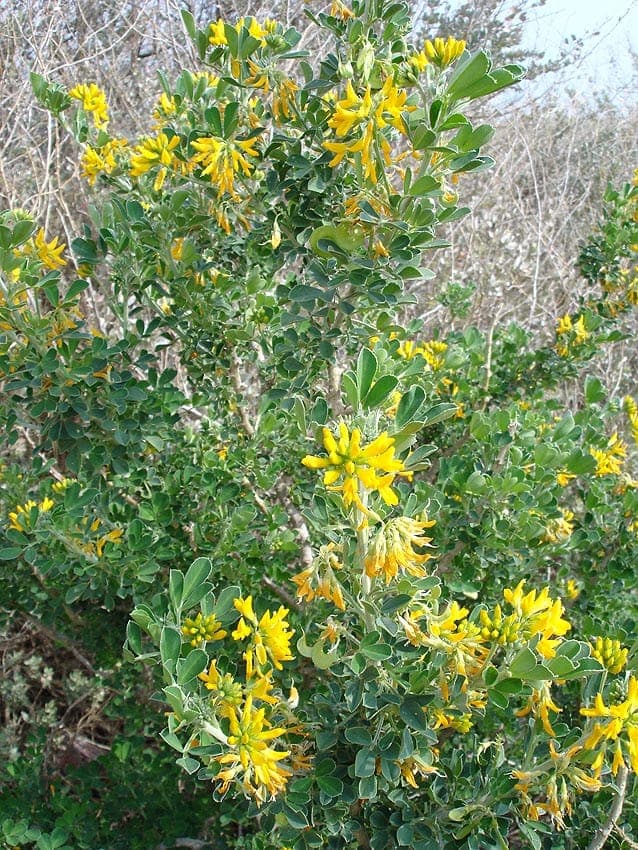
Tree medic forms a very elegant, upright shrub to approximately two to three meters tall with fine, dark green foliage. The leaves are compound, approximately ten to fifteen centimeters long, with three leaflets per leaf (trifoliate structure). The foliage color is glossy green and remains attractive and healthy throughout the entire season. The stems are smooth and green when young, darkening with age. The growth habit is elegant and architecturally interesting.
The blooming is subtle but very significant. Flowers are small, approximately eight to ten millimeters long, and are colored yellow to orange. They grow in dense, terminal clusters along the stems appearing quite decorative. Blooming begins in May and continues through October in warm climates. Flowers are self-fertile but are eagerly visited by bees, bumblebees and other pollinators which increases ecological value. Following bloom, very characteristic spirally-twisted seed pods develop that characterize all Medicago species. These seed pods are very distinctive and decorative.
Ideal Location
Tree medic grows optimally in sunny locations with minimum six to eight hours direct sunlight daily which is essential. The plant tolerates wind reasonably well and grows on diverse soil types without much support. In temperate climates, tree medic grows best in sheltered locations protected from strong southwest winds. The plant may be grown as a single specimen or in groups for greater impact. Because of its unique nitrogen-fixing property, it is valuable in green manure systems where it is periodically ploughed under.
Tree medic blooms during an extended period and attracts masses of bees and other beneficial insects. Therefore it is valuable in garden ecosystems for biodiversity. The plant grows well against warm walls where thermal mass provides extra heat which promotes growth. In permaculture systems it is used as a nitrogen-fixing layer in multi-strata designs.
Soil
Tree medic grows on virtually all soil types but prefers well-draining, slightly neutral to alkaline soils. In acidic soils, adding lime proves very beneficial. The plant tolerates poor soil excellently, especially because of its unique ability to fix atmospheric nitrogen. This makes expensive soil enrichment actually unnecessary. The symbiosis with nitrogen-fixing Rhizobium bacteria means poor soil actually enhances rather than limits the plant's ecological value.
In container culture, well-draining potting mix should be used. The plant grows better with minimal feeding than with abundance which is unique. This fundamentally distinguishes tree medic from many other garden plants that prefer nutrient-rich soil.
Diseño gratis
¿Quieres ver Tree Medic: Sustainable Nitrogen-Fixing Legume for Ecological Gardens en tu jardín? Crea un diseño gratis ahora.
Watering
Tree medic is extremely drought-tolerant once established and requires only minimal watering which promotes water conservation. During the first growing season after planting, regular water should be given to stimulate strong root development. Thereafter, the plant tolerates extended drought excellently without decline. Actually, excessive water can be harmful, especially in cold wet winters where root rot can occur.
Once established, tree medic can survive long periods without supplemental water which can last for months. This makes it ideal for areas with low precipitation. No mulching is needed and is actually not recommended due to rot risk around the stem base.
Pruning
Tree medic requires minimal pruning which keeps maintenance costs low. The plant naturally develops an attractive, compact form without intervention. Only dead, damaged, or disease-infected branches should be carefully removed. Pruning is best done immediately after blooming or in early spring when new growth begins. The plant can be substantially cut back if renewal is desired, but this is usually unnecessary.
The plant grows slowly to moderately, so excessive pruning is not needed for form maintenance. Old specimens can sometimes be cut back to encourage renewal.
Maintenance Calendar
Spring (March-April): carefully inspect for winter damage, plant new specimens, add compost to soil, remove mulch.
Summer (May-October): enjoy blooming, water regularly during establishment period especially first year, observe masses of insect activity, no feeding needed, collect seed.
Fall (October-November): gradually reduce watering, collect seed for propagation, prepare for winter by removing foliage.
Winter (December-February): minimal maintenance, no feeding needed, protect young specimens from extreme frost, inspect for damage.
Winter Hardiness
Tree medic is fully hardy to approximately minus ten to minus fifteen degrees Celsius and thrives well in USDA zones 7-10. In Netherlands, Belgium and southern France it survives without protection. In very cold regions, protecting young trees may prove useful. Once established, mature trees are quite hardy and robust. The plant prefers not overly wet winters and thrives better in dry winter situations which explains the plant's preference for Mediterranean climates.
Companion Plants
Tree medic grows well in polyculture systems with other Fabaceae members and diverse other plants. The nitrogen-fixing property means neighboring plants benefit from improved soil fertility. Grasses, herbs and other garden producers grow considerably better near tree medic. In permaculture systems, tree medic is often used as a "nitrogen fixing layer" in multi-strata designs.
The plant provides bee and butterfly forage and contributes significantly to biodiversity and ecological health. This is an essential plant for ecologically conscious gardeners wishing to create sustainable garden systems. The plant is invaluably precious for regenerative landuse and climate-smart agriculture.
Closing Thoughts
Tree medic deserves a place in every front yard and permaculture system where ecology is priority. This remarkable plant offers sustainable soil improvement without chemical input. For environmentally conscious gardeners this is an indispensable choice. Gardenworld.app provides extensive inspiration for regenerative and sustainable garden designs. This is a plant for future-focused gardeners.
¿Quieres ver Tree Medic: Sustainable Nitrogen-Fixing Legume for Ecological Gardens en tu jardín? Crea un diseño gratis ahora.
Sube una foto, elige un estilo y obtén un diseño fotorrealista con lista de plantas en menos de un minuto.
Más de 10.000 jardines diseñados
Sin tarjeta de crédito


Plantas similares
Tall Silky Lupine: complete guide
Lupinus elatus
Tall silky lupine is a fast-growing Californian perennial with silvery foliage and blue-purple flower spikes, ideal for a prairie-style garden.
Garfield Lupine: complete guide
Lupinus garfieldensis
The Garfield lupine is a rare, fast-growing American perennial for alkaline, dry grassland gardens, with striking blue flower spikes.
Lupinus elegans: complete guide
Lupinus elegans
Lupinus elegans, the elegant lupine, is a spectacular blooming plant from Mexico with blue flower spikes. Care, cultivation and garden use.