
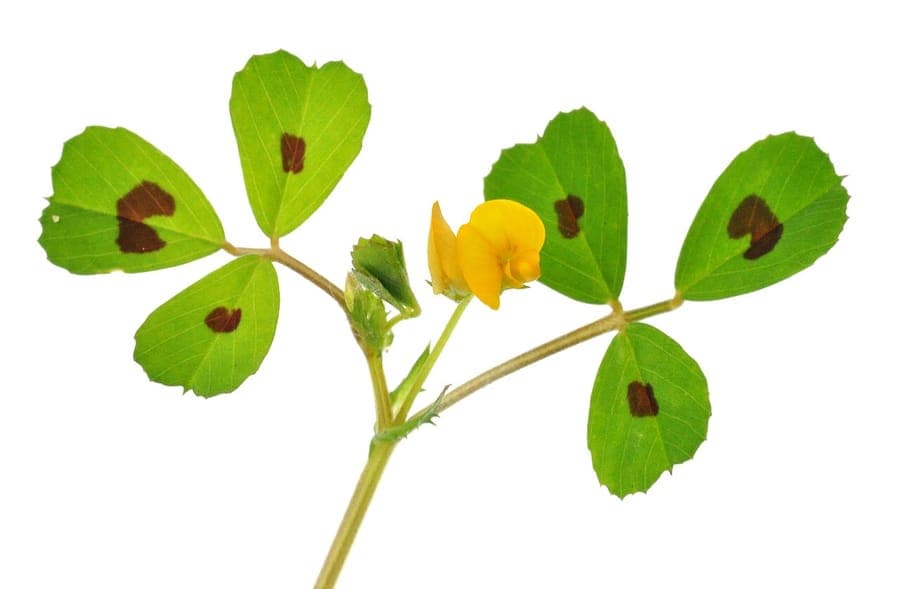
User:Amada44 / CC BY-SA 3.0, via Wikimedia Commons
Spotted Bur-clover (Medicago arabica): complete guide
Medicago arabica
¿Quieres ver Spotted Bur-clover (Medicago arabica): complete guide en tu jardín?
1 minuto, sin tarjeta de crédito
Overview
Spotted bur-clover, scientifically Medicago arabica, is a fascinating leguminous herb originating from the Mediterranean region with distribution extending to Morocco and the Caucasus. While less prominent than common alfalfa (Medicago sativa), spotted bur-clover offers distinctive advantages in organic farming and sustainable garden practices. The plant derives its name from characteristic spotted leaflets and hairy growth form, easily distinguishing it from other medick species.
This annual herb proves particularly valuable in soil management systems. It establishes symbiosis with nitrogen-fixing rhizobial bacteria, enabling the plant to capture atmospheric nitrogen and render it available for subsequent crops. This makes spotted bur-clover invaluable for organic gardeners and small-scale farmers seeking independence from synthetic fertilizers. Additionally, the plant attracts numerous beneficial insects, supports pollinator populations, and serves as nutritious fodder for livestock.
Appearance and Bloom Cycle
Spotted bur-clover grows as a low, spreading crop reaching approximately 15 to 40 centimeters tall, depending on growing conditions and moisture availability. Stems are finely hairy, relatively weak and spreading in growth pattern, meaning the plant extends horizontally rather than vertically. Leaves are characteristically trifoliate (three-parted), with elliptical leaflets, some bearing fine purple spots – hence the common name.
Flowers appear in small, golden-yellow flower clusters (racemes) from June through September, providing an extended, attractive blooming period. Individual flowers measure just several millimeters, but their abundance creates a full, golden appearance against green foliage. Following pollination, the plant produces distinctive spiral-shaped seed pods – intricate coiled structures sometimes bearing tiny spicules, creating instantly recognizable visual features.
Ideal Location
Spotted bur-clover performs optimally in sunny locations receiving at least six hours of direct sunlight. The plant exhibits excellent drought tolerance, making it suitable for warmer climates and drier regions. In the Netherlands and Belgium, it thrives equally well with regular moisture provision. The plant feels most at home in open, well-ventilated growing positions without excessive shade.
Wind tolerance is good; the plant withstands windy gardens and open fields admirably. Sheltered, shaded positions in gardens are less ideal – growth will be slower and nitrogen fixation compromised.
Soil Requirements
Spotted bur-clover adapts well to various soil types, thriving in soils ranging from sandy to moderately heavy clays. The plant prefers neutral to slightly alkaline soil (pH 6.5-7.5). The critical requirement is good drainage; the plant tolerates waterlogging poorly and will rot in waterlogged terrain.
The plant is non-demanding regarding fertility – this is precisely the advantage: it can improve depleted land by introducing nitrogen. For optimal growth, work in some compost or sow following grain crops, preparing the soil appropriately.
Diseño gratis
¿Quieres ver Spotted Bur-clover (Medicago arabica): complete guide en tu jardín? Crea un diseño gratis ahora.
Watering
Spotted bur-clover exhibits excellent drought tolerance once established. Young seedlings require more regular watering during their first two to three weeks. Thereafter, they manage adequately with natural rainfall in temperate climates, though supplemental watering during warm dry periods stimulates growth.
In container culture, water when the top centimeter feels dry. Field-grown plants typically manage without supplemental water under normal summer conditions in northern European climates. During drought periods (July-August), supplemental watering increases productivity.
Maintenance Requirements
Spotted bur-clover is exceptionally low-maintenance. No fertilizing or pruning is necessary. The plant grows autonomously, requiring minimal human intervention. Weed management may be needed in severely weedy fields, but in tidy gardens, spotted bur-clover as an understory crop grows vigorously enough to suppress weeds.
When used as green manure, allow the plant to grow through season, terminating growth by incorporation in late October or November. Working plant matter into soil substantially improves soil organic matter and nitrogen status. For fodder use, harvesting occurs while the plant remains in bloom for optimal nutritive value.
Maintenance Calendar
April-May: Direct seed sowing into ground requires minimal preparation. June-July: Growth proceeds autonomously. July-August: Flowering; supplemental deep watering during drought. September-October: Continued flowering and seed set. October-November: Green manure harvest, incorporation into soil or mulching.
Winter Hardiness
Spotted bur-clover is an annual crop that doesn't survive winter in temperate zones. The plant dies with frost. This is actually advantageous for green manure programs, as the plant terminates growth at predetermined time. In very mild climates (southern France), volunteer regrowth from seed may occur in subsequent seasons, but this isn't the norm.
Combinations and Agricultural Value
Spotted bur-clover excels in crop rotation systems. Plant this crop following grains and preceding food crops like potatoes or vegetables. Nitrogen enrichment is substantial: up to 100 kilograms of nitrogen per hectare can be fixed during a single season, substantially reducing reliance on synthetic fertilization.
The plant also serves as feed for sheep, goats, and horses, particularly when dried. Nutritive value is high in protein and calcium content, important for livestock health.
Benefits and Applications
Spotted bur-clover offers numerous advantages for sustainable gardens and small farms. Nitrogen fixation reduces dependence on synthetic fertilizers. The plant attracts bees and butterflies, supporting pollinator populations. In organic systems, it proves indispensable.
The plant functions effectively as a cover crop, preventing erosion and stimulating soil biology. Many certified organic farms employ medick species extensively within crop rotations.
Gardenworld.app supports gardeners establishing sustainable green manure systems. With advice based on photographs, you'll learn integrating green manure crops with food production. Gardenworld.app assists in crop planning for optimal soil management across seasons.
Conclusion
Spotted bur-clover is invaluable for organic gardeners and sustainable farmers. Sow in April-May, enjoy autonomous growth throughout the season, and harvest in October-November as green manure. Symbiotic nitrogen fixation, pollinator support, and minimal maintenance make this crop an essential component of productive, ecologically healthy gardens.
¿Quieres ver Spotted Bur-clover (Medicago arabica): complete guide en tu jardín? Crea un diseño gratis ahora.
Sube una foto, elige un estilo y obtén un diseño fotorrealista con lista de plantas en menos de un minuto.
Más de 10.000 jardines diseñados
Sin tarjeta de crédito


Plantas similares
Tall Silky Lupine: complete guide
Lupinus elatus
Tall silky lupine is a fast-growing Californian perennial with silvery foliage and blue-purple flower spikes, ideal for a prairie-style garden.
Garfield Lupine: complete guide
Lupinus garfieldensis
The Garfield lupine is a rare, fast-growing American perennial for alkaline, dry grassland gardens, with striking blue flower spikes.
Lupinus elegans: complete guide
Lupinus elegans
Lupinus elegans, the elegant lupine, is a spectacular blooming plant from Mexico with blue flower spikes. Care, cultivation and garden use.