
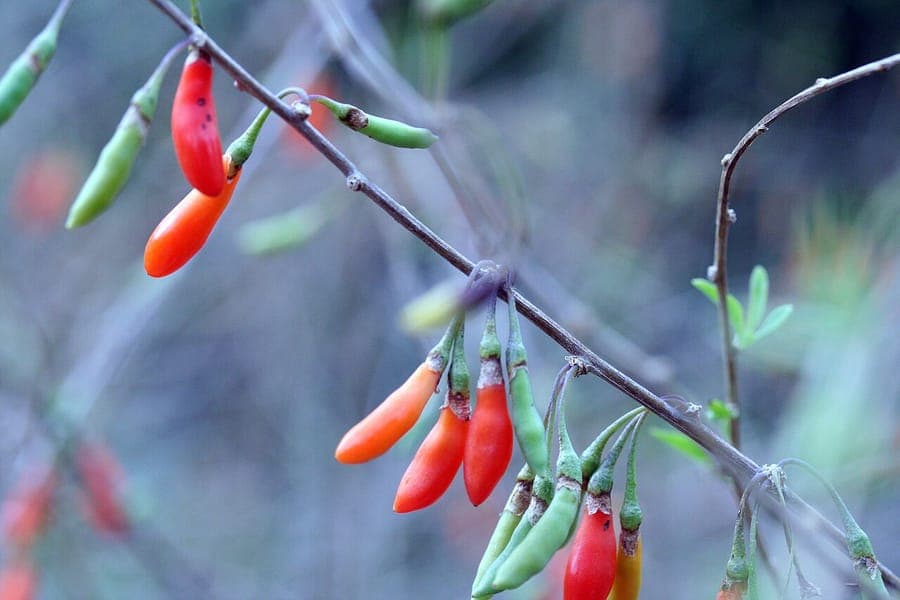
Sambuca / CC BY-SA 3.0, via Wikimedia Commons
Chinese boxthorn: complete guide
Lycium chinense
¿Quieres ver Chinese boxthorn: complete guide en tu jardín?
1 minuto, sin tarjeta de crédito
Lycium chinense: Complete Guide to Growing Chinese Boxthorn
Lycium chinense, commonly called Chinese boxthorn or Chinese box-thorn, is a closely related, highly productive fruit shrub originating from China and temperate East Asia. This member of the nightshade family (Solanaceae) distinguishes itself from related Lycium barbarum through subtle botanical differences while sharing much the same garden value: nutritious, harvestable fruits, attractive flowers, and extremely robust growth habits. For British gardeners seeking alternatives or supplements to better-known goji berry, Lycium chinense offers fascinating possibilities with distinctive characteristics.
The botanical name Lycium chinense refers to its origin in China and temperate East Asian regions. This plant grows naturally in warm, dry mountain areas of central and southern China, where it forms important elements of local food systems. The fruit species proves valuable in traditional Chinese medicine as tonic and nutritive supplement, similar to Lycium barbarum but with subtle differences in flavour and nutrient composition.
Appearance and Flowering Pattern
Lycium chinense closely resembles Lycium barbarum in overall form but displays several distinguishing features. The plant forms a spiny shrub reaching approximately 1.5 to 2.5 metres height with grey-green, fine leaves. The leaves are, however, on average somewhat broader than L. barbarum (approximately 2-3 millimetres versus 1-2 millimetres), making the plant slightly more visually prominent in gardens.
Flowering of Lycium chinense extends from June through October, slightly later in season than L. barbarum. The flowers are light purple to lavender-like, approximately 0.7 to 1.2 centimetres across, appearing in clusters along stems. These slightly larger flowers and their later flowering period make this species interesting for gardeners desiring extended flowering cycles.
The fruits of Lycium chinense resemble those of L. barbarum: brilliant red berries approximately 0.8 to 1.2 centimetres long, ripening from August through November. The later ripening season makes this species interesting for gardeners wishing to spread harvests later in the season. The fruits possess slightly more acidic flavour than L. barbarum, which for some tastes proves preferable.
Ideal Growing Location
Lycium chinense thrives optimally in fully sunny positions receiving minimum 6-8 hours direct sunlight daily. The plant also accepts somewhat more partial shade (4-6 hours) than L. barbarum, though yields will decrease under such conditions. For a heat-preferring plant from southern China, Lycium chinense may prove slightly more shade-sensitive than its relative.
The plant shows very good tolerance for windy locations and grows well in exposed garden situations. This makes it suitable for many British gardens, including those in coastal zones or windy valleys. The plant also grows well on lean, dry soils, though improved results occur with regular moisture availability.
Soil and Nutritional Requirements
Lycium chinense grows in diverse soil types but prefers well-draining, moderately fertile soils. pH preference centres around neutral to slightly acidic (pH 6.0 to 7.5). The plant proves very tolerant of poor soils and even grows in very sandy or loamy ground, though organic matter supplementation promotes growth.
At planting, incorporating 20-25 percent rotted compost or leaf mould is recommended for initial nutrition. Once established, the plant is very self-sufficient; supplemental feeding is usually unnecessary. In very poor soils, annual application of organic fertiliser (such as bone meal) may prove beneficial, but is not essential.
Diseño gratis
¿Quieres ver Chinese boxthorn: complete guide en tu jardín? Crea un diseño gratis ahora.
Watering and Moisture Management
Lycium chinense is very drought-tolerant, possibly even more so than L. barbarum, owing to its origin in dry, mountainous regions of southern China. In British gardens with regular rainfall, supplemental watering is often completely unnecessary. The plant accepts dry periods exceeding one month without serious damage, though growth will be less vigorous under such conditions.
At planting and during first growing season, regular watering (twice weekly) should be provided to promote initial establishment. Once established (after two growing seasons), supplemental watering is usually needed only in very dry summers. This makes Lycium chinense particularly suitable for gardens where water scarcity is a concern.
It is important to note that regular moisture provision significantly improves fruit production. Gardeners seeking maximum yields should provide cautious watering around the flowering and fruiting period (June through October).
Pruning and Maintenance
Lycium chinense requires regular pruning for optimal form and productivity. In first year following planting, guide the plant to single central stem, cut at approximately 60 centimetres height. This stimulates formation of 3-4 primary branches.
In following years, annual pruning in early spring (February to March) should be performed, removing all dead or damaged branches and trimming the plant slightly. The plant grows faster and more exuberantly than Lycium barbarum, so regular pruning is essential to maintain neat form.
Differences with L. barbarum: Lycium chinense typically grows stronger and can reach greater heights (to 3 metres under good conditions), so more cautious pruning may be needed to control height.
Fruit Harvesting
The fruits of Lycium chinense ripen later than L. barbarum, typically from August through November. Ripe fruits are brilliant red and can be manually picked or collected by carefully shaking the plant. The fruits possess slightly more acidic flavour than L. barbarum, which for some preferences may be less desirable, though others specifically value this sharpness.
Freshly harvested berries can be eaten directly or dried for long-term storage (up to 2 years in hermetically sealed containers). Drying concentrates nutrient values and makes berries sweeter than fresh.
Winter Hardiness
Lycium chinense is reasonably hardy and suits many British climate zones, though somewhat less hardy than L. barbarum. The plant tolerates winters around -10 to -15°C without serious damage but may experience significant damage problems in very cold winters (below -20°C). In northern regions, protecting young plants is recommended.
The plant can be cut back to ground in severe winters but usually regrows from the root stock. This is not ideal for harvests, as new growth requires considerable time to reach fruiting size.
Suitable Plant Combinations
Lycium chinense combines well with Lycium barbarum for extended harvest periods: earlier L. barbarum and later L. chinense can together provide extended harvesting from July through November. With other berry shrubs such as Sambucus nigra or Viburnum opulus, multi-functional berry gardens result.
For ornamental purposes, the plant combines well with herbs such as lavender and can form part of medicinal/food garden schemes.
Availability and Sources
Lycium chinense is less widely available in Britain than L. barbarum but can be found through specialized online suppliers. Search online for "Lycium chinense" for direct sources. The plant can also be grown from seed, though this requires patience (see Lycium barbarum section for seed preparation).
Conclusion
Lycium chinense offers excellent alternative or supplement to Lycium barbarum, with later flowering, slightly more acidic fruits, and greater drought tolerance. For British gardeners seeking less common berry shrub with nutritional qualities, this plant proves fascinating choice. For more advice on garden integration, consult gardenworld.app.
¿Quieres ver Chinese boxthorn: complete guide en tu jardín? Crea un diseño gratis ahora.
Sube una foto, elige un estilo y obtén un diseño fotorrealista con lista de plantas en menos de un minuto.
Más de 10.000 jardines diseñados
Sin tarjeta de crédito


Plantas similares
Goji berry: complete guide
Lycium barbarum
Discover Lycium barbarum, the nutritious goji berry shrub for full sun. Learn harvesting, nutrition, watering, and cultivation in British gardens.
Tomato: complete guide
Solanum lycopersicum
Everything you need to know about growing tomatoes: ideal conditions, care tips, soil needs, and companion plants. Perfect for backyard gardens and containers.
Red capsicum: complete guide
Capsicum annuum
A full guide to growing red capsicum in your garden: ideal conditions, watering needs, soil tips, and a seasonal calendar for a bountiful harvest.