
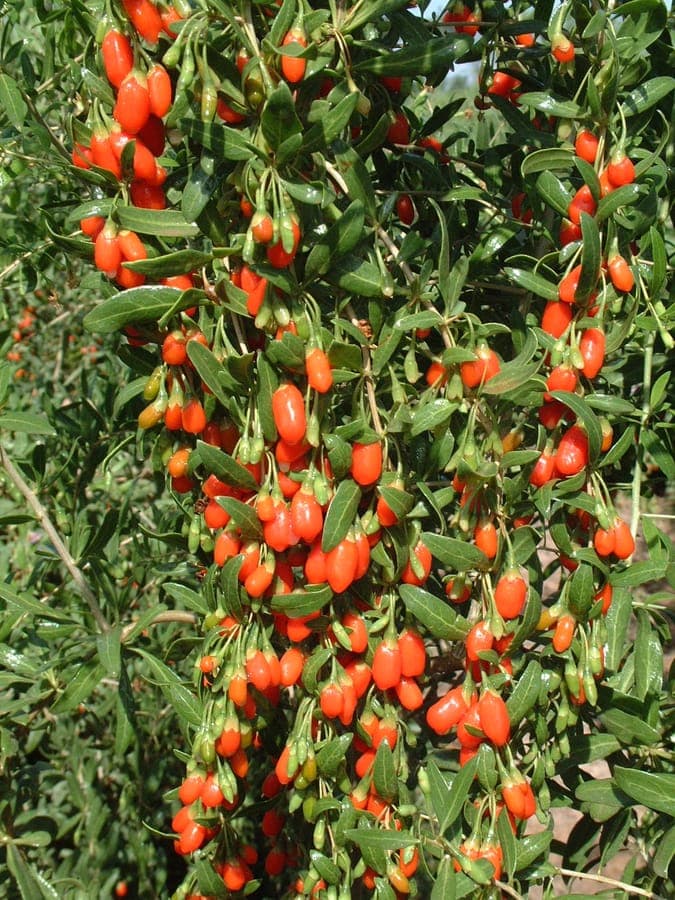
Paul Gross (paul144) and Richard Zhang / Public domain, via Wikimedia Commons
Goji berry: complete guide
Lycium barbarum
¿Quieres ver Goji berry: complete guide en tu jardín?
1 minuto, sin tarjeta de crédito
Lycium barbarum: Complete Guide to Growing Goji Berries
Lycium barbarum, commonly known as goji berry, Chinese boxthorn, or wolfberry, is a fascinating, highly productive berry shrub originating from northern and central China. This member of the nightshade family (Solanaceae) has experienced remarkable growth in western garden popularity over recent decades, not only for aesthetic qualities but primarily for its highly nutritious, harvestable fruits. In British gardens, the plant establishes robustly as a self-sufficient, hardy crop that delivers reliable annual yields without intensive pesticide or artificial input requirements.
The botanical name Lycium barbarum refers to "barbarians" or "foreigners", pointing to the plant's Chinese origin. In traditional Chinese medicine, this plant has been used for over 2,000 years, with berries valued as tonic and nutritive supplement. Modern nutritional science has confirmed much of this traditional wisdom: goji berries contain significant quantities of vitamins C and A, antioxidants, and polysaccharides justifying their reputation as a "superfood".
Appearance and Flowering Pattern
Chinese boxthorn is a spiny, light-growing shrub reaching 1.5 to 3.5 metres in height. The plant features characteristic slender, grey-green leaves approximately 1-2 centimetres long. Stems are green and often bearing small, sharp thorns, giving the plant its botanical name "boxthorn". This spiny character provides defensive qualities useful in less hospitable garden environments.
Flowering of Lycium barbarum occurs from May onwards, extending through September, providing an exceptionally long flowering period. Small, delicate flowers are bright pink to purple, approximately 0.7 to 1.5 centimetres across, appearing in small clusters along stems. These modest flowers are highly attractive to pollinators, particularly bees and butterflies, and prove invaluable in bee gardens.
Following successful pollination, characteristic small, brilliant red berries form. These berries measure approximately 0.8 to 1.5 centimetres long and ripen from July through October, depending on climatic conditions and variety. Fresh berries can be eaten directly from the plant, though they exhibit subtle sweet-sour character with slight bitterness. Many gardeners prefer drying berries for long-term storage and use, concentrating sweet and nourishing qualities.
Ideal Growing Location
Lycium barbarum thrives optimally in fully sunny positions where the plant receives minimum 6-8 hours of direct sunlight daily. Under these conditions, the plant produces abundant flowers and berries. The plant tolerates partial shade (4-6 hours sun), though under such conditions yields decline noticeably. For maximum productivity, position the plant in sunny location, preferably against south-facing wall or in open, unshaded situation.
The plant proves highly resilient to wind and grows without difficulty in somewhat exposed situations, including coastal zones. This makes it suitable for many British gardens, including those in higher or windier locations. The plant also accepts very dry soils better than many other cultivated crops, though improved growth occurs with regular watering.
Soil and Nutritional Requirements
Lycium barbarum grows in diverse soil types, from heavy clay to sand, but thrives best in well-draining, moderately fertile soils. pH preference centres around neutral (pH 6.5 to 7.5), though the plant grows in somewhat more acidic soils (pH 6.0). Crucial requirement is excellent drainage: waterlogging is poorly tolerated and causes root rot.
Organic matter incorporation at planting is recommended. Mixing 25-30 percent rotted compost or leaf mould in planting hole improves both drainage and nutrient availability. Once established, minimal synthetic feeding is needed. Annual application of slow-release organic fertiliser (such as bone meal or blood meal) in early spring (March) supports continued productivity.
Diseño gratis
¿Quieres ver Goji berry: complete guide en tu jardín? Crea un diseño gratis ahora.
Watering and Moisture Management
Lycium barbarum is relatively drought-tolerant and accepts regular periods of reduced rainfall without serious growth decline. However, for optimal fruit production, regular moisture availability is recommended. In British conditions, this means regular rainfall usually suffices, though supplemental watering proves helpful during dry periods (exceeding 3 weeks without rain).
At planting, initial watering proves important. During first growing season, the plant requires watering two to three times weekly. Once established (after two growing seasons), the plant tolerates substantial dry periods. Important to avoid permanent dryness, particularly during flowering and fruiting periods (May through October), when regular moisture availability maximizes fruit production.
Drip irrigation proves ideal, as this method delivers water directly to roots without waste. In smaller gardens, conventional can watering also proves effective, with advantage that the gardener directly observes moisture content.
Pruning and Training
Chinese boxthorn requires regular pruning to maintain productive, neat form. First year following planting, guide the plant to single central stem with 3-4 primary branches. This is achieved by cutting the plant at 50-60 centimetres height, retaining strongest 3-4 shoots as primary structure.
In following years (years 2-4), these primary branches should be trained to approximately 100-120 centimetres height, after which they form side branches bearing fruit. Annual pruning in early spring (February to March) is recommended, removing dead or damaged branches and trimming plant slightly to encourage compact growth.
Many British gardeners prefer allowing the plant to grow without strict pruning. This is also acceptable, though more irregular growth occurs. For maximum fruit production, regular pruning is recommended, as this stimulates formation of numerous young, fruit-bearing shoots.
Harvesting Goji Berries
Goji berries are ready for harvesting when achieving full red colour, occurring July through October depending on variety and weather. Berries can be manually picked from the plant, though this proves labour-intensive. Alternative method involves gently shaking plant over cloth or basket, allowing ripe berries to fall. This method works well when ripe and unripe berries coexist.
Freshly harvested berries can be enjoyed directly, though many gardeners prefer drying. Drying methods vary: natural air-drying in warm room or sunny location typically requires 1-2 weeks until berries shrivel. This concentrates sweet and nutritious values. Dried berries store up to 2 years in airtight containers in cool location.
Winter Hardiness
Lycium barbarum is reasonably winter-hardy and suits most British climate zones, including areas experiencing annual minimum temperatures around -15 to -20°C. The plant may suffer damage in very cold winters (below -20°C), particularly young specimens. In northern regions, protecting young plants in first winter is recommended, for example mulching around stems.
The plant is deciduous and loses leaves in autumn, which is not problematic. New foliage appears in spring (April to May). Winter damage does not permanently kill the plant.
Suitable Plant Combinations
Lycium barbarum combines well with other sun-loving berry shrubs for mixed harvest garden. Sambucus nigra (elder), Viburnum opulus (guelder rose), or Rosa canina (dog rose) can create together multi-functional berry and wildlife food zone. Brilliant red berries of Lycium barbarum contrast attractively with blue berries of other species.
For ornamental purposes, Lycium barbarum combines well with lavender or rosemary, creating medicinal garden effect where nutritious crops grow alongside culinary herbs. This works particularly well in Mediterranean garden schemes.
Availability and Sources
Lycium barbarum is available from various British garden centres, particularly those specialising in fruit crops or medicinal plants. Online research reveals numerous fruit-crop suppliers usually carrying diverse varieties. Plant one to two specimens for optimal self-pollination and regular harvests.
The plant can also be grown from seed, though this requires patience: seed requires 4-6 weeks cold stratification and subsequent warm-light germination (20-25°C) for 2-3 weeks before germination occurs.
Conclusion
Lycium barbarum is an exceptionally versatile plant for British gardens: ornamentally valuable for purple flowers and red berries, productive as fruit crop, and nutritious as food. With minimal care once established, it is reliable addition to sunny gardens for those seeking both beauty and nutritious harvests. For more information on garden integration, consult gardenworld.app.
¿Quieres ver Goji berry: complete guide en tu jardín? Crea un diseño gratis ahora.
Sube una foto, elige un estilo y obtén un diseño fotorrealista con lista de plantas en menos de un minuto.
Más de 10.000 jardines diseñados
Sin tarjeta de crédito


Plantas similares
Chinese boxthorn: complete guide
Lycium chinense
Discover Lycium chinense, a nutritious berry shrub for full sun with later ripening season. Learn cultivation, harvesting, and garden integration.
Elderberry: complete guide
Sambucus nigra
Everything about Common Elder (Sambucus nigra): planting, pruning, care, and culinary uses of flowers and berries. Practical tips for this versatile native tree.
Guelder rose: guia completa
Viburnum opulus
Una guia detallada de Viburnum opulus: crecimiento, cuidado, poda y condiciones ideales de plantacion. Aprende como cultivar guelder rose exitosamente en tu jardin.