
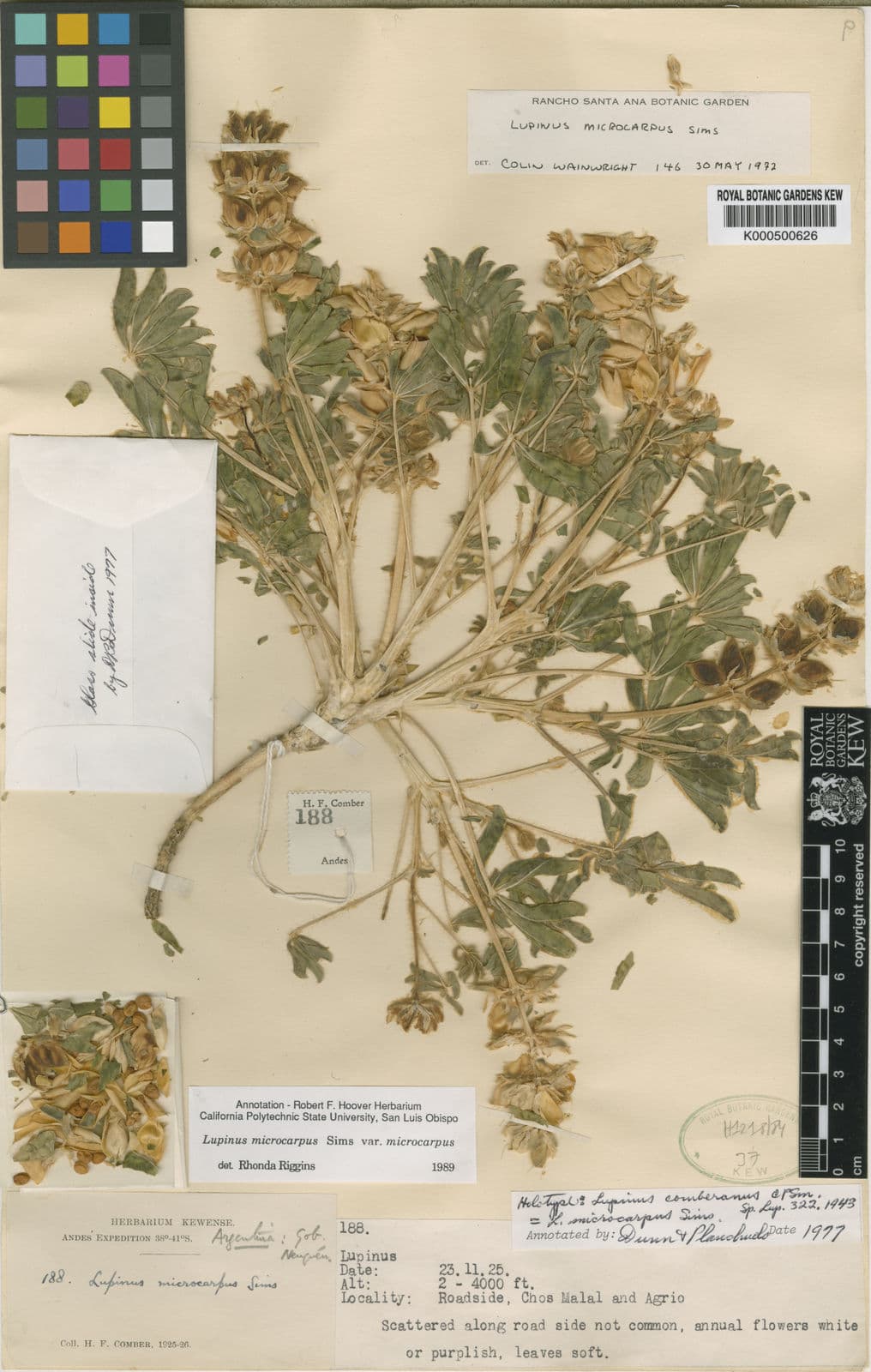
Lupinus microcarpus: complete guide
Lupinus microcarpus Sims
¿Quieres ver Lupinus microcarpus: complete guide en tu jardín?
1 minuto, sin tarjeta de crédito
Overview
Chick lupine (Lupinus microcarpus), also known as Chick lupine, is a fascinating annual flower native to western North America and South America. This plant belongs to the Fabaceae family (legume family), the same family as peas, beans and clover. Unlike many lupines, this is a relatively short, compact plant that is very suitable for borders and wild flower collections.
Naturally, chick lupine grows from western United States (California, Oregon, Washington) to Peru, Chile and Argentina in South America. It grows on dry, often rocky terrain, slopes and desert edges where few other plants can grow.
The plant usually grows 30-60 centimeters tall and forms a graceful, upright shrub. This is an annual plant that sets seed and dies after one growing season, so it must be resown each year or self-seed.
Appearance and bloom
The leaves of Lupinus microcarpus are highly characteristic of lupines. They are hand-shaped, composed of 5-9 narrow, elongated leaflets. The leaves are softly hairy, giving them a gray-green color. The leaves grow on long petioles.
The stem is upright and often purple-tinted, especially at the base. It sometimes branches slightly and is hairy. The entire plant looks elegant and fine.
Flowers appear from May to July in striking, dense, vertical clusters. These flowers are about 1-1.5 centimeters long and have the characteristic legume-like shape. The flowers are usually purple to blue, but can also have white, pink or red tints. They often have a darker spot or line on the petal.
The flowers produce abundant nectar and are irresistible to butterflies, bees and other pollinators. After pollination, small, fuzzy pods form with only 1-4 seeds - hence the name "microcarpus" (small fruit).
Ideal location
Chick lupine thrives best in full sun. At least 6 hours of direct sunlight per day is ideal, more is always better. This plant needs full sun for optimal flowering. Without enough sun it will form much leaf but little flower.
This is a drought-lover that grows naturally on dry, sunny slopes. You can therefore use it well in xeriscaping projects or in gardens where water is scarce.
The plant is reasonably frost-hardy as an annual. In milder winters, seedlings can overwinter if you sow them in fall. In harsher winters, it's better to sow in spring.
Soil
Chick lupine makes very low demands on the soil. It grows naturally on poor, sandy to rocky soils. It is very drought-tolerant and does best in well-draining soil.
Ideal is well-draining soil with a pH between 6.0 and 7.5, that is slightly acidic to neutral. The plant can also grow on alkaline soils.
The soil does not need to be moisture-retaining. Heavy compost can actually be counterproductive and lead to much leaf formation and little flowering.
Feeding is not necessary. This plant grows on very poor soils and prefers it. Heavy feeding stimulates leaf growth at the expense of flowering.
Watering
Chick lupine is very drought-tolerant once germinated. In the first growth stage (germination stage) you should water regularly. Water when the top centimeter of soil feels dry.
Once established (after 3-4 weeks of growth) the plant usually does not need extra water unless you live in a very dry climate with less than 300 millimeters of annual rainfall. In that case, you can water somewhat in very dry periods.
Provide good drainage. The plant can suffer from root rot in very wet, acidic soil. Never plant it in waterlogged areas.
With too much water the plant will form mainly much leaf and little flower.
Diseño gratis
¿Quieres ver Lupinus microcarpus: complete guide en tu jardín? Crea un diseño gratis ahora.
Pruning
Pruning is not necessary. This plant grows compactly and forms a nice shape naturally. Optionally remove wilted flower stalks to get neater plants and possibly stimulate more flowering.
If you want the plant to spread through seed dispersal, you can let the seed pods ripen. In many gardens, however, self-seeding is desirable.
Remove dead or damaged leaves as you notice them.
Maintenance calendar
March-April (northern regions): Indoor seed sowing - Sow seed indoors in light, well-draining potting soil. Seed germinates in 10-21 days.
April-May: Sowing in open field - Plant out after frost danger has passed, at 15-20 centimeter spacing.
May-June: First care - Water regularly in dry periods. No feeding needed.
June-July: Flowering - Enjoy the beautiful flowers. Remove wilted flowers to stimulate more blooms.
July-August: Seed formation - If you want to keep seed, let seed pods ripen on the plant.
August-September: Seed collection - Harvest seed pods when they turn brown. Seed can be saved for future years.
Winter hardiness
Chick lupine is hardy to approximately USDA zone 9 (about -5 to 0 degrees Celsius). This means it can be grown as a biennial in southern regions (sow in fall, bloom next spring), but in the north it does better as an annual plant (sow in spring).
In very severe winters and in the far north, it's better to sow in spring.
Companion plants
Chick lupine combines well with other drought-lovers and wild flowers. Good companions:
- Poppies (Papaver species)
- Cornflowers (Centaurea)
- Larkspur (Delphinium)
- Sunflowers (Helianthus)
- Oriental poppies (Papaver orientale)
- Cut flower mixes
- Bee-friendly plants
This combination creates a colorful, butterfly-friendly border.
Propagation
Seed is the only practical way to propagate chick lupine, since as an annual it forms no rootstock to divide, and cuttings rarely succeed on this fine-rooted plant. For best germination, soak seeds 12 to 24 hours in lukewarm water, or lightly nick the hard seed coat with sandpaper. Sow at 15 to 20 centimeter spacing directly in a sunny border, or start in 8-centimeter pots for later transplanting.
Store harvested seed pods in a cool, dry spot in a paper envelope; well-dried seed remains viable for 3 to 5 years. In mild regions, direct-sow outdoors in September for earlier blooms the following spring.
Pests and Diseases
Chick lupine is generally low-maintenance when it comes to pests, partly thanks to its short life cycle. Aphids, particularly the grey-green lupine aphid, can form large colonies on flower stalks in June and July; rinse them off with a strong water spray or treat with a mild soap solution. Slugs pose the greatest threat to young seedlings in April and May; protect fresh sowings with slug pellets or a ring of sharp grit around the stem base.
In prolonged wet weather with poor drainage, root rot can develop, recognizable by wilting, yellowing stems despite moist soil. There is no cure beyond removing affected plants and improving soil structure with coarse sand or grit before the next season.
Conclusion
Chick lupine is an exceptional choice for gardeners who want elegant lupines in a small format, for dry locations or for butterfly-friendly gardens. It forms beautiful purple to blue flowers, grows with virtually no care, and provides nectar to butterflies and bees. Seed is available from various garden centers.
On gardenworld.app you will find more about growing wild flowers and butterfly-friendly plants. More plant combinations are also available on gardenworld.app.
¿Quieres ver Lupinus microcarpus: complete guide en tu jardín? Crea un diseño gratis ahora.
Sube una foto, elige un estilo y obtén un diseño fotorrealista con lista de plantas en menos de un minuto.
Más de 10.000 jardines diseñados
Sin tarjeta de crédito


Plantas similares
Tall Silky Lupine: complete guide
Lupinus elatus
Tall silky lupine is a fast-growing Californian perennial with silvery foliage and blue-purple flower spikes, ideal for a prairie-style garden.
Garfield Lupine: complete guide
Lupinus garfieldensis
The Garfield lupine is a rare, fast-growing American perennial for alkaline, dry grassland gardens, with striking blue flower spikes.
Lupinus elegans: complete guide
Lupinus elegans
Lupinus elegans, the elegant lupine, is a spectacular blooming plant from Mexico with blue flower spikes. Care, cultivation and garden use.