
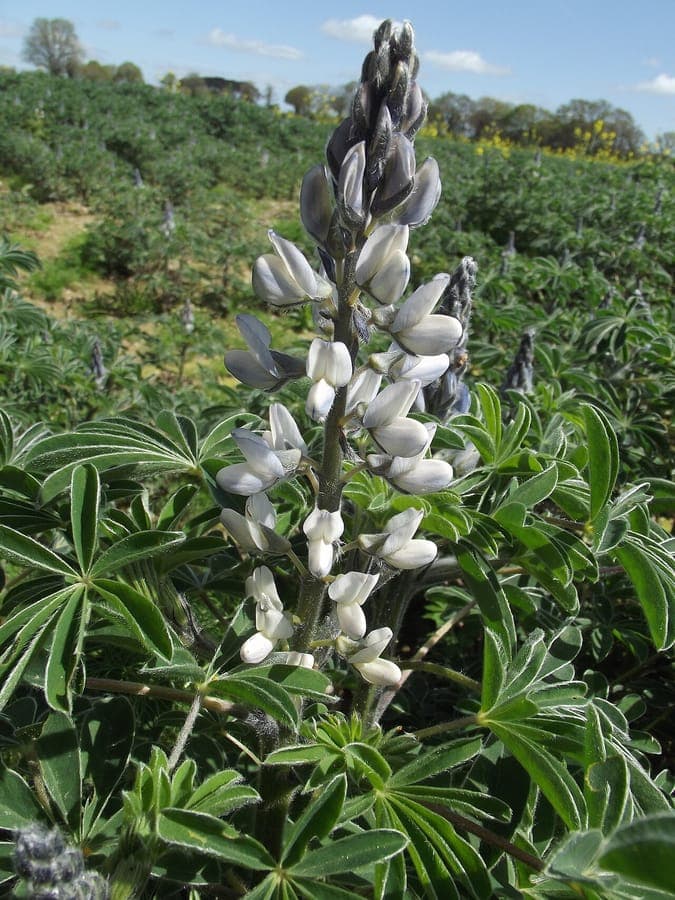
Jean-Claude Echardour [CC BY-SA], via Tela Botanica / CC BY 2.0, via Wikimedia Commons
White lupin: complete guide
Lupinus albus
¿Quieres ver White lupin: complete guide en tu jardín?
1 minuto, sin tarjeta de crédito
Overview
White lupin (Lupinus albus) is an elegant, upright annual from the Fabaceae family (pea family). Native to the Mediterranean region, this plant thrives as an annual in temperate climates. Reaching 60 to 120 centimeters tall, it's renowned for beautiful, dense flower spikes of pure white blooms.
Appearance & Bloom Cycle
Lupinus albus forms a compact, upright plant with deep green, palmate leaves. Each leaf consists of 9 to 11 leaflets radiating from a central point - characteristic of lupines everywhere.
Flowers appear April through May in temperate regions, growing in dense spike formations at stem tips. Individual flowers measure 1.5 to 2cm long, pure white or occasionally tinged yellow or purple. After flowering, elongated pods develop, each containing 4-6 smooth seeds.
The plant reaches peak ornamental value May through June when flower spikes provide maximum garden impact.
Ideal Location
White lupin performs best in full sun with minimum 6 to 8 hours direct daily light. Insufficient sun produces weak growth and poor flowering.
Ideal placements:
- Full sun borders
- Mediterranean gardens
- Group plantings with other annuals
- Gravel or scree beds
Soil Requirements
White lupin thrives in well-draining, not overly rich soil. pH preference ranges 6.0 to 7.5. Heavy clay soils improve with added sand, gravel, and organic matter.
Critical: lupines evolved on nitrogen-poor soils, so avoid excess fertilization which promotes leaf growth at flower expense. Excellent drainage is essential; waterlogging causes root rot.
Watering
As a young plant, water until established (first 3 weeks post-planting). Once rooted, this lupin tolerates drought, especially in Mediterranean climates.
Water only during persistent dry spells and when soil 5cm below surface feels dry. Water mornings if needed; avoid wetting foliage.
Diseño gratis
¿Quieres ver White lupin: complete guide en tu jardín? Crea un diseño gratis ahora.
Support
In windy locations, taller varieties may need bamboo stakes. Install early and tie gently - don't constrict growth.
Maintenance Calendar
- March-April: Direct seed or transplant seedlings after last frost
- April-May: Flowering, water during drought
- May-June: Peak bloom, deadhead faded flowers for extended blooming
- June-July: Seed pod formation, allow ripening on plant
- July-August: Plant senescence, remove and compost
- September-October: Dry seed and store for next season
Sowing & Propagation
White lupin germinates easily from seed. Direct sow in spring after last frost, or start indoors February-March at 18-20°C, pricking out after true leaves appear.
Tip: lupine seed has a hard coat. Lightly scarify with sandpaper or soak 24 hours in warm water before sowing - this significantly improves germination.
Winter & Following Seasons
White lupin doesn't survive hard winters (below -5°C) in open gardens unless as dormant seed. For same-plant continuity, collect seed from spent flower spikes and store dry until spring.
Plants self-seed in some gardens if seed disperses naturally.
Pests & Diseases
White lupin is relatively robust. Caterpillars may nibble foliage but rarely cause fatal damage. Phytophthora (root rot) can occur in extremely wet seasons; prevent via excellent drainage.
Companion Plants
White lupin pairs elegantly with:
- Red poppies and cornflowers
- Blue delphiniums
- Silver artemisia
- Yellow achillea
Closing
White lupin is a classic Mediterranean garden plant that grows easily from seed. With well-draining soil, full sun, and minimal maintenance, this accommodating plant delivers months of pure white spikes. For more Mediterranean garden inspiration, visit GardenWorld. Explore additional plant combinations on GardenWorld for your garden design.
¿Quieres ver White lupin: complete guide en tu jardín? Crea un diseño gratis ahora.
Sube una foto, elige un estilo y obtén un diseño fotorrealista con lista de plantas en menos de un minuto.
Más de 10.000 jardines diseñados
Sin tarjeta de crédito


Plantas similares
Tall Silky Lupine: complete guide
Lupinus elatus
Tall silky lupine is a fast-growing Californian perennial with silvery foliage and blue-purple flower spikes, ideal for a prairie-style garden.
Garfield Lupine: complete guide
Lupinus garfieldensis
The Garfield lupine is a rare, fast-growing American perennial for alkaline, dry grassland gardens, with striking blue flower spikes.
Lupinus elegans: complete guide
Lupinus elegans
Lupinus elegans, the elegant lupine, is a spectacular blooming plant from Mexico with blue flower spikes. Care, cultivation and garden use.