
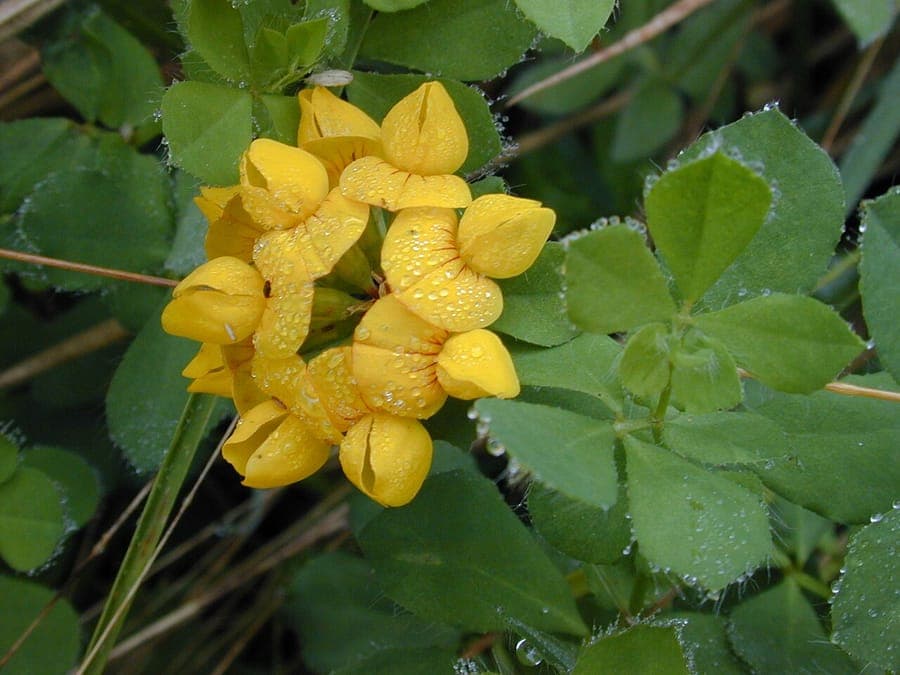
Forest & Kim Starr / CC BY 3.0, via Wikimedia Commons
Lotus pedunculatus: complete guide
Lotus pedunculatus
¿Quieres ver Lotus pedunculatus: complete guide en tu jardín?
1 minuto, sin tarjeta de crédito
Overview
Lotus pedunculatus, commonly called marsh bird's-foot trefoil or greater bird's-foot trefoil, is a robust, moisture-loving perennial from Europe. This species differs dramatically from its drier-site-loving cousin bird's-foot trefoil (Lotus corniculatus) through its preference for waterlogged soils and wetland conditions. This makes it unequaled in value for gardeners with wet, problematic terrain or those wanting to create ecological marshes.
Originally from Europe and temperate Asia, marsh bird's-foot trefoil grows wild in wet meadows, marshes, reedbeds and along river and ditch banks. This moisture-loving character distinctly sets it apart from many other garden plants. The plant is particularly valuable in gardens where drainage is poor or where you want to create wetland effects. It thrives vigorously in conditions where many other plants would perish, making it essential for difficult locations.
What makes this plant even more valuable is its benefit to wildlife and insects. Like its cousin, it fixes nitrogen in soil through root-dwelling bacteria. This adds nutrition to marsh soils. The plant attracts bees, butterflies and other pollinators with its bright yellow flowers and forms an important food source for many insects. This makes it ideal for gardeners wanting to support bees and butterflies.
Appearance & bloom cycle
Lotus pedunculatus grows as an upright to sprawling perennial, typically 20-60 cm tall and 30-70 cm wide. This makes it larger and more robust than its cousin bird's-foot trefoil. The plant forms green clumps of fine foliage. The leaves are small, composed of 5 tiny leaflets in the characteristic bird's-foot appearance, but much larger than those of maritime species. The foliage is green and remains visible throughout much of the year, though it's not fully evergreen.
The flowers are bright yellow to orange-yellow, approximately 10-12 mm long, appearing in larger clusters than bird's-foot trefoil, with 3-7 flowers per cluster. They bloom from May through August, peaking in June and July. The flowers are highly attractive to bees and butterflies. They emit subtle fragrance.
The seed pods are interesting and become important for bird food. They grow in drooping structures on long stalks, which marks this species' botanical distinction - "pedunculatus" means with prominent stalks. These seed pods are approximately 1-2 cm long and highly interesting later in the growing season.
The plant reaches full size within the first or second season and spreads via seeds and underground root systems. In very wet conditions, it can grow almost submerged.
Ideal location
Lotus pedunculatus grows best in full sun to partial shade. The plant needs at least 4-5 hours of direct daily sunlight for optimal flowering. In more shaded situations it will still grow and flower reasonably, though less lushly. This is a highly adaptive plant regarding light conditions.
The plant is extremely tolerant of marshy conditions. Unlike most other garden plants, wet feet are no problem - the plant thrives in them! This is its greatest unique advantage. It also grows well on slopes and wet banks. In coastal situations it also grows well, though it has less advantage of salt tolerance than its small cousin maritime trefoil.
The plant grows well in water containers or in extremely wet soils. This makes it ideal for gardeners with difficult drainage problems.
Diseño gratis
¿Quieres ver Lotus pedunculatus: complete guide en tu jardín? Crea un diseño gratis ahora.
Soil requirements
Lotus pedunculatus thrives in wet, moisture-rich soils and is actually less particular about pH than bird's-foot trefoil. The ideal pH is between 5.0 and 7.5, so it accepts both slightly acidic and neutral to slightly alkaline soils. The plant grows in waterlogged marsh soils where many other plants won't.
When planting, though some organic material can help, it's not necessary in moisture-rich soils. The plant genuinely thrives in difficult, wet conditions. In excessively wet situations, no drainage improvement is needed - the plant will thrive. This makes it ideal for true marshes.
Watering
Lotus pedunculatus is unique in that it requires abundant water - actually, wet feet are its preference! Newly planted specimens should water regularly, but in most cases the wet garden will naturally provide this. Once established, the plant will thrive and flourish in all but the most extreme dry periods.
The plant also grows in shallow water up to 5-10 cm deep, making it ideal for marsh edges. In water-filled containers it will thrive. This is a plant that dislikes drought and much prefers wet conditions.
Pruning
Lotus pedunculatus tolerates pruning well and can be cut back annually without problems. Many gardeners prune it after flowering (August-September) to maintain a neater appearance. This also helps maintain a more compact form and stimulates denser growth the following season.
The plant tolerates heavy pruning well, which is useful in intense wet conditions. This can occur in early spring for vigorous restart.
In very wet situations where the plant grows almost wild, minimal pruning may be needed, but the plant continues thriving without guidance.
Maintenance calendar
April: Inspect after winter. Perform light pruning if needed. Add organic material in drier years.
May-August: Ensure moisture is sufficient - this is not difficult in most gardens with this plant. Enjoy yellow flowers. Watch for bees and butterflies.
August-October: After flowering perform pruning. Continue moisture checking.
November-March: Minimal feeding needed. Protection from extreme frost very unlikely needed.
Winter hardiness
Lotus pedunculatus is very winter hardy and tolerates temperatures down to approximately -18 to -20°C, making it suitable for USDA zones 4-9. This is excellent given its European origin. The plant is practically indestructible in temperate climates.
Even in very severe winters, the plant will practically never die, though it may suffer some foliage damage. It regenerates vigorously in spring. In wet conditions, frost damage can be minimal because the plant doesn't completely dry out.
No winter protection is normally needed.
Companion plants
Lotus pedunculatus combines well with other marsh plants and moisture-loving groundcovers. Caltha palustris (marsh marigold) grows well together. Iris laevigata (Japanese iris) is a classic pairing. Filipendula (meadowsweet) also works well. These are all plants that appreciate wet ground.
The plant excels as underplanting in marsh edges. It combines well with other insect-friendly plants. Because it attracts birds, it grows well near bird feeders. It also works well with other nitrogen-fixers in wet wetlands.
Avoid plants with very low water requirements nearby, as this plant values moisture and may compete for space.
Conclusion
Lotus pedunculatus is an excellent choice for gardeners with wet soils or those wanting to create ecological marshes. With its yellow flowers, moisture-loving character and value for insects, it performs consistently well in difficult conditions. Whether you have a marsh-edge garden or simply want to improve a difficult wet corner, marsh bird's-foot trefoil is likely an ideal choice.
Explore more inspiration for difficult garden locations at gardenworld.app, where you'll find guidance for transforming wet terrain into valuable ecological habitats. With gardenworld.app help, you can transform your difficult wet corners into thriving, insect-friendly spaces.
¿Quieres ver Lotus pedunculatus: complete guide en tu jardín? Crea un diseño gratis ahora.
Sube una foto, elige un estilo y obtén un diseño fotorrealista con lista de plantas en menos de un minuto.
Más de 10.000 jardines diseñados
Sin tarjeta de crédito


Plantas similares
Tall Silky Lupine: complete guide
Lupinus elatus
Tall silky lupine is a fast-growing Californian perennial with silvery foliage and blue-purple flower spikes, ideal for a prairie-style garden.
Garfield Lupine: complete guide
Lupinus garfieldensis
The Garfield lupine is a rare, fast-growing American perennial for alkaline, dry grassland gardens, with striking blue flower spikes.
Lupinus elegans: complete guide
Lupinus elegans
Lupinus elegans, the elegant lupine, is a spectacular blooming plant from Mexico with blue flower spikes. Care, cultivation and garden use.