
Wikimedia Commons / Public domain, via Wikimedia Commons
Lolium temulentum: complete guide
Lolium temulentum
¿Quieres ver Lolium temulentum: complete guide en tu jardín?
1 minuto, sin tarjeta de crédito
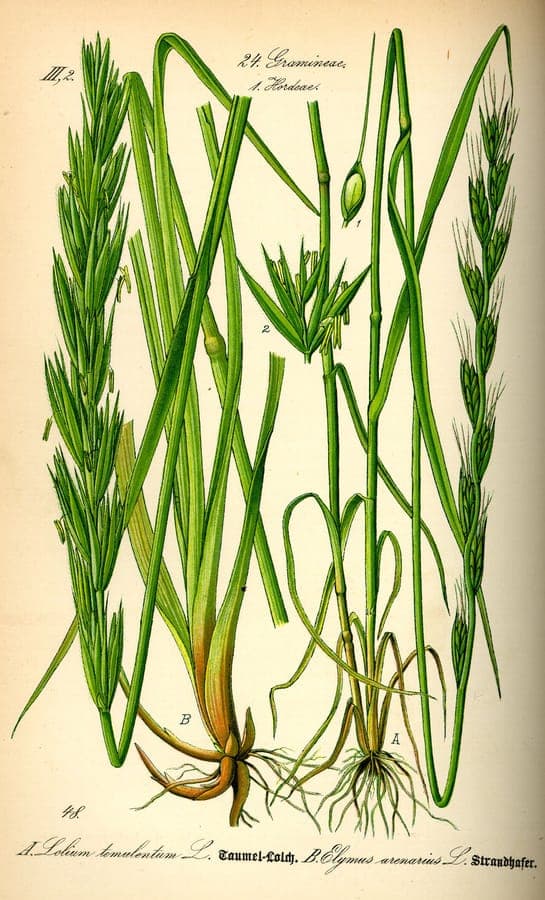
Lolium temulentum, commonly known as darnel or bearded darnel, is a distinctive and historically fascinating grass species from the Poaceae family native to north Africa, Mediterranean regions, and temperate Eurasia. This plant holds remarkable significance in human history, having been problematically associated with grain harvests due to seeds containing toxic alkaloids capable of producing intoxicating and psychoactive effects. Historically, it was often inadvertently threshed with wheat crops, occasionally leading to documented cases of poisoning in medieval villages. Today, Lolium temulentum is primarily of botanical, chemical, and historical interest, though wild populations persist in certain Mediterranean and West Asian grasslands. This comprehensive guide provides botanical information and necessary safety protocols.
Appearance and Morphology
Lolium temulentum is a gracile, erect annual to winter-annual grass typically reaching 30 to 80 centimeters tall. Culms (stems) are green to yellowish-green, smooth, and markedly erect without bending. Leaves are linear and dark green, relatively narrow (approximately 0.2 to 0.4 centimeters wide), with distinctive rough margins, particularly on the upper surface. This roughness distinguishes it from the smooth-edged leaves of Lolium multiflorum. Plants flower between May and July in temperate zones, producing characteristic compact panicles. Panicles consist of 10 to 20 small spikelets distributed tightly along a central rachis. Each spikelet contains four to eight small florets. After flowering, seeds ripen rapidly by August.
Distribution and Habitat
Lolium temulentum is native to north Africa, Mediterranean regions, and temperate Eurasia. Historically it was primarily encountered as an arable weed in wheat and barley fields, where seeds mixed with grain harvests. This created significant problems in medieval Europe and Asia when contaminated grain produced flour containing toxic alkaloids. In modern agriculture, incidence is far reduced because contemporary seed cleaning is highly effective. Nevertheless, wild populations persist in certain Mediterranean and West Asian grasslands, particularly in warm temperate to Mediterranean climates.
Soil and Growth Requirements
Lolium temulentum grows on diverse soil types, from sandy to loamy, with preference for fertile grain fields. The plant tolerates pH values from 5.5 to 7.5, with optimal growth around pH 6.5. It prefers full sun but tolerates partial shade, though flowering and seed production are reduced. The plant displays reasonable drought tolerance once established. For purposeful cultivation, sow in prepared seedbed during March-April. Seeds germinate within seven to ten days at temperatures of 15-20 degrees Celsius.
Diseño gratis
¿Quieres ver Lolium temulentum: complete guide en tu jardín? Crea un diseño gratis ahora.
Toxicity and Safety Precautions
The critical safety consideration with Lolium temulentum is that seeds are toxic and must never be ingested. Seeds contain alkaloids, particularly temuline and loline, capable of producing neurological, gastrointestinal, and psychotropic effects. Symptoms of toxic exposure can include nausea, vomiting, diarrhea, dizziness, pupil dilation, hallucinations, and in severe cases, convulsions. Toxicity depends on seed quantity ingested and individual sensitivity. Historically, the plant was occasionally used ritually or spiritually for its psychoactive properties, though this is extremely dangerous and unpredictable. Modern cultivation demands strict precaution protocols, especially in households with young children. Seed ingestion must absolutely be avoided. Always wash hands thoroughly after handling the plant.
Historical and Cultural Significance
Lolium temulentum occupies a remarkable position in human history. In ancient and medieval agriculture, it was frequently cultivated inadvertently alongside wheat because seeds were similarly weighted. This led to numerous poisoning outbreaks in medieval European villages. In certain ancient cultures, particularly Greece and Rome, Lolium temulentum was sometimes deliberately used in secret ceremonies for its psychoactive properties. Ancient mystery cults occasionally involved grain-based preparations possibly containing Lolium alkaloids. The plant's association with altered consciousness made it relevant to religious and shamanic practices.
Cultivation and Seed Collection
For botanical interest, Lolium temulentum may be cautiously cultivated with appropriate safety precautions. Sowing must occur carefully in containers or in carefully demarcated areas. Sow in March-April in prepared seedbed. Seeds germinate in seven to ten days. Young plants grow rapidly and reach flowering in May-July. Seed production occurs August-September. All plant waste must be safely disposed of. Gloves are recommended when working with mature plants.
Scientific Research Applications
Lolium temulentum has been subject to scientific investigation due to its alkaloid content. Chemical analysis using modern chromatographic techniques permits precise identification and quantification of temuline. The plant is of interest to phytochemical researchers investigating grass alkaloid biosynthesis pathways. Ethnobotanical researchers have documented historical use patterns in different societies. Genetic studies reveal that Lolium temulentum is closely related to Lolium perenne and Lolium multiflorum.
Conclusion
Lolium temulentum represents a botanically and historically fascinating plant with remarkable properties, though with serious toxicity precautions essential. The species embodies the interface between useful agricultural crops and dangerous weed species. Its rich history makes it ongoing subject of interdisciplinary research. For careful cultivators, respectful attention to toxicity hazards is absolutely essential.
¿Quieres ver Lolium temulentum: complete guide en tu jardín? Crea un diseño gratis ahora.
Sube una foto, elige un estilo y obtén un diseño fotorrealista con lista de plantas en menos de un minuto.
Más de 10.000 jardines diseñados
Sin tarjeta de crédito


Plantas similares
Sporobolus pungens: complete guide
Sporobolus pungens
Sporobolus pungens is a stoloniferous Mediterranean coastal grass with outstanding salt and drought tolerance, perfect for seaside and dry gardens.
Mediterranean aegilops: complete guide
Aegilops biuncialis
Everything about Aegilops biuncialis, a Mediterranean annual grass with ornamental spikes and outstanding drought tolerance for dry gardens.
Silver bluestem: complete guide
Bothriochloa saccharoides
Full guide to Bothriochloa saccharoides (silver bluestem): site, soil, watering, winter hardiness, pruning, and garden companions.