
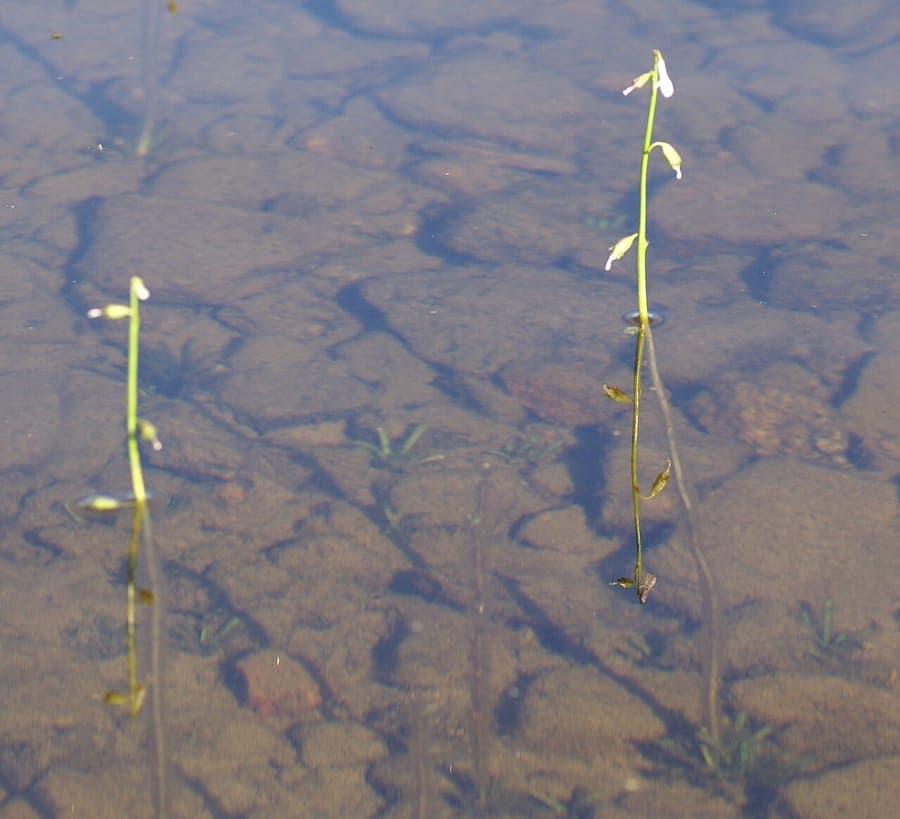
Rolf Engstrand / CC BY 2.5, via Wikimedia Commons
Water lobelia: complete guide
Lobelia dortmanna
¿Quieres ver Water lobelia: complete guide en tu jardín?
1 minuto, sin tarjeta de crédito
Overview
Water lobelia, scientifically known as Lobelia dortmanna, is a fascinating aquatic plant belonging to the Campanulaceae family. This unique plant is native to northern regions of North America and Europe, where it naturally inhabits cold, nutrient-poor lakes and ponds. In Belgium and the Netherlands, the plant remains less widely known than its ornamental cousin Lobelia erinus, but it holds significant value for those interested in constructing biologically authentic water gardens. The botanical name references the German city of Dortmund, where the plant once flourished in substantial populations. This is a true specialist in nutrient-poor, crystal-clear water environments, making it the perfect choice for gardeners seeking ecologically responsible water feature design.
Water lobelia is renowned for its fascinating amphibious lifestyle: in aquatic settings it functions as a fully submerged plant, yet at water margins it can grow partially emergent. This characteristic makes Lobelia dortmanna exceptionally suitable for pond margins experiencing natural water level fluctuations. Aquarium hobbyists particularly value this plant because its presence and health reliably indicates excellent water quality. This plant is therefore not only beautiful but also a valuable water quality indicator. With proper conditions, particularly cool, clear water, this species can flourish for many years.
The plant grows slowly but steadily, rewarding patient observation as an ecosystem gradually achieves perfect balance. For gardenworld.app users, Lobelia dortmanna represents a proven method for establishing professionally designed, biologically accurate water gardens. The slow growth rate actually benefits aquascapers by maintaining stable layouts with minimal replanting requirements.
Appearance & bloom cycle
Water lobelia presents itself as a graceful aquatic plant featuring extremely narrow, fine leaves emerging directly from the base. The leaves are exceptionally thin, nearly hair-like, typically 3 to 8 centimeters in length, maintaining consistent green coloration. In fully submerged conditions, the plant develops tight rosette formations growing upward from the substrate. Along water margins, the same species exhibits different growth patterns, with individual leaves reaching directly upward in a more dispersed arrangement.
The blooming of Water lobelia is magnificent and noteworthy. Flowers emerge above the water surface, displaying light blue to purplish-pink coloration with delicate petals. The bloom period extends from June through September, reaching peak intensity during July and August. Individual flowers measure only 1 to 1.5 centimeters across, but they appear in sufficient numbers to create a highly attractive overall appearance. Cool water and excellent light conditions actively stimulate blooming. This plant thrives exceptionally well in North European climates featuring mild summers.
The plant grows together very slowly, advancing approximately 2 to 3 centimeters monthly under ideal conditions. This slow pace demands patience but provides the significant advantage of maintaining stable aquascape layouts without frequent replanting interventions. Underwater growth is remarkably compact and elegant, proving ideal for aquascaping purposes and natural water garden design.
Ideal location
Water lobelia performs best in cool, clear locations with moderate to good light intensity. The plant accepts 4 to 6 hours of direct sunlight daily but also tolerates partial shade with adequate artificial aquarium lighting. In aquariums, ideal lighting provides 0.5 to 0.75 watts per liter of tank volume. Excessive direct sunlight in warm climates can prove problematic; the plant grows much more slowly under such stress conditions.
Water temperature is absolutely critical for Lobelia dortmanna success. This is a plant of cold, deep lakes and must be grown in cool conditions to thrive. Ideal water temperature ranges from 8 to 16 degrees Celsius. In unheated aquariums, particularly in northern buildings, this plant flourishes exceptionally well. Water warmer than 20 degrees Celsius causes plant suffering and can prove fatal over extended periods.
The plant tolerates quiet water without significant current but genuinely benefits from gentle water movement delivering dissolved oxygen. Positions with stagnant, polluted water must be avoided entirely. In outdoor ponds positioned near tree shade, the plant better tolerates even extremely hot summers. Moderate shade benefits this cool-water specialist.
Diseño gratis
¿Quieres ver Water lobelia: complete guide en tu jardín? Crea un diseño gratis ahora.
Soil requirements
Water lobelia grows best in extremely nutrient-poor sand or fine gravel. This remains absolutely critical: excessive nutrition, such as from abundant organic debris, stimulates unwanted algae growth and plant competition. The plant specializes in "clean" water environments. In aquariums, sand substrate or extremely nutrient-poor aquatic plant gravel should be selected carefully.
Water pH can range from very acidic (pH 4.5) to neutral (pH 7.0). The plant demonstrates growth preference for slightly acidic water over alkaline conditions. Very alkaline water exceeding pH 8.0 is poorly tolerated and produces stressed plants.
Nutrition is actually undesirable for this specialized plant. Water lobelia evolved in extremely nutrient-poor environments and functions optimally in such conditions. Excessive fertilizer stimulates only unwanted algae proliferation. In aquariums, very cautious, minimal fertilization (perhaps one-quarter standard dosage) may prove beneficial if the plant shows visible growth restrictions under apparent nutrient limitation.
Watering
In both aquariums and ponds, water must be exceptionally clean, crystal clear, and richly supplied with dissolved oxygen. Regular water changes prove essential: at least 25-30% weekly. The plant cannot tolerate polluted water containing substantial organic matter. This plant actually functions as a water quality indicator: if it grows vigorously, water quality is excellent!
Oxygen circulation is of paramount importance. The plant grows significantly better in oxygen-rich water. This can be achieved through filtration, water movement, and optional supplemental aeration equipment. In aquariums lacking adequate filtration, the plant rapidly declines and eventually dies.
Moisture requirements are obviously maximum for this true aquatic plant that requires permanent submersion or saturation.
Pruning
Water lobelia requires virtually no pruning intervention. The plant grows compactly and slowly. Yellowed or dead leaves can be carefully removed. When underwater vegetation becomes too dense, several rosettes can be gently removed to create space for new growth development.
Maintenance calendar
May: Prepare for growing season; exercise caution with fertilization (use minimal amounts). June-August: Peak growth period; maintain regular water changes and verify oxygen circulation. August-September: Bloom reaches maximum intensity; light maintenance suffices. October-April: Winter dormancy; minimal interventions required, water circulation continues.
Winter hardiness
Water lobelia is completely winter-hardy in temperate European climates. The plant survives in northern ponds and overwinters without protection. This represents one of the significant advantages: it is a genuinely cold-hardy plant that aligns with local seasonality patterns.
Companion plants
Water lobelia combines successfully with other nutrient-poor aquatic plants including Lobelia pultenaea, various sedge species, and aquatic bistort. In aquariums it grows well alongside other fine-leaved plants such as Eleocharis varieties. Combining Water lobelia with clean water, native sedges, and rushes creates authentically natural and ecologically valuable water landscapes reflecting local flora.
Avoid algae-promoting companions such as Cabomba caroliniana requiring substantial nutrition. Floating plants should also be avoided because they create excessive shade. Water lobelia thrives much better in open water conditions. The plant benefits from fish species consuming organic debris, such as certain bottom-dwelling varieties. Snails require careful consideration, as they can consume young green growth.
Closing
Water lobelia represents an exceptional plant for anyone seeking clean, ecologically responsible water systems. With cool temperatures, clear water, and patient observation, it becomes a magnificent addition to pond or aquarium. This is genuinely a plant for perfectionists, which explains why it is so highly valued. Visit gardenworld.app for additional inspiration regarding water gardens and aquatic plant cultivation and design.
¿Quieres ver Water lobelia: complete guide en tu jardín? Crea un diseño gratis ahora.
Sube una foto, elige un estilo y obtén un diseño fotorrealista con lista de plantas en menos de un minuto.
Más de 10.000 jardines diseñados
Sin tarjeta de crédito


Plantas similares
Campanula alaskana: complete guide
Campanula alaskana
Discover Campanula alaskana, the delicate alpine bellflower from Alaska. Growing tips, hardy requirements, and design ideas for rock gardens and alpine troughs.
Campanula scouleri: complete guide
Campanula scouleri
Discover Campanula scouleri, the refined Pacific bellflower. Growing tips, care requirements, and design ideas for woodland and mountain gardens.
Doublehorn calicoflower: complete guide
Downingia bicornuta
All about Downingia bicornuta - the doublehorn calicoflower: sowing, location, bloom and care for this rare annual in your garden.