
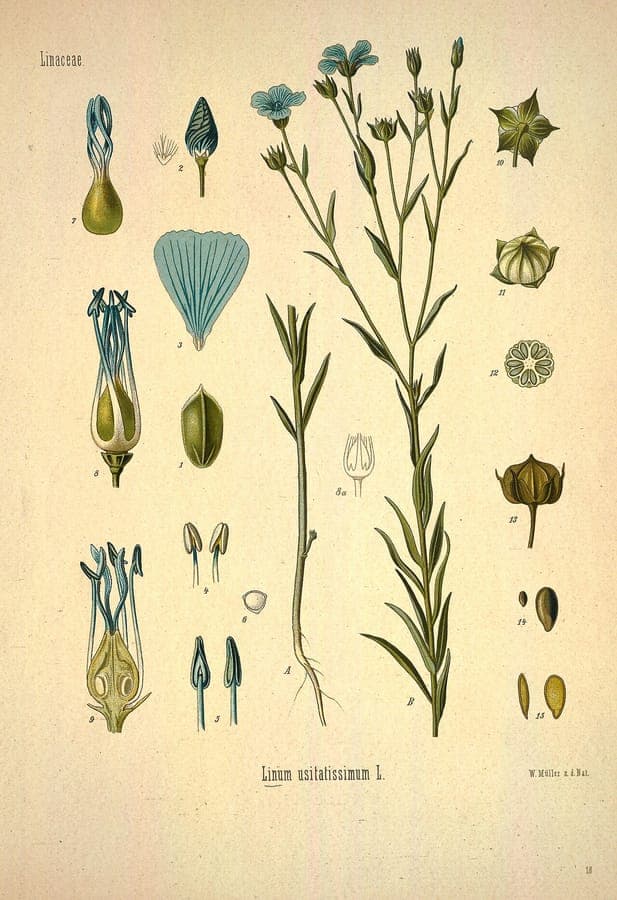
Brandt, Wilhelm; Gürke, M.; Köhler, F. E.; Pabst, G.; Schellenberg, G.; Vogtherr, Max. / Public domain, via Wikimedia Commons
Flax (Linum usitatissimum): complete guide
Linum usitatissimum
¿Quieres ver Flax (Linum usitatissimum): complete guide en tu jardín?
1 minuto, sin tarjeta de crédito
Overview
Flax (Linum usitatissimum), also called linseed or cultivated flax, is an annual plant that has arguably had more impact on humanity than many other crops. Used for textile production, oil extraction, and nutrition, flax is a fascinating crop with thousands of years of cultivation history. In gardens, flax not only grows beautifully but also offers educational value and self-sufficiency possibilities.
Appearance & Bloom
Flax is an elegant, slender plant reaching 40-90 cm in height. The plant features thin, line-like foliage and, crucially, delicate flowers in blue, pink, or white tones - though blue is most common. Each plant bears hundreds of small flowers during May-August. After blooming, seed capsules form containing the famous seeds from which linseed oil is extracted, prized for its omega-3 fatty acids.
Ideal Location
Flax thrives in full to partial sun (minimum 4-6 hours daylight). The plant tolerates some shade but thrives optimally in full sunlight. For garden designs, flax works beautifully in front borders, mixed borders, or even in clusters as accents. The plant adds textural diversity through its slender growth habit.
Soil Requirements
Flax is not fussy about soil type but prefers well-draining, moderately fertile soil. Heavy clay can impede growth, so add organic matter for improvement. A pH of 6.0–7.0 is ideal. Unlike its ornamental cousin (blue flax), cultivated flax better tolerates nutrient-rich environments, though not excessively so.
Watering
Flax must be well-established; sow directly after the last frost date. Once rooted, flax tolerates drought reasonably well. Water regularly until established (first 4 weeks). Thereafter, water only during extreme drought. Excess water causes lush growth and less seed production.
Diseño gratis
¿Quieres ver Flax (Linum usitatissimum): complete guide en tu jardín? Crea un diseño gratis ahora.
Pruning
Flax doesn't really need pruning. However, removing affected or weak plant parts helps. Some growers pinch the top for more branching, but this is optional. After flowering, allow seeds to ripen for harvest or seed saving for next season.
Maintenance Calendar
April–May: Sow directly after last frost (5–10 cm deep, 5–10 cm spacing). Water for seed germination.
June–July: Peak blooming! Plant heights plateau. Regular watering, no fertilization needed.
August–September: Seed setting and ripening. Seed capsules turn yellow-brown.
October: Harvest seeds when capsules are brown and rattle. Dry indoors for storage.
November–March: Rest period. Plant can be removed after seed harvest.
Winter Hardiness
Flax is annual and tolerates light frost in early stages but dies in severe freezing. For Dutch, French, and German climates, sow after the last frost date. No winter hardiness - the plant is seasonal.
Companion Plants
Flax combines wonderfully with:
- Borage (edible flowers, pollinator favorite)
- Chamomile (Matricaria chamomilla)
- Dill and other herbs (Anethum graveolens)
- Sunflowers (Helianthus annuus) - for height and contrast
- Nigella (black cumin) - similar texture
- Growing broom (Cytisus) for background
- Wild daisy (Leucanthemum vulgare)
Closing
Flax is more than just beautiful; it's a connection to agricultural history and self-sufficiency possibilities. Growing flax in your garden offers educational value, stunning flowers, and valuable seeds. You can spin and weave the fibers or simply enjoy the seeds. Merge function and beauty by planting flax. For more inspiration on functional gardens and design help, visit gardenworld.app - the platform to design your perfect garden.
Flax seed is available from seed suppliers in the Netherlands (Intratuin, Gamma) and Germany (OBI, Hornbach).
¿Quieres ver Flax (Linum usitatissimum): complete guide en tu jardín? Crea un diseño gratis ahora.
Sube una foto, elige un estilo y obtén un diseño fotorrealista con lista de plantas en menos de un minuto.
Más de 10.000 jardines diseñados
Sin tarjeta de crédito


Plantas similares
Lewis's flax: complete guide
Linum lewisii
Everything about Linum lewisii (Lewis's flax): location, soil, watering and maintenance. An elegant blue-flowered prairie plant for sunny, dry garden borders.
Tree Flax: complete guide
Linum arboreum
Discover Tree Flax (Linum arboreum), a Mediterranean shrub with golden-yellow flowers and fine needle-like foliage. Perfect for sun-soaked dry gardens and rocky terraces.
Sea flax: complete guide
Linum maritimum L.
Sea flax is a Mediterranean coastal shrub with delicate yellow flowers. Learn how to grow and care for this salt-tolerant plant in your garden.