
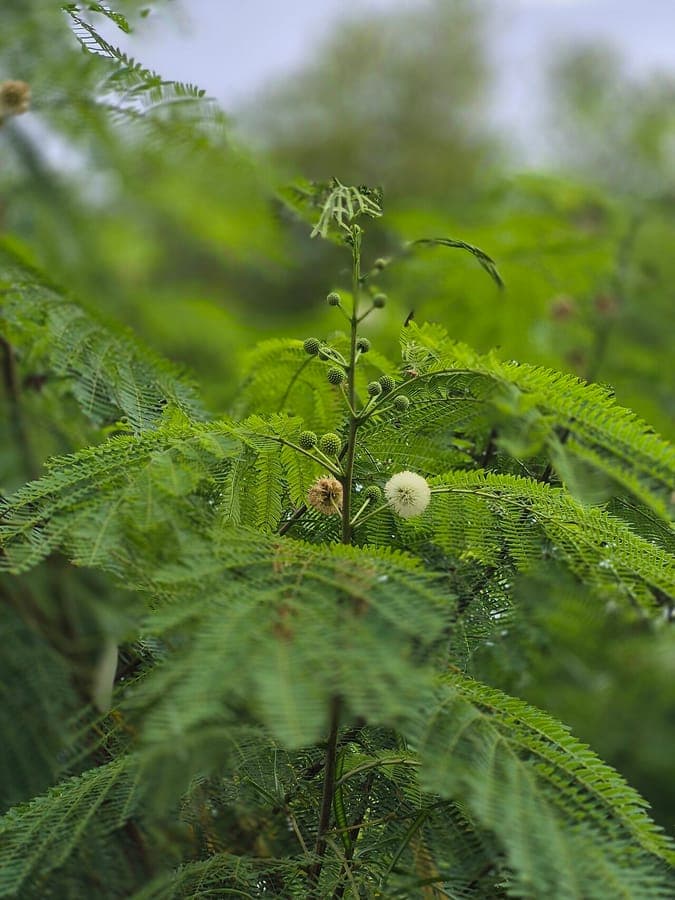
O Tupinólogo / CC BY 4.0, via Wikimedia Commons
White leadtree (Leucaena): complete guide
Leucaena leucocephala
¿Quieres ver White leadtree (Leucaena): complete guide en tu jardín?
1 minuto, sin tarjeta de crédito
Overview
White leadtree (Leucaena leucocephala), also known as ipil-ipil or sneakytree, is a fast-growing legume tree from the Fabaceae family, native to Central America. This tree reaches 3-8 meters at maturity and is renowned for its nitrogen-fixing ability, fine, fern-like foliage, and showy white flower clusters.
Thriving in tropical and subtropical climates, white leadtree excels at rapid shade production, soil enrichment, and erosion control. Caution: can be invasive in some regions; check local regulations.
Appearance & Bloom
White leadtree forms an elegant tree with feathery, fern-like green leaves (bipinnate). The trunk is gray, smooth. From May to July, spectacular ball-shaped flower clusters of pure white appear, highly fragrant, attracting honeybees and butterflies.
After blooming, flat, yellow, pod-shaped fruits of 12-20 cm form with seeds inside. These fruits ripen in September-October.
Ideal Location
White leadtree thrives in full sun to light shade. Suitable for south-facing, open gardens.
- Light requirement: Full sun to light shade (minimum 6 hours sunlight)
- Drainage: Very well-draining
- Temperature: USDA zone 9b-11 (-5 to +10°C winter minimum)
- Height: 3-8 m
Soil Requirements
White leadtree grows on nearly all soils, including very poor ground. It fixes atmospheric nitrogen, so external fertilization is usually unnecessary. Suited to acidic and basic soils.
- pH: 4.5-7.5 (highly tolerant)
- Moisture: Dry to moderately moist; fairly drought-tolerant after establishment
- Nutrition: No external fertilization needed
Diseño gratis
¿Quieres ver White leadtree (Leucaena): complete guide en tu jardín? Crea un diseño gratis ahora.
Watering
Regular watering during first 2 years of growth; thereafter very drought-tolerant. During extreme drought (>60 days), spray weekly.
- Year 1: Weekly
- Year 2: Bi-weekly
- After: Only during extreme drought
Pruning & Maintenance
Pruning optional. Remove dead branches annually. For more shape control, prune after bloom. Warning: explosive self-seeding possible; remove dispersed seeds.
Maintenance Calendar
- March-April: Plant from seed or cuttings
- May-July: Blooming
- August-October: Seed ripening
- November-February: Dormant/rest period
Winter Hardiness
Usually for USDA zone 9b-11 (-5 to +10°C winters). In zone 9a-9b possible winter dieback; cut back to buds.
Companion Planting
Combine beneath white leadtree with shade-lovers:
- Aucuba (Aucuba japonica)
- Hydrangea (Hydrangea spp.)
- Fern plantings (Dryopteris erythrosora)
Final Thoughts
White leadtree is an excellent choice for tropical garden designs with sustainable soil enrichment. At gardenworld.app, discover more on fast-growing trees and nitrogen-fixer systems. Note: can be invasive; check local regulations!
Want more ideas for fast, sustainable shade trees? Visit gardenworld.app and download our tropical garden planning guide.
¿Quieres ver White leadtree (Leucaena): complete guide en tu jardín? Crea un diseño gratis ahora.
Sube una foto, elige un estilo y obtén un diseño fotorrealista con lista de plantas en menos de un minuto.
Más de 10.000 jardines diseñados
Sin tarjeta de crédito


Plantas similares
Tall Silky Lupine: complete guide
Lupinus elatus
Tall silky lupine is a fast-growing Californian perennial with silvery foliage and blue-purple flower spikes, ideal for a prairie-style garden.
Garfield Lupine: complete guide
Lupinus garfieldensis
The Garfield lupine is a rare, fast-growing American perennial for alkaline, dry grassland gardens, with striking blue flower spikes.
Lupinus elegans: complete guide
Lupinus elegans
Lupinus elegans, the elegant lupine, is a spectacular blooming plant from Mexico with blue flower spikes. Care, cultivation and garden use.