
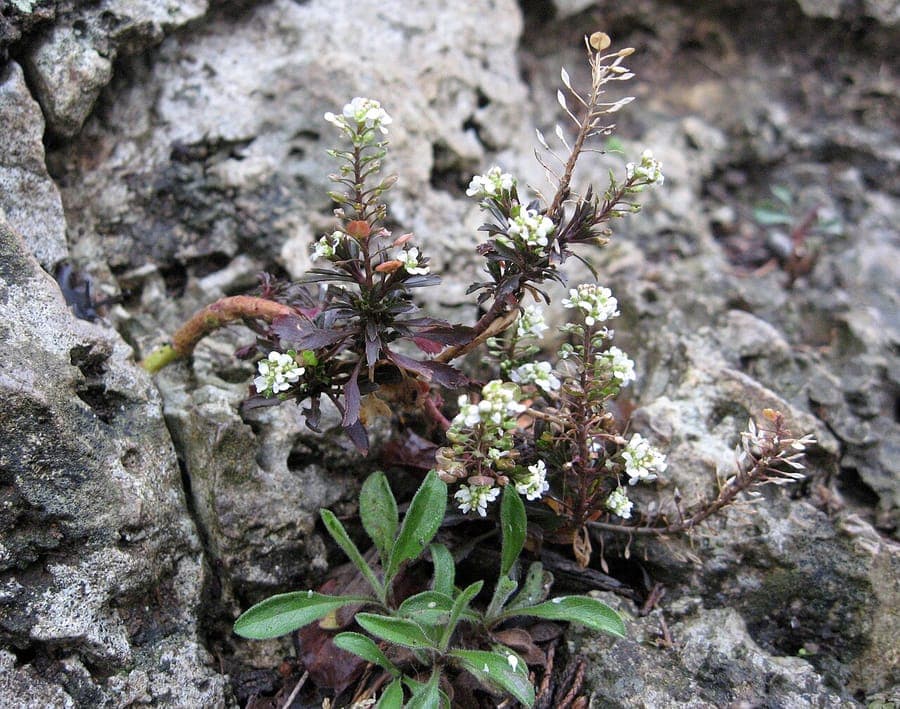
Mason Brock (Masebrock) / Public domain, via Wikimedia Commons
Virginia cress: complete guide
Lepidium virginicum
¿Quieres ver Virginia cress: complete guide en tu jardín?
1 minuto, sin tarjeta de crédito
Overview
Virginia cress (Lepidium virginicum) is a compact annual to biennial plant from the Brassicaceae family, native to North America. Now naturalized in Europe, it grows rapidly as a pioneer on disturbed sites, birdseed locations, and compacted roads. It reaches 15-45 cm and is known for its frost hardiness and aggressive seed production.
The plant self-seeds naturally via numerous tiny seeds, making it useful for ecological bird gardens but requiring vigilance in container cultivation.
Appearance & Bloom
Virginia cress forms a compact, aggressively branched rosette. The leaves are linear to lanceolate, green, coarsely hairy, and aromatic. The plant grows initially in a low pattern (first year), then upright (second year).
From May to September, tiny white to pale-pink flowers appear in thin-thread-like spires, followed by characteristic thin, oval seedpods of 4-5 mm with very numerous seeds (100+).
Ideal Location
Virginia cress thrives in full sun. Especially suitable for warm, dry spots.
- Light requirement: Full sun (minimum 6 hours direct sunlight)
- Drainage: Very well-draining
- Temperature: Hardy to -10°C (USDA zone 7)
- Height: 15-45 cm
Diseño gratis
¿Quieres ver Virginia cress: complete guide en tu jardín? Crea un diseño gratis ahora.
Soil Requirements
Grows on virtually all soils, including very poor, compacted, rocky, and saline soils. This is advantageous for erosion control on difficult sites.
- pH: 5.0-8.0 (highly tolerant)
- Moisture: Dry to moderately moist
- Nutrition: No fertilizer needed
Watering
Minimal watering needed. Once established, rainwater is usually sufficient. During extreme drought (>30 days), light misting helps prevent desiccation.
- Frequency: Weekly only during very dry weather
- Method: Bottom watering
Pruning & Maintenance
No pruning needed. Remove seedpods before ripening to prevent self-seeding (unless naturalization desired). Remove entire plant by fall.
Maintenance Calendar
- March-April: Direct sow in ground
- May-September: Bloom & seed production
- October-November: Plant senescence
- Winter: Dormant; regrows in spring
Winter Hardiness
Hardy to -10°C (USDA zone 7). In milder winters possibly persistent.
Companion Planting
Combine in ecological plantings with:
- Purple coneflower (Echinacea purpurea)
- Larkspur (Delphinium)
- Daisy (Chrysanthemum)
Final Thoughts
Virginia cress is ideal for dry, difficult sites with minimal care. At gardenworld.app, discover more on ecological, low-maintenance gardens. Warning: can become invasive; monitor seed production!
Want more ideas for tough, drought-tolerant plants? Visit gardenworld.app and download our xeriscaping guide.
¿Quieres ver Virginia cress: complete guide en tu jardín? Crea un diseño gratis ahora.
Sube una foto, elige un estilo y obtén un diseño fotorrealista con lista de plantas en menos de un minuto.
Más de 10.000 jardines diseñados
Sin tarjeta de crédito


Plantas similares
Garden cress: complete guide
Lepidium sativum
Garden cress is a fast, nutritious leafy vegetable with a peppery kick. Learn how to grow this noble Brassicaceae at home in just 2-3 weeks.
Narrow-leaf pepperwort: complete guide
Lepidium ruderale
Narrow-leaf pepperwort is a cold-hardy, volunteer plant colonizing disturbed soils. Learn how to cultivate this robust Brassicaceae on poor ground without fertilizer.