
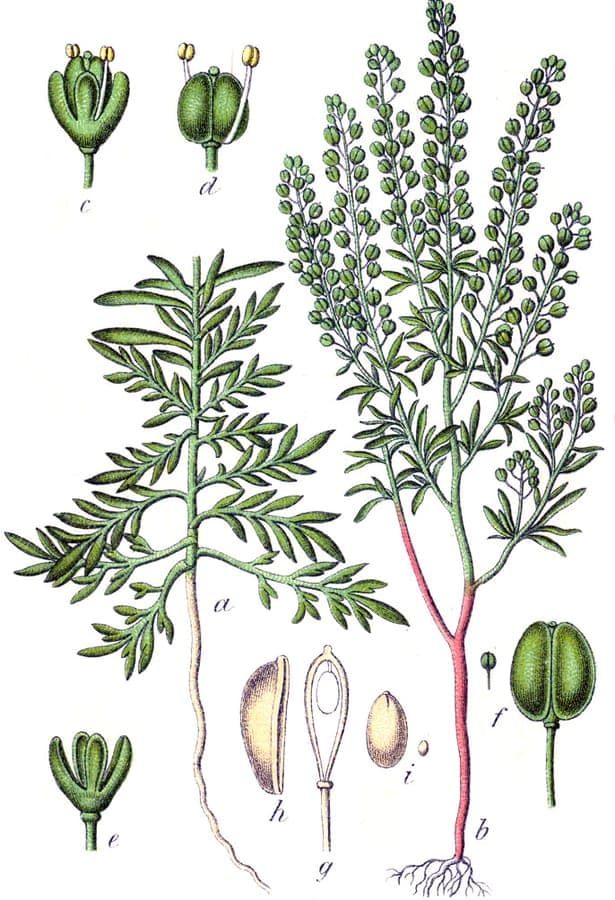
Johann Georg Sturm (Painter: Jacob Sturm) / Public domain, via Wikimedia Commons
Narrow-leaf pepperwort: complete guide
Lepidium ruderale
¿Quieres ver Narrow-leaf pepperwort: complete guide en tu jardín?
1 minuto, sin tarjeta de crédito
Overview
Narrow-leaf pepperwort (Lepidium ruderale) is a fast-growing annual to biennial herb from the Brassicaceae family. This compact, dark-green plant reaches 20-50 cm in height and is renowned for outcompeting weeds on birdseed mixes and fallow land. It spreads naturally throughout Europe and Asia.
Its leaves have a sharp, peppery taste and are edible, though rarely grown commercially. Despite poor, compacted soil, narrow-leaf pepperwort establishes readily and actively aids in erosion control.
Appearance & Bloom
The plant forms a compact bushy clump with many branching stems. The leaves are linear to lanceolate, grey-green in color, and strongly aromatic. From May to June, tiny white to pale-pink flowers appear in dense clusters.
After pollination, distinctive flat, round seedpods of 4-6 mm diameter form, containing 2 seeds each. These light yellow-brown seedpods are highly attractive to birds.
Ideal Location
Narrow-leaf pepperwort thrives in full sun and partial shade. Plant on south-facing terraces or in open fallows.
- Light requirement: Full to partial shade (minimum 4 hours direct sunlight)
- Drainage: Excellent, even on sandy soils
- Temperature: Hardy to -15°C
- Height: 20-50 cm
Soil Requirements
This plant grows on the poorest soils. Poor, sandy, clayey, and compacted soils are ideal - the poorer the better for competitive dominance. No fertilizer needed.
- pH: 5.5-8.0 (neutral to basic)
- Moisture: Dry to moderately moist
- Nutrition: No fertilizer required
Diseño gratis
¿Quieres ver Narrow-leaf pepperwort: complete guide en tu jardín? Crea un diseño gratis ahora.
Watering
Frequent watering is unnecessary after establishment. During dry spells (>14 days without rain), light misting prevents wilting.
- Frequency: Once weekly during drought
- Method: Bottom watering; monitor top 2-3 cm for moisture
Pruning & Maintenance
No pruning is needed. Remove faded flowers to prevent seed dispersal. Remove the entire plant in August/September and compost it.
Maintenance Calendar
- March-April: Direct sow in ground
- May-June: Blooming and pollination
- July-August: Seed production
- September-October: Senescence and overwintering
Winter Hardiness
Hardy to -15°C (USDA zone 6b). Snow and ice protection typically unnecessary.
Companion Planting
Combine with other nutrient-poor birdseed species:
- Sunflower seeds (Helianthus annuus)
- Cornflower (Centaurea cyanus)
- Thistle (Carduus or Cirsium spp.)
Final Thoughts
Narrow-leaf pepperwort is ideal for ecological bird gardens and erosion control on poor soils. At gardenworld.app, discover more on ecological garden planning and wild birdseed combinations. Definitely consider it for winter bird feeding!
Want more information on native species for bird habitat? Visit gardenworld.app and download our plant guide.
¿Quieres ver Narrow-leaf pepperwort: complete guide en tu jardín? Crea un diseño gratis ahora.
Sube una foto, elige un estilo y obtén un diseño fotorrealista con lista de plantas en menos de un minuto.
Más de 10.000 jardines diseñados
Sin tarjeta de crédito


Plantas similares
Garden cress: complete guide
Lepidium sativum
Garden cress is a fast, nutritious leafy vegetable with a peppery kick. Learn how to grow this noble Brassicaceae at home in just 2-3 weeks.
Virginia cress: complete guide
Lepidium virginicum
Virginia cress is a tough, colonizing plant from North America. Learn how to grow this naturalizing Brassicaceae with minimal maintenance.