
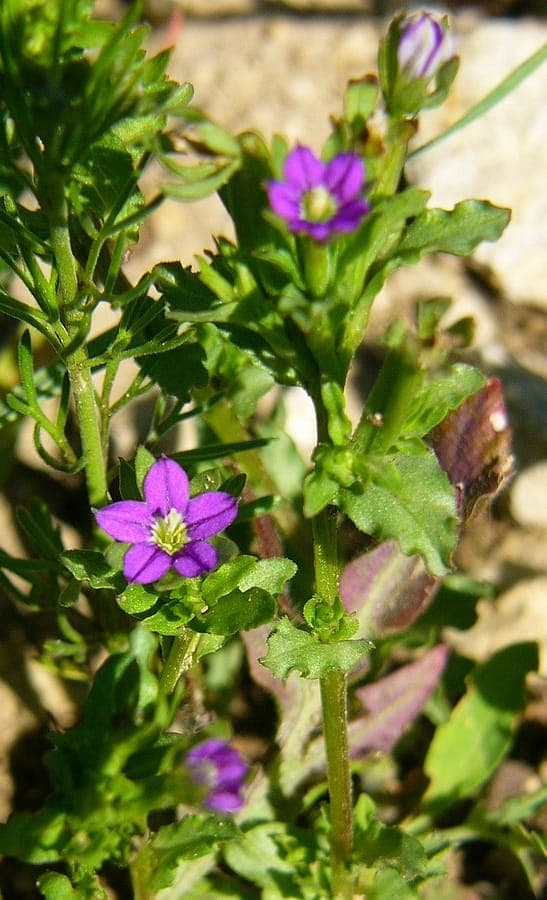
Thomas Meyer, Günzburg / CC BY-SA 3.0, via Wikimedia Commons
Venus' Looking-Glass: Complete Guide to Growing Legousia hybrida
Legousia hybrida
¿Quieres ver Venus' Looking-Glass: Complete Guide to Growing Legousia hybrida en tu jardín?
1 minuto, sin tarjeta de crédito
Overview
Legousia hybrida, commonly known as Venus' looking-glass, is an elegant annual flowering plant from the Campanulaceae family. This delicate wildflower originates from the Mediterranean region and is now found throughout Europe and neighboring areas. The plant is celebrated for its distinctive purple and pink flowers with striking white centers, which bloom continuously throughout the growing season.
Appearance and Blooming
Venus' looking-glass is a compact grower, typically reaching 15-40 cm in height. The stems are slender and branched, bearing small, linear leaves arranged closely along the stems. The flowers are round to flat, measuring approximately 1-2 cm across. They appear in rich shades of purple, pink, and violet, with characteristic white markings in the center. The blooms emerge on short stalks and distribute across the entire plant, creating a full, floriferous appearance.
The blooming season extends from May through September, providing months of colorful display. Multiple flowers open simultaneously, creating a constantly evolving floral exhibition that keeps the plant attractive throughout summer.
Ideal Location
Legousia hybrida thrives in sunny positions receiving at least 6 hours of direct sunlight daily. The plant tolerates partial shade but produces fewer and less vibrant flowers in reduced light. In extremely hot climates, afternoon shade during July and August may prevent excessive wilting and drying.
Soil Requirements
The plant performs well in well-draining, airy soil. Heavy clay soils can be amended with sand and organic matter to improve drainage. A soil pH between 6.0 and 7.5 is optimal. Highly fertile soils are not necessary, but moderate organic material incorporation helps establish healthy root systems.
Watering
Venus' looking-glass requires moderate moisture. Water regularly, especially during dry spells, but avoid waterlogged conditions. In most climates, rainfall provides adequate moisture. During drought periods in July and August, supplemental watering may be necessary. Prevent excessive moisture, particularly in heavy soils.
Diseño gratis
¿Quieres ver Venus' Looking-Glass: Complete Guide to Growing Legousia hybrida en tu jardín? Crea un diseño gratis ahora.
Pruning
Pruning is not essential. Remove spent flowers to encourage continuous blooming and maintain a neat, compact appearance - this deadheading technique significantly extends the flowering period. Remove any diseased or damaged stems at any time.
Maintenance Calendar
March-April: Sow seeds directly outdoors after the last frost, or start indoors 4-6 weeks before frost date. Prepare beds and incorporate compost.
May-June: Transplant seedlings when 5-8 cm tall. Establish regular watering and begin deadheading emerging flowers.
July-August: Maintain irrigation as needed. Intensive deadheading promotes prolonged flowering. Monitor for drought stress.
September: Blooming declines as the season ends. Uproot plants or allow them to self-seed in mild climates.
October-February: Dormant season. No specific care required for annual plantings.
Winter Hardiness
Legousia hybrida is an annual plant lacking frost hardiness. In regions experiencing freezing winters, plants will perish at first frost. Even in mild climates with only light frosts, the plant typically doesn't survive year-round. While young plants tolerate light frosts of -2 to 0°C, mature plants cannot withstand freezing temperatures. Resow annually for successive seasons.
Companion Plants
Legousia hybrida naturally pairs well with other Mediterranean wildflowers and annuals:
- Papaver rhoeas (corn poppy) - similar growing period and light requirements
- Centaurea cyanus (cornflower) - comparable height and bloom time
- Calendula officinalis (marigold) - shared sunny preference
- Eschscholzia californica (California poppy) - excellent color contrast
These combinations create stunning summer wildflower displays and cottage garden borders.
Closing Remarks
Venus' looking-glass is a charming annual requiring minimal effort while delivering abundant flowers and color. It's ideal for gardeners seeking low-maintenance plants that add Mediterranean charm to borders and containers. Plant in groups to create full, colorful summer displays. Explore more plant selections and professional garden designs at gardenworld.app - your destination for customized garden transformations. For expert guidance and advanced design services, visit gardenworld.app today.
¿Quieres ver Venus' Looking-Glass: Complete Guide to Growing Legousia hybrida en tu jardín? Crea un diseño gratis ahora.
Sube una foto, elige un estilo y obtén un diseño fotorrealista con lista de plantas en menos de un minuto.
Más de 10.000 jardines diseñados
Sin tarjeta de crédito


Plantas similares
Campanula alaskana: complete guide
Campanula alaskana
Discover Campanula alaskana, the delicate alpine bellflower from Alaska. Growing tips, hardy requirements, and design ideas for rock gardens and alpine troughs.
Campanula scouleri: complete guide
Campanula scouleri
Discover Campanula scouleri, the refined Pacific bellflower. Growing tips, care requirements, and design ideas for woodland and mountain gardens.
Doublehorn calicoflower: complete guide
Downingia bicornuta
All about Downingia bicornuta - the doublehorn calicoflower: sowing, location, bloom and care for this rare annual in your garden.