
Wikimedia Commons / CC BY-SA 3.0, via Wikimedia Commons
Ledum palustre: complete guide
Ledum palustre
¿Quieres ver Ledum palustre: complete guide en tu jardín?
1 minuto, sin tarjeta de crédito
Ledum palustre, known as Marsh Labrador Tea or Wild Rosemary, is an enchanting small native shrub of wetlands and marshes throughout northern Europe and Asia. This member of the Ericaceae family (the same as Rhododendrons and Heathers) grows low and compact, possessing small shiny leaves with characteristic aromatic fragrance. The plant reaches only 30 to 80 centimetres in height and forms dense clumps.
Appearance and Bloom
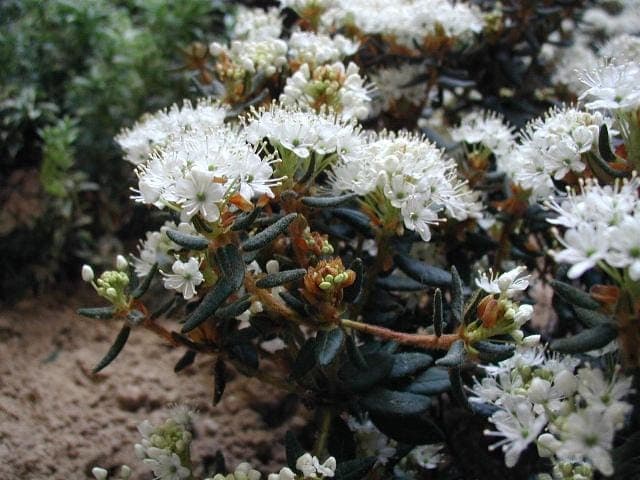
Ledum palustre forms a compact, shrubby plant with numerous low branches and small, narrow, elliptical leaves arranged along stems. Leaves measure approximately 1 to 2 centimetres in length, are dark green, and have undersides covered with dull-brown hairs, making them distinctive. When touched or disturbed, leaves release a powerful, camphor-like aroma reminiscent of rosemary.
Flowers appear in May to June in dense, umbrella-shaped clusters (umbels) at twig tips. Each bloom is small, approximately 8 to 10 millimetres in diameter, white to pale pink in colour, and five-petalled. Flowers possess a primrose-like appearance and are remarkably attractive. After blooming, small seed capsules form. The plant retains foliage year-round in temperate climates, though winter leaves may droop somewhat.
Ideal Location
Ledum palustre grows best in full sun to dappled shade, requiring 4 to 6 hours direct sunlight daily. The plant is highly flexible and thrives even in more shaded locations, though flowering may diminish.
Despite its name "palustre" (marshy), the plant grows in well-draining, moist heathland gardens, alpine borders, heath gardens, and even in gardens with acidic clay or loam soils. It is suitable for USDA zones 2 to 7 (winter temperatures to -45°C), making it absolutely frost-hardy throughout Europe.
The plant prefers cool, moisture-retentive soils and naturally grows in mountain habitats, coniferous forests, and boggy heathland. In gardens, it excels in moisture-rich niches, atop freely draining substrates, and in areas that remain consistently moist.
Soil Requirements
This is where Ledum palustre truly shines: it requires acidic, humus-rich soil with pH between 4.5 and 6.0. It cannot grow in alkaline, lime-containing soils. Add generous amounts of peat moss, composted leaves, or peat alternatives (e.g., coir) to your garden soil if you have neutral to alkaline conditions.
When container-growing, use specialist heather or azalea compost (acidic, humus-rich). The plant thrives in permanently moisture-retentive soils, so drainage must be excellent but soil must never dry completely.
Watering Practices
Ledum palustre requires regular water, especially during growing seasons (May to September). The plant grows in moisture-retentive soil types in the wild, so ensure consistent moisture without waterlogging. In dry summers, provide moderate, regular watering but allow soil to dry only slightly between waterings.
In winter when growth ceases, reduce watering to moderate levels, although soil must never dry completely. Container-grown plants require more frequent watering as drainage causes faster moisture loss.
Use rainwater when possible, as the plant is sensitive to chemicals in tap water and lime.
Diseño gratis
¿Quieres ver Ledum palustre: complete guide en tu jardín? Crea un diseño gratis ahora.
Pruning and Maintenance
Ledum palustre requires minimal pruning. Remove spent flowers after blooming to prevent seed production and channel plant energy toward growth. Light pruning after flowering (June) maintains compact form, but aggressive cutting reduces next year's flowering.
Remove withered foliage in late autumn. Dead wood can be removed from the plant's heart. For rejuvenating mature specimens, careful pruning to mid-stem is possible, though the plant prefers gentle treatment.
Maintenance Calendar
May-June: Flowering. Enjoy white/pink blooms.
July-September: Growing season. Regular watering. No feeding needed (natural humus suffices).
October-November: Growth slows. Reduce watering.
December-April: Winter period. Minimal watering. Plant almost dormant. No feeding.
Winter Hardiness
Ledum palustre is extremely cold-hardy and grows without any winter protection in USDA zones 2 to 7, covering all European climates. Winter temperatures to -45°C pose no problems. The plant requires no mulch and thrives in snowy regions.
Winter damage occurs only in exceptionally extreme conditions. The plant even grows above the Arctic Circle.
Companion Plants
Ledum palustre pairs beautifully with other heathland and alpine-like plants. Ideal companions include other heather species, Gaultheria, Vaccinium (bilberries), Kalmia, and low-growing Rhododendrons. Acid-loving soils support combinations with blue Corydalis and shade-tolerant hellebores.
White flowers and aromatic foliage create lovely contrast with dark foliage such as purple-leaved heathers or dark green conifers. In heathland gardens, it is an essential plant. In alpine borders, it forms a low, shrubby layer.
It is also suitable for marsh edges (if garden conditions permit) and wet clay-grit mixes.
Uses
Historically, Ledum palustre was used for tea (Labrador tea) and in traditional medicine. Today, it is primarily grown as an ornament. The aromatic leaves make fine additions to gardens that stimulate sensory enjoyment.
Conclusion
Ledum palustre is a beautiful native European shrub that deserves revival in modern gardens. For gardeners with acidic, moisture-retentive soils, this is a valuable asset to your border. Its white flowers, aromatic foliage, and evergreen character make it a treasure for heathland gardens, alpine borders, and winter-interest designs. With minimal care and appropriate soil conditions, you will enjoy this Marsh Labrador Tea for decades.
Gardenworld.app helps you find the ideal growing environment for Ledum palustre. Questions about acidic soil or heathland gardens? Visit gardenworld.app for more guidance.
¿Quieres ver Ledum palustre: complete guide en tu jardín? Crea un diseño gratis ahora.
Sube una foto, elige un estilo y obtén un diseño fotorrealista con lista de plantas en menos de un minuto.
Más de 10.000 jardines diseñados
Sin tarjeta de crédito


Plantas similares
Zenobia pulverulenta: complete guide
Zenobia pulverulenta
Everything about Zenobia pulverulenta (honeycup): siting, acid soil, pruning and the fragrant white bells, in this complete care guide.
Dwarf huckleberry: complete guide
Gaylussacia dumosa
Everything about dwarf huckleberry (Gaylussacia dumosa): acidic soil, partial shade, pruning and care for this compact North American berry shrub.
Drooping leucothoe: complete guide
Leucothoe fontanesiana
Everything about drooping leucothoe (Leucothoe fontanesiana): shade tolerance, soil, watering, pruning, hardiness and companion plants.