
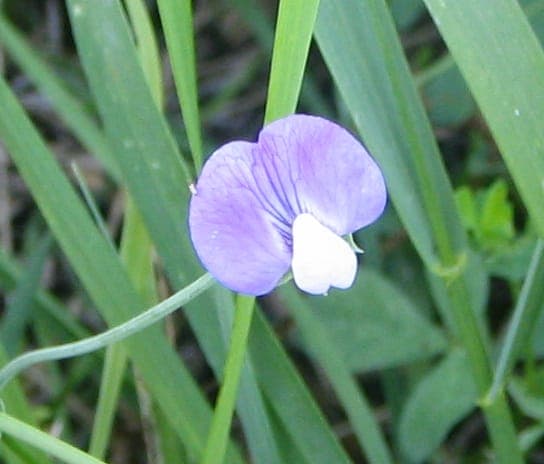
No machine-readable author provided. Bogdan assumed (based on copyright claims). / CC BY-SA 3.0, via Wikimedia Commons
Austrian Winterpea: complete guide
Lathyrus hirsutus
¿Quieres ver Austrian Winterpea: complete guide en tu jardín?
1 minuto, sin tarjeta de crédito
Overview
The Austrian Winterpea, scientifically known as Lathyrus hirsutus, is an interesting climbing plant with a broad geographic range from Europe to North Africa and Central Asia. This annual plant belongs to the Fabaceae family and gets its name from the characteristic roughness of its leaves and stems. The plant displays purple flowers and is a valued addition to mixed planting schemes.
This is a plant better suited to temperate climates than some of its Mediterranean relatives. On gardenworld.app, you can see how to integrate this versatile plant into your garden plan.
Appearance & Blooming
The Lathyrus hirsutus grows as an upright to climbing plant, usually 40-80 cm tall. The most characteristic feature is the passionate hairy texture of the leaves, stems and even fruits. The flowers are purple-violet, sometimes with pink accents, and appear from May to July. The plant has fine tendrils with which it clings. The pods are compact and densely hairy.
Ideal Location
This plant grows well in full sun to partial shade. It is flexible regarding soils. The plant can grow against a support or be used as ground cover. However, good drainage is needed. It thrives in temperate climates and is less demanding than Mediterranean varieties.
Soil
The plant grows on varied soils, from sand to clay, provided well-drained. It is not very nutrient-demanding, thanks to the symbiosis with nitrogen-fixing bacteria. pH 5.5-7.5 is suitable. Slightly acidic to neutral soils are preferred.
Diseño gratis
¿Quieres ver Austrian Winterpea: complete guide en tu jardín? Crea un diseño gratis ahora.
Watering
Once established, this plant requires only moderate water supply. Regular watering during blooming (May-July) gives better results. It tolerates some drought but prefers consistently moist soil. Ensure good drainage.
Maintenance
Minimal maintenance required. Removing faded flowers extends the blooming period. The plant can grow against a support or be used as natural ground cover. No fertilizer needed; too much nitrogen promotes foliage at the expense of flowers.
Maintenance Calendar
April-May: Sow or plant May-July: Blooming period; water regularly July-August: Seed formation September-October: Plant gradually fades
Winter Hardiness
The Lathyrus hirsutus is only annual and not winter-hardy in temperate climates. In milder climates (USDA zones 8-9), the plant may possibly overwinter. For most of the Benelux, this is a seasonal plant.
Companion Plants
Perfect as support for other plants in a mixed border. Combines well with white flowers, coneflowers and other summer bloomers. The purple flowers provide nice contrast with yellow or white flowers.
Closing
Austrian Winterpea is a versatile plant that adapts well to temperate climates. With minimal maintenance and flexible growing conditions, this plant blooms beautifully. Discover on gardenworld.app how to incorporate this characterful climbing plant into your garden plan.
¿Quieres ver Austrian Winterpea: complete guide en tu jardín? Crea un diseño gratis ahora.
Sube una foto, elige un estilo y obtén un diseño fotorrealista con lista de plantas en menos de un minuto.
Más de 10.000 jardines diseñados
Sin tarjeta de crédito


Plantas similares
Tall Silky Lupine: complete guide
Lupinus elatus
Tall silky lupine is a fast-growing Californian perennial with silvery foliage and blue-purple flower spikes, ideal for a prairie-style garden.
Garfield Lupine: complete guide
Lupinus garfieldensis
The Garfield lupine is a rare, fast-growing American perennial for alkaline, dry grassland gardens, with striking blue flower spikes.
Lupinus elegans: complete guide
Lupinus elegans
Lupinus elegans, the elegant lupine, is a spectacular blooming plant from Mexico with blue flower spikes. Care, cultivation and garden use.