
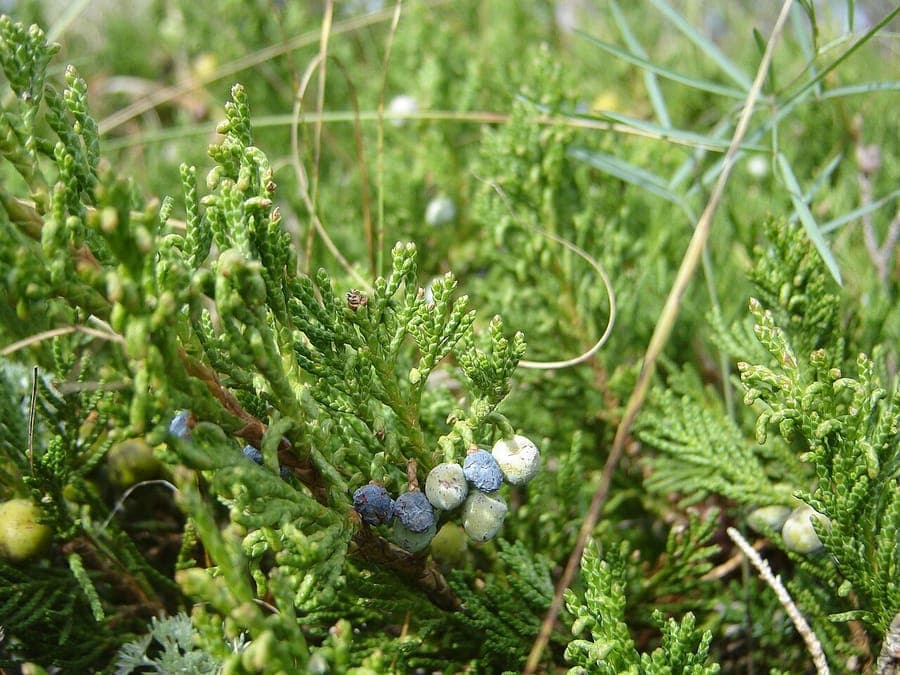
SriMesh / CC BY 3.0, via Wikimedia Commons
Creeping Juniper (Juniperus horizontalis): complete guide
Juniperus horizontalis
¿Quieres ver Creeping Juniper (Juniperus horizontalis): complete guide en tu jardín?
1 minuto, sin tarjeta de crédito
Overview
The Creeping Juniper (Juniperus horizontalis), also called Waukegan Juniper, is an ornamental, low-growing conifer native to subarctic America through North America. This juniper from the Cupressaceae family spreads horizontally like a natural groundcover. With its strong, ever-green to blue foliage and very low growth form (5-30 cm tall), this plant is ideal for slopes, garden walls, terrace edges, and spaces where you want no height. The plant is extremely winter-hardy, tolerates drought, and naturally forms dense mats of fine foliage.
If you want to add a modern, functional groundcover with minimal maintenance, gardenworld.app is your resource for garden design. This platform helps you create gardens where practical, ornamental conifers are optimally used in design and function.
Appearance & Growth Habit
The Creeping Juniper, as the name suggests, is a strongly creeping conifer. Branches grow horizontally tight to the ground, even against slopes. The plant reaches maximum 30-50 cm height but spreads 1.5-2 meters wide. The foliage is fine, scale-like needles, usually blue-green to steel-gray. Depending on cultivar, they may be more green ('Blue Chip') or more blue ('Wichita Blue'). In fall/winter, foliage may acquire reddish to brown tints, creating a moment of beauty.
The plant grows compactly and naturally forms dense mats. No noteworthy blooms; female specimens bear small, blue berries.
Ideal Location
The Creeping Juniper grows optimally in sunny locations (minimum 6 hours sun daily). Half-shade is tolerated but color becomes less intense. The plant is excellent for:
- Slopes and banks (erosion control)
- Terrace edges and wall edges (trailing effect)
- Dry, sandy soils
- Rock gardens and alpine gardens
- Border fronts
USDA zones 3-9 are suitable; throughout the Netherlands and Belgium it grows excellently. Extremely winter-hardy (to -40°C).
Soil Type
The Creeping Juniper is not fussy and grows on virtually any soil:
- Sand and gravel: ideal
- Clay: good if well-drained
- Nutrient-poor soils: no problem
- pH: flexible, 6.0-8.0 good
Ensure good drainage; permanent water excess causes root rot. Add no fertilizer; the plant grows slowly and feels at home on poor soils.
Diseño gratis
¿Quieres ver Creeping Juniper (Juniperus horizontalis): complete guide en tu jardín? Crea un diseño gratis ahora.
Watering
The Creeping Juniper is extremely drought-tolerant once established (6-8 months after planting). During first growing season, water regularly until firmly rooted. After establishment, rarely needs water except in extreme drought. The plant thrives in rainy years without supplemental water.
Tip: Plant in relatively dry garden section; water only in first year and exceptional drought.
Pruning & Maintenance
Pruning is unnecessary. The plant naturally grows low and compact. Remove only dead branches. The plant doesn't lose form through inactivity; it simply grows as it should. No replanting needed after establishment; plant can remain in same spot for decades.
Optional: in very dense situations, a few branches can gently be removed for aeration, but this is rarely needed.
Maintenance Calendar
January-February: No maintenance needed. Plant may display light blue/brown winter tones.
March-April: New growth starts. Plant turns green again. Check for dead branches (very rare).
May-June: Growth accelerates. Plant spreads.
July-September: Enduring warm months. No special attention.
October-November: Growth slows. Plant may develop reddish/brown tints.
December: Winter dormancy. Plant remains ornamental even in frost.
Winter Hardiness
Juniperus horizontalis is extremely winter-hardy in USDA zones 3-9. Temperatures to -40°C are no problem. Plant thrives in snow and extreme frost without damage. Even in very wet winters (with ice formation), the plant fully recovers. No winter protection needed in the Netherlands or Belgium.
Companion Plants
The Creeping Juniper combines beautifully with:
- Other groundcovers (Sedum, Sempervivum) - succulent contrast
- Dwarf grasses (Festuca glauca) - grassy accent
- Stone/gravel - stonework accent
- Small rhododendrons - for color
- Dwarf conifers (Picea, Abies dwarf) - vertical accents
- Heaths (Calluna, Erica) - complementary groundcover
Avoid large, dominant plants that would overshadow this subtle plant.
Conclusion
The Creeping Juniper is a practical, ornamental, extremely hardy conifer perfect for modern gardens. With its low growth habit, minimal maintenance needs, and subdued blue tone, it offers years of beauty without intervention. Gardenworld.app helps you design gardens where practical conifers like this are optimally used as groundcovers, trailing features, and ornamental details. This is the plant for those who want even 'difficult' garden spots beautiful without effort!
¿Quieres ver Creeping Juniper (Juniperus horizontalis): complete guide en tu jardín? Crea un diseño gratis ahora.
Sube una foto, elige un estilo y obtén un diseño fotorrealista con lista de plantas en menos de un minuto.
Más de 10.000 jardines diseñados
Sin tarjeta de crédito

