
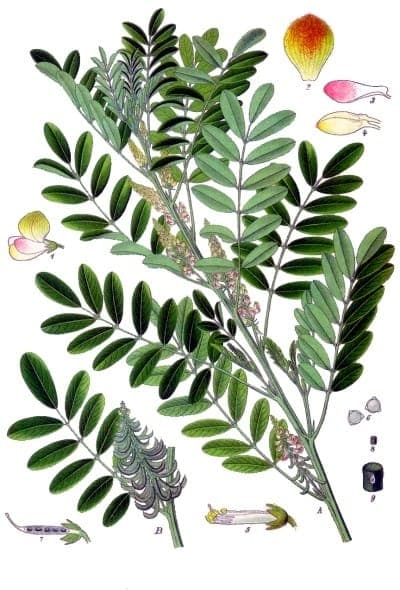
Franz Eugen Köhler, Köhler's Medizinal-Pflanzen / Public domain, via Wikimedia Commons
Anil Indigo: complete guide
Indigofera suffruticosa
¿Quieres ver Anil Indigo: complete guide en tu jardín?
1 minuto, sin tarjeta de crédito
Overview
Anil Indigo (Indigofera suffruticosa) is a fascinating tropical shrub from tropical and subtropical America. This plant is known for its bright purple flowers and its historical significance as a source of indigo dye. The plant belongs to the Fabaceae family (legumes).
Historically, Anil Indigo was widely cultivated for indigo extraction, one of the most valuable natural dyes. In modern gardens, it is primarily appreciated for its ornamental value.
For gardeners, it is an interesting exotic plant that can grow in a pot or greenhouse. The plant can also be placed outside during warm summers.
Appearance and Bloom
Anil Indigo typically reaches 100-150 centimeters in height and width, with a fairly compact, bushy growth pattern. The plant has compound leaves typical of the legume family, with small elliptical leaflets.
The flowers are the highlight. They are bright pink-purple or purple, small and clustered, on terminal spikes. The flowers appear throughout the growing season when the plant is well maintained.
After pollination, the plant forms characteristic pods containing small seeds. The entire plant can be used to extract indigo dye, an ancient industrial application.
Ideal Location
Anil Indigo thrives best in a warm, sunny location. The plant needs at least 6-8 hours of direct sun per day. A southeast or southwest-facing spot is ideal. In the Netherlands, it can be grown outside in the summer months in a protected location.
Indoors, it can grow in a sunny window, though avoid direct midday sun which can cause wilting. Ensure good ventilation.
The plant is not winter hardy and must be kept indoors in winter. A greenhouse or warm conservatory is ideal, with temperatures at least 10-15 degrees.
Soil
Anil Indigo grows best in well-drained, moderately nutrient-rich garden soil. A mixture of garden soil and fine sand works well. The pH should be around 6.0-7.5.
Ensure good drainage; waterlogging is harmful. For pot culture, use container soil with perlite or vermiculite.
The plant is not extremely fussy about soil composition, as long as it is well-drained.
Diseño gratis
¿Quieres ver Anil Indigo: complete guide en tu jardín? Crea un diseño gratis ahora.
Watering
Water regularly during the growing season. Ensure the soil becomes somewhat dry between waterings. Excessive water causes root rot.
In winter, when the plant grows less, water much less. Check soil moisture regularly.
In very hot periods, daily watering may be necessary. However, ensure water doesn't pool around the plant.
Pruning
Prune Anil Indigo in spring to encourage a bushier form. Remove dead, damaged, or old woody stems.
The plant responds well to hard pruning. This also helps stimulate blooming.
During the growing season, you can regularly pinch off the tips to encourage branching.
Maintenance Calendar
March-April: Start of growing season. Begin regular watering. Feed once weekly.
May-June: Full growth. Water regularly. Continue feeding. First flowers may appear.
July-August: Peak blooming. Water regularly, possibly daily in hot periods. Continue feeding.
September-October: Blooming still abundant. Gradually reduce feeding.
November-February: Winter rest. Move plant indoors. Give minimal water. Stop feeding.
Winter Hardiness
Anil Indigo is not winter hardy in temperate climates and must be kept indoors during winter. A warm greenhouse with temperatures of 10-15 degrees Celsius is ideal. The plant can suffer severe frost damage or even die if exposed to frost.
In very warm years, you can move the plant outside in May and bring it back inside in October.
Companion Plants
Anil Indigo grows beautifully with other tropical plants. Low-growing plants at the base work well. In a greenhouse, it can be grown with other heat-loving plants.
At gardenworld.app, you can discover this exotic plant in our plant catalog. Combinations with other Indigofera species can be very effective.
Conclusion
Anil Indigo is a beautiful and historically fascinating plant for those who want to grow tropical exotics. With its purple flowers and interesting cultural history, it offers a unique addition to a greenhouse or warm windowsill. Plant it in a sunny spot and enjoy months of blooms!
¿Quieres ver Anil Indigo: complete guide en tu jardín? Crea un diseño gratis ahora.
Sube una foto, elige un estilo y obtén un diseño fotorrealista con lista de plantas en menos de un minuto.
Más de 10.000 jardines diseñados
Sin tarjeta de crédito


Plantas similares
Tall Silky Lupine: complete guide
Lupinus elatus
Tall silky lupine is a fast-growing Californian perennial with silvery foliage and blue-purple flower spikes, ideal for a prairie-style garden.
Garfield Lupine: complete guide
Lupinus garfieldensis
The Garfield lupine is a rare, fast-growing American perennial for alkaline, dry grassland gardens, with striking blue flower spikes.
Lupinus elegans: complete guide
Lupinus elegans
Lupinus elegans, the elegant lupine, is a spectacular blooming plant from Mexico with blue flower spikes. Care, cultivation and garden use.