
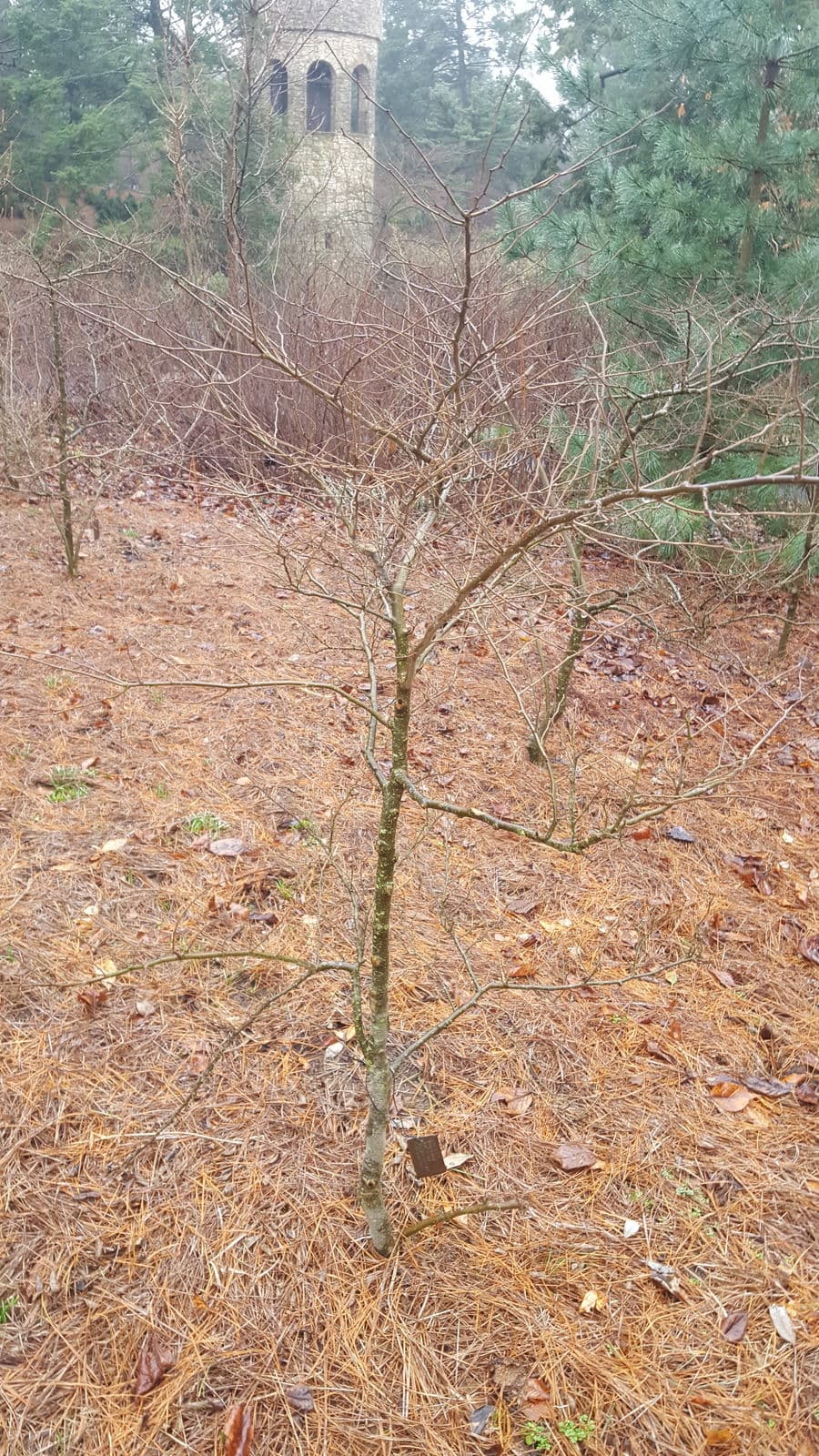
Japanese Winterberry: complete guide
Ilex serrata
¿Quieres ver Japanese Winterberry: complete guide en tu jardín?
1 minuto, sin tarjeta de crédito
Overview
Japanese winterberry (Ilex serrata) is a deciduous holly native to Japan and south-central China. Unlike the familiar evergreen holly (Ilex aquifolium), this species drops all its leaves in October, leaving the countless small, bright red berries fully exposed and glowing well into winter. It belongs to the holly family (Aquifoliaceae) and has become a favorite in gardens across Europe and North America precisely because of that striking winter silhouette: a bare framework of twigs studded with red beads exactly when the rest of the border looks grey and empty. Anyone designing a winter-interest bed on gardenworld.app will often see Japanese winterberry suggested as a structural shrub for the cold months. In cultivation the shrub typically reaches 150 to 300 cm tall and roughly as wide, growing at a steady but manageable pace that suits an average front or back garden without becoming unruly. One key fact before buying a plant at a garden center: Ilex serrata is dioecious, meaning individual plants are either male or female, and only female plants set berries, and only if a male pollinator grows somewhere nearby.
Appearance and bloom
Small, unremarkable flowers appear in May and June, pale lilac to pinkish white, clustered along the twigs. They are easy to overlook but essential: bees and other pollinating insects visit them in early summer, after which the fertilized flowers on female plants swell into berries. From September onward those berries slowly change from green to a brilliant coral red or orange red, depending on the cultivar. The cultivar 'Sundrop' produces golden yellow berries instead of red, while 'Koshobai' stays more compact with smaller, denser clusters. The leaves themselves are oblong to egg-shaped, 3 to 8 cm long, with a finely toothed edge (hence the species name 'serrata', meaning 'saw-toothed') and a fresh green color that turns yellow in October before dropping. Once the bare branches in November and December carry nothing but red berries, the plant delivers the effect it is known for: a delicate silhouette full of color against a grey winter sky, often lasting until thrushes and other birds have stripped the branches clean.
Ideal location
Give Japanese winterberry a spot in full sun to partial shade; the more sun it receives, the heavier the flowering and, in turn, the berry set in autumn. In deep shade, for example directly under large trees, berry production stays sparse and the growth habit gets leggier. The plant appreciates a sheltered position, away from harsh winds, since young shoots in early spring are sensitive to cold, drying easterly gusts. An ideal placement is along the edge of a border, close to a terrace or path, so you can enjoy the berried branches from indoors during winter. Because the shrub only becomes truly decorative late in the season, pair it with plants that carry the display in spring and summer instead. Think of hydrangeas, ornamental grasses, or perennials that get cut back for winter, letting the winterberry step into the spotlight once they fade. To see how such a seasonal combination would look in your own garden before planting anything, generating a design on gardenworld.app from a photo of your own yard is a useful first step.
Soil
Ilex serrata thrives best in fertile, slightly acidic to neutral soil with a pH between 5.5 and 6.5. In the wild it grows in moist, humus-rich woodland soil, so in the garden it pays to enrich the planting hole with compost or well-rotted leaf mold before planting. Heavy, wet clay that stays waterlogged through winter is less suitable, since the fine roots rot quickly in standing water, making good drainage essential. On strongly alkaline, chalky ground the plant can develop chlorosis, visible as yellow leaves with green veins caused by a shortage of available iron. In that case, work compost or an acidifying soil amendment into the ground, or grow the shrub in a large container filled with ericaceous compost if your native soil is naturally too chalky. A 5 to 7 cm layer of mulch, whether bark chips or leaf litter, around the base keeps roots cool and moist through summer and suppresses weeds, considerably simplifying maintenance.
Diseño gratis
¿Quieres ver Japanese Winterberry: complete guide en tu jardín? Crea un diseño gratis ahora.
Watering
During the first year after planting, Japanese winterberry needs regular watering, especially through hot, dry spells in July and August; count on a thorough soak twice a week when rainfall is scarce. Once established, after two to three growing seasons, the shrub tolerates short dry periods reasonably well, but it clearly performs better, with heavier berry set, when the soil never fully dries out in summer. Pay particular attention during flowering in May and June and during berry formation in August and September: water stress in those windows can cause the plant to drop flowers or young berries. Water at the base of the plant in the early morning or evening so it does not evaporate immediately and the foliage stays dry, which helps prevent fungal problems. In a container, for instance on a patio, soil dries out much faster than in open ground, so check moisture weekly with a finger test.
Pruning
Japanese winterberry needs little pruning and responds best to a light, yearly tidy-up rather than aggressive cutting back. The best time to prune is right after leaf drop, in November or December, just before true winter dormancy sets in, or alternatively in March before new growth breaks. Remove dead, damaged, or inward-growing branches and thin the shrub occasionally so light and air can reach the center of the plant. Keep in mind that flowers, and therefore next season's berries, form on the previous year's wood, so overly aggressive spring pruning can substantially reduce that autumn's berry display. If the shrub has become too dense or too large and needs rejuvenating, spread the work over two to three years, removing roughly a third of the oldest stems down to the base each time, rather than cutting everything back hard in a single season.
Maintenance calendar
A quick season-by-season overview: in March, apply a layer of compost or organic fertilizer around the base and check for any winter damage. In May and June, enjoy the discreet flowering and keep the soil moist to encourage good berry set. In July and August, water during dry spells and check for aphids, which sometimes settle on young shoots. From September the first berries start to color, and this is a good moment to top up the mulch layer ahead of winter. In October the leaves drop and the full berry display becomes visible; it is also a sensible time to test the soil pH if you suspect it has drifted. November and December are ideal for pruning and for admiring the shrub against a low winter sun, while January and February are mostly a quiet period, though a good time to plan any expansion or transplanting.
Winter hardiness
Ilex serrata is fully hardy across most of Europe and North America, tolerating temperatures down to roughly minus 20 degrees Celsius, corresponding to USDA zones 5 to 8. The shrub therefore needs no winter protection in most gardens, with the exception of newly planted specimens in their first year or plants grown in containers, whose roots are more vulnerable to freezing than roots in open ground. In that case, wrap the pot in fleece or move it temporarily to a sheltered spot against a wall. Notably, the combination of cold air and a clear winter sky makes the red berries stand out even more, which is part of why this species ranks among the most valued winter plants in temperate climates. Late spring frost, such as a cold snap in April, can damage the young flower buds and reduce that year's berry crop, so a sheltered planting position remains sensible for that reason too.
Companion plants
Japanese winterberry pairs beautifully with plants that carry the show in other seasons, keeping the border interesting all year round. Think of hydrangeas such as Hydrangea paniculata for late-summer bloom, ornamental grasses like Miscanthus for autumn structure, and early bulbs such as snowdrops and crocuses that flower before the winterberry even leafs out. Evergreen plants like boxwood, yew, or a low planting of Skimmia japonica also create a lovely contrast against the bare, berry-studded twigs. For a naturalistic, bird-friendly garden, pairing it with native berry-bearing shrubs such as hawthorn or elder is a smart choice, ensuring food is available for thrushes, robins, and other garden birds throughout the year. To see how such a seasonal combination would look in your own space before you commit to planting, a visual design through gardenworld.app is a handy way to compare options side by side.
Closing
Japanese winterberry is an underrated addition to any garden that could use a bit of extra color in the cold months. With minimal care, the right soil composition, and a male pollinator nearby, this deciduous holly rewards you year after year with a spectacular berry display that lasts for weeks. Whether you have a small front garden or a spacious backyard with room for several shrubs, Ilex serrata deserves a permanent spot in the winter garden plan.
¿Quieres ver Japanese Winterberry: complete guide en tu jardín? Crea un diseño gratis ahora.
Sube una foto, elige un estilo y obtén un diseño fotorrealista con lista de plantas en menos de un minuto.
Más de 10.000 jardines diseñados
Sin tarjeta de crédito


Plantas similares
Clustered holly: complete guide
Ilex aggregata
Clustered holly (Ilex aggregata) is a rare Andean holly with glossy foliage and bright red berry clusters, perfect for a sheltered, partly shaded corner.
Farges's holly: complete guide
Ilex fargesii
Farges's holly (Ilex fargesii) is an evergreen Chinese holly with glossy, spine-free foliage and bright red winter berries, ideal as a specimen or hedge.
Ilex yunnanensis: complete guide
Ilex yunnanensis
Discover the Yunnan Holly, an elegant Asian shrub with glossy foliage perfect for shady spots. Full care guide, tips, and companion planting.