
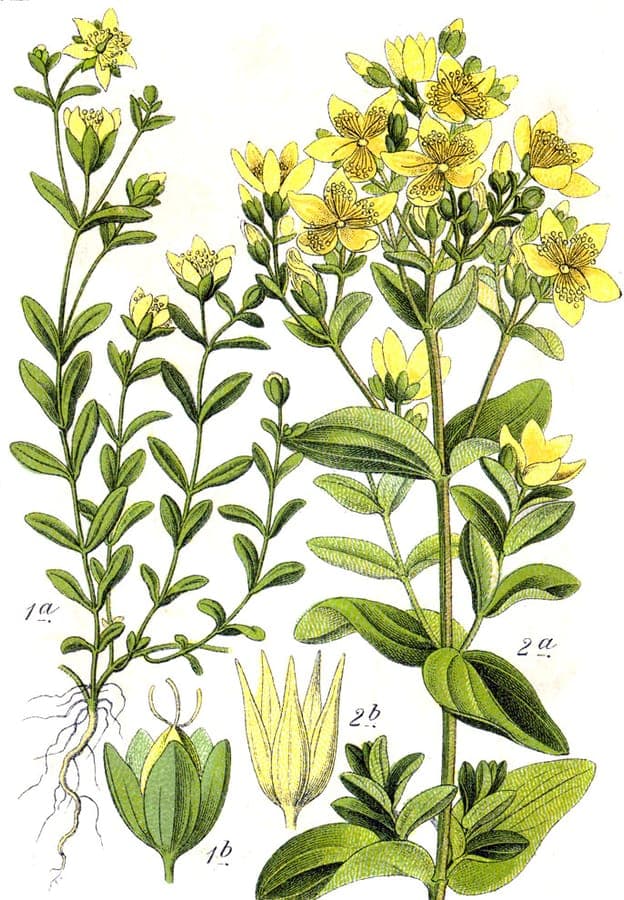
Johann Georg Sturm (Painter: Jacob Sturm) / Public domain, via Wikimedia Commons
St. Peter's-wort: complete guide
Hypericum tetrapterum
¿Quieres ver St. Peter's-wort: complete guide en tu jardín?
1 minuto, sin tarjeta de crédito
Overview
St. Peter's-wort (Hypericum tetrapterum), native to Europe through the Caucasus and Mediterranean through Iran, is a unique moisture-loving perennial. Growing 40–80 cm tall, it thrives in USDA zones 5–9 and is particularly suited to wetland and water gardens. The most striking feature is the four wing-like, linear ridges on the stems - hence the name 'tetrapterum' (four-winged).
On gardenworld.app, St. Peter's-wort is ideal for water edges, bog gardens, retention ponds, and wet borders where you want yellow colour from a plant that thrives in conditions other species find challenging. It's the perfect solution for perpetually moist ground.
Appearance & bloom cycle
The plant forms upright, four-winged stems with oval, mid-green leaves 1–3 cm long. The four wing structures are highly distinctive - these are linear and give the plant a very characteristic, almost architectural appearance. From July through September, numerous small, yellow flowers about 1.5 cm across appear in various flower clusters.
Flowers share the same long stamens characteristic of other St. John's-worts. Following flowers, red seed capsules develop, turning brown. These remain highly ornamental and feed overwintering birds. The wing structures remain visible late into the season.
Ideal location
St. Peter's-wort thrives on moist to wet sites (light level 8–10 out of 10). While it tolerates full sun to partial shade, it's most at home alongside water - at pond edges, along ditches, in boggy areas, and retention ponds. It can even grow in shallow water. This is a plant for wet ground, never for dry borders.
On gardenworld.app, use St. Peter's-wort as a key component in water gardens, boggy landscapes, and wet landscaping schemes.
Soil requirements
St. Peter's-wort prefers wet to very wet soil, even muddy or swampy conditions. pH can vary between 5.5 and 7.5. This plant thrives on nutrient-rich bog sand and silt. Unlike other St. John's-worts, this species actually welcomes waterlogging - it's ideal.
Plant it at pond edges, along ditches, or in wet garden beds where soil remains moist most of the year. Boggy, poorly-drained ground that would kill other plants is perfect here.
Diseño gratis
¿Quieres ver St. Peter's-wort: complete guide en tu jardín? Crea un diseño gratis ahora.
Watering
Supplemental watering is unnecessary - this plant needs the opposite. Ensure the soil stays consistently moist. During very dry summers without supplemental irrigation, the plant may wilt. This is a plant you're more likely to over-water than under-water.
If planting in a drier bed, provide supplemental moisture via drip irrigation or regular hand-watering. Ideally, this plant remains permanently on wet sites.
Pruning
Pruning is minimal. In spring (March–April), old stems from the previous year can be removed. This encourages fresh, dense growth. After flowering, spent flower clusters can be trimmed, but the red seed capsules are highly ornamental and best left.
In autumn (October–November), withered stems may be removed. If the plant spreads unwantedly along pond edges, it can be cut back.
Maintenance calendar
- January: Monitor water levels. Plant is dormant.
- February: No action unless very old stems present.
- March: Remove previous season stems. Ensure adequate water.
- April: Monitor growth. Plant begins active growth.
- May: Check moisture levels. Plant grows rapidly.
- June: Prepare for flowering. Maintain adequate moisture.
- July–August: Peak bloom. Minimal maintenance.
- September: Flowering subsides. Leave seed capsules.
- October: Red seed capsules now highly ornamental.
- November–December: Senescence. Dead stems can be removed.
Winter hardiness
St. Peter's-wort is hardy to USDA zone 5 (-30°C), making it reliably winter-hardy throughout much of Europe. In wet conditions, ice may form around the plant, but this causes no harm. The plant regenerates vigorously from underground roots. In mild winters, substantial foliage persists.
Companion plants
Combine with other moisture-loving plants: Lysichitum, Filipendula, Lythrum, Astilboides. In water gardens, associate with aquatic plants like Sagittaria, Acorus, and dwarf ferns. For contrast, incorporate silver-grey partners such as Eleocharis (silver water grass). For woodland edges, pair with Salix and Alnus species.
Avoid dry, desert-like companions entirely.
Closing
St. Peter's-wort is indispensable for wet gardens and waterside plantings. With its four-winged stems, it's architecturally interesting year-round. Plant at water edges, in bogs, or in wet beds. Available from specialist water plant nurseries. Use gardenworld.app to design combinations with other moisture-loving plants for natural, dynamic water gardens and wetland landscapes where biodiversity flourishes.
¿Quieres ver St. Peter's-wort: complete guide en tu jardín? Crea un diseño gratis ahora.
Sube una foto, elige un estilo y obtén un diseño fotorrealista con lista de plantas en menos de un minuto.
Más de 10.000 jardines diseñados
Sin tarjeta de crédito


Plantas similares
Hypericum coris: complete guide
Hypericum coris
Complete guide to Hypericum coris, the heath-leaved St John's wort from the Alps: location, soil, watering and rock gardens.
St. Peter's-wort: complete guide
Hypericum crux-andreae
St. Peter's-wort is a low-growing North American shrub with yellow flowers, ideal for acidic, damp soil and naturalistic borders.
Hypericum densiflorum: complete guide
Hypericum densiflorum
Hypericum densiflorum is a dense-flowering American shrub with bright yellow summer blooms, well suited to damp gardens, rain gardens, and pollinator borders.