
Didier Descouens / CC BY-SA 4.0, via Wikimedia Commons
St. John's-wort: complete guide
Hypericum perforatum
¿Quieres ver St. John's-wort: complete guide en tu jardín?
1 minuto, sin tarjeta de crédito
Overview
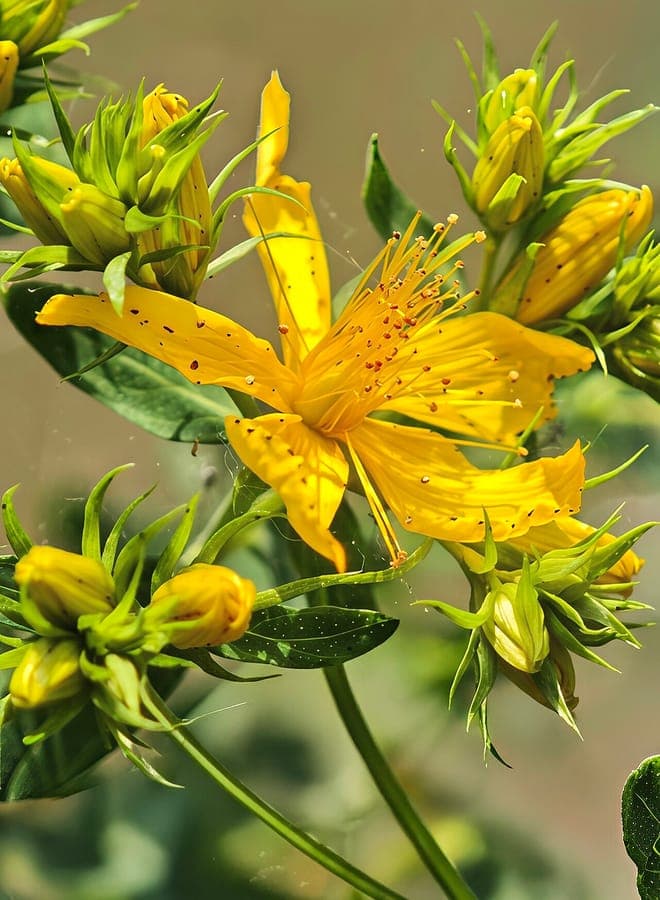
St. John's-wort (Hypericum perforatum), also known as Klamathweed, is one of the toughest and most widespread perennials in Europe and beyond. Native across Macaronesia, Europe to China, North Africa, and Southwest Sudan, this 40–80 cm tall plant thrives in USDA zones 4–9 and flowers with near-certain reliability. Golden-yellow blooms adorned with distinctive black-spotted petals, combined with reddish-brown seed capsules that persist until winter, make it visually engaging from June through October.
On gardenworld.app, St. John's-wort is ideal for sunny, dry borders where you want prolific yellow colour. It pairs beautifully with ornamental grasses, sun-loving perennials, and naturalistic plantings, attracting numerous pollinating insects.
Appearance & bloom cycle
The plant forms dense, upright, branching stems with narrow, oval leaves 1–3 cm long. Foliage is dark green with characteristic transparent dots (hence the botanical name 'perforatum'). From June through October, dense clusters of golden-yellow flowers, about 2–3 cm across, cover the plant. Each bloom is distinctively marked with black spots along petal margins.
Following flowers, reddish-brown seed capsules develop, turning deep chocolate-brown by autumn. These remain ornamental through winter. The plant self-seeds readily if you wish, but is not invasive in temperate climates.
Ideal location
St. John's-wort thrives in full sun (light level 9–10 out of 10). With a minimum of 6 hours direct sunlight daily, flowering is abundant and growth compact. In partial shade, stems become lax and flowering diminishes. This is a plant for full-sun sites - it excels on sunny, dry slopes, gravel pathways, or south-facing borders. Though wind-tolerant, protect from extreme exposure.
On gardenworld.app, use St. John's-wort as the core summer-flowering component in naturalistic plantings.
Soil requirements
St. John's-wort is remarkably tolerant of poor soil. It thrives on infertile sand, gravel, and stone just as readily as moderately fertile ground. Ideal is well-drained soil with pH 5–8. On heavy clay, incorporate sand to improve drainage. The plant detests waterlogging; place it on raised beds if you experience wet winters.
On very nutrient-rich soil, growth becomes sluggish. Sterile, dry soils are actually perfect for this species.
Diseño gratis
¿Quieres ver St. John's-wort: complete guide en tu jardín? Crea un diseño gratis ahora.
Watering
Once established, St. John's-wort is extraordinarily drought-tolerant. Young plants require regular watering during their first growing season until deep roots develop. After year one, supplemental water is practically unnecessary, even during dry summers. Excess moisture invites root rot and reduces flowering.
This plant is designed for dry, Mediterranean-like conditions. Water only during extreme drought (more than 4 weeks without rain).
Pruning
Pruning is minimal. In early spring (late March), remove withered stems from the previous year. This promotes healthy, dense growth. After flowering, stems can be cut back for neatness, but consider leaving them - seed capsules are ornamental. At season's end (November), cut all stems back to 15 cm above ground to rejuvenate the plant.
Maintenance calendar
- January: Plant is dormant. No action required.
- February: No action unless severe frost damage is visible.
- March: Remove dead stems from previous year.
- April: Monitor growth. No feeding needed on poor soils.
- May: Prepare for flowering. Check watering needs.
- June–August: Peak bloom. Minimal maintenance.
- September: Flowering subsides. Leave seed capsules.
- October: End of bloom. Optional cleanup.
- November: Cut back dead stems. Prepare for dormancy.
- December: Dormant. No care needed.
Winter hardiness
St. John's-wort is hardy to USDA zone 4 (-30 to -35°C), making it reliably winter-hardy throughout the UK and much of Europe. Stems may freeze back in the harshest winters, but the plant regrows vigorously from its roots - a desirable trait that keeps it compact. In mild winters, substantial foliage persists.
Companion plants
Combine with other sun-loving perennials: Rudbeckia, Heliopsis, Achillea. Ornamental grasses such as Stipa, Festuca, and Miscanthus provide fine textural contrast. For colour contrast, include blue flowers (Salvia, Veronica) or purple-leaved cultivars. In Mediterranean plantings, pair with Santolina, Teucrium, and silver-leaved Artemisia.
Avoid shade-loving plants - this species demands sun.
Closing
St. John's-wort is indispensable for sunny, dry gardens. With minimal care, it delivers years of prolific golden-yellow flowers. Plant in full sun on well-drained soil. Available at most garden centres. Use gardenworld.app to design sunny borders combining St. John's-wort with grasses and blue flowers for maximum impact. A plant that grows almost anywhere once established.
¿Quieres ver St. John's-wort: complete guide en tu jardín? Crea un diseño gratis ahora.
Sube una foto, elige un estilo y obtén un diseño fotorrealista con lista de plantas en menos de un minuto.
Más de 10.000 jardines diseñados
Sin tarjeta de crédito


Plantas similares
Hypericum coris: complete guide
Hypericum coris
Complete guide to Hypericum coris, the heath-leaved St John's wort from the Alps: location, soil, watering and rock gardens.
St. Peter's-wort: complete guide
Hypericum crux-andreae
St. Peter's-wort is a low-growing North American shrub with yellow flowers, ideal for acidic, damp soil and naturalistic borders.
Hypericum densiflorum: complete guide
Hypericum densiflorum
Hypericum densiflorum is a dense-flowering American shrub with bright yellow summer blooms, well suited to damp gardens, rain gardens, and pollinator borders.