
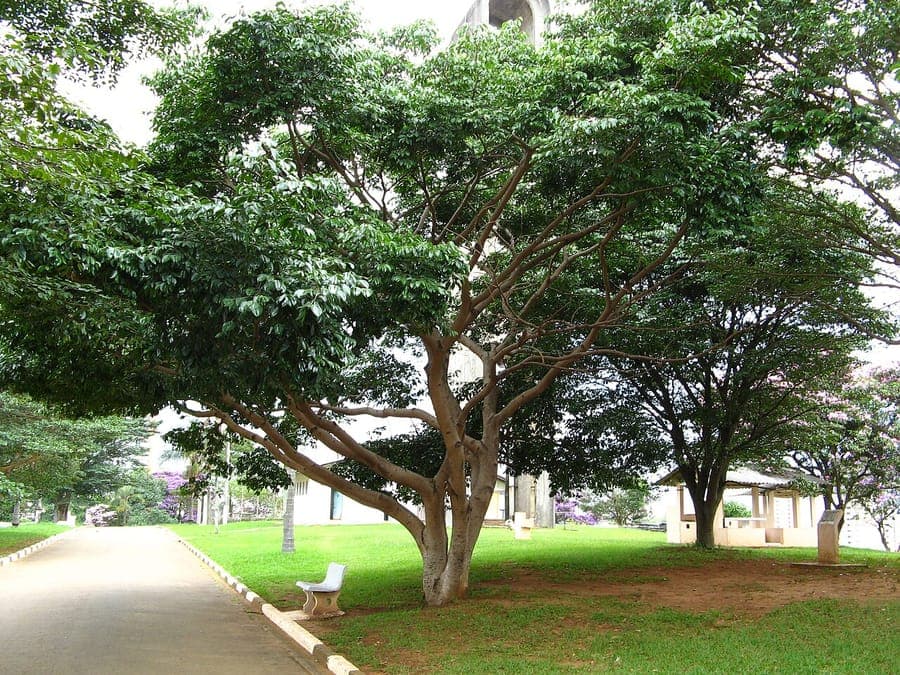
mauroguanandi / CC BY 2.0, via Wikimedia Commons
Hymenaea courbaril: complete guide
Hymenaea courbaril
¿Quieres ver Hymenaea courbaril: complete guide en tu jardín?
1 minuto, sin tarjeta de crédito
Overview
Hymenaea courbaril, commonly known as Courbaril, Jatoba, or Brazilian Copal, is an impressive tropical tree ranging from Mexico to South America. This is a slow-growing specimen producing timber of exceptional quality, making it highly valued in the wood processing industry. The tree can reach 40 meters high and has a long lifespan with a very dense canopy.
Beyond its timber value, the tree is also interesting for medicinal applications, particularly the resin traditionally used in herbal medicine. The tree grows slowly but is renowned for its resilience and air-purifying properties.
Appearance and Bloom
Hymenaea courbaril has large, compound leaves with two large, glossy leaflets on each stem. The leaves are dark green, giving the tree an elegant, light-transmitting canopy compared to many other tropical species. The tree produces small, yellow flowers in dense clusters designed for insect pollination.
The fruits are long, rectangular pods reaching 10-30 cm in length, dark brown in color. The pods contain sweet pulp and hard-shelled seeds that mature slowly. The tree blooms during warm seasons and produces fruits dependent on natural dispersal mechanisms.
Ideal Location
The Courbaril thrives in warm, tropical climates with abundant sunlight. Provide direct sunshine throughout the day for optimal growth. The tree is more shade-tolerant than many tropical species, especially when young, but flowers and fruits better in full sun locations.
The tree is very frost-sensitive and doesn't tolerate temperatures below 10 degrees Celsius well. This makes greenhouse cultivation necessary in temperate climates. Protection from strong winds is beneficial, especially for young specimens.
Soil Requirements
Hymenaea courbaril grows best in deep, well-drained soil with sufficient nutrients. The tree is not particularly fussy about pH but prefers neutral to slightly acidic terrain (pH 5.5-7.5). Ensure good drainage by adding sand and organic material.
In container culture, a mixture of garden soil, coconut coir, and perlite is excellent. Annual top-dressing with leaf mold supports growth and flowering/fruiting.
Diseño gratis
¿Quieres ver Hymenaea courbaril: complete guide en tu jardín? Crea un diseño gratis ahora.
Watering
Provide regular watering during the growing season but avoid waterlogging. The tree tolerates drought periods better as it matures. In container culture, you must be more careful with moisture management than in ground cultivation.
In winter, significantly reduce watering, especially if temperatures drop around 15 degrees Celsius. Monitor moisture content regularly, especially in containers.
Pruning
The Courbaril requires minimal pruning if you want to maintain a natural form. Remove only dead or damaged branches. Young trees can be carefully pruned to encourage strong tree structure, but be cautious and minimal with pruning operations.
The tree grows slowly and recovery from heavy pruning takes considerable time. A minimalist approach is better.
Maintenance Calendar
- March-April: Growing period begins, gradually increase watering
- April-June: Peak growth period, regular feeding with slow-release fertilizer
- July-August: Flowering and fruiting period, maintain adequate watering
- September: Stabilize growth, water less frequently
- October-November: Prepare for dormancy, minimal feeding
- December-February: Rest period, sparse watering, no fertilizing
Winter Hardiness
Hymenaea courbaril is completely frost-sensitive and cannot survive outdoors in temperate European climates. Minimum survival temperature is approximately 10-15 degrees Celsius. Temperatures below 5 degrees Celsius will cause serious damage or death.
This tree requires greenhouse cultivation in Northern and Central Europe. In very warm Mediterranean regions, possibly protected from frost, outdoor placement might be considered, but frost protection is essential.
Companion Plants
The Courbaril grows in tropical forests alongside other large trees. In garden cultivation, combine this specimen with other heat-loving plants:
- Other tropical fruit trees
- Shade-tolerant understory plants
- Large-leaved plants
- Epiphytes and vines
This creates a natural tropical ecosystem.
Conclusion
The Courbaril is a very interesting and valuable tree for those wanting to grow a true tropical timber tree. Despite slow growth, it's worth the effort for this durable and useful specimen. With patience and proper warmth, you'll cultivate an impressive tree.
Find seedlings at major garden centers. For more inspiration, visit gardenworld.app. Start your garden project on gardenworld.app, where personal designs await!
¿Quieres ver Hymenaea courbaril: complete guide en tu jardín? Crea un diseño gratis ahora.
Sube una foto, elige un estilo y obtén un diseño fotorrealista con lista de plantas en menos de un minuto.
Más de 10.000 jardines diseñados
Sin tarjeta de crédito


Plantas similares
Tall Silky Lupine: complete guide
Lupinus elatus
Tall silky lupine is a fast-growing Californian perennial with silvery foliage and blue-purple flower spikes, ideal for a prairie-style garden.
Garfield Lupine: complete guide
Lupinus garfieldensis
The Garfield lupine is a rare, fast-growing American perennial for alkaline, dry grassland gardens, with striking blue flower spikes.
Lupinus elegans: complete guide
Lupinus elegans
Lupinus elegans, the elegant lupine, is a spectacular blooming plant from Mexico with blue flower spikes. Care, cultivation and garden use.