
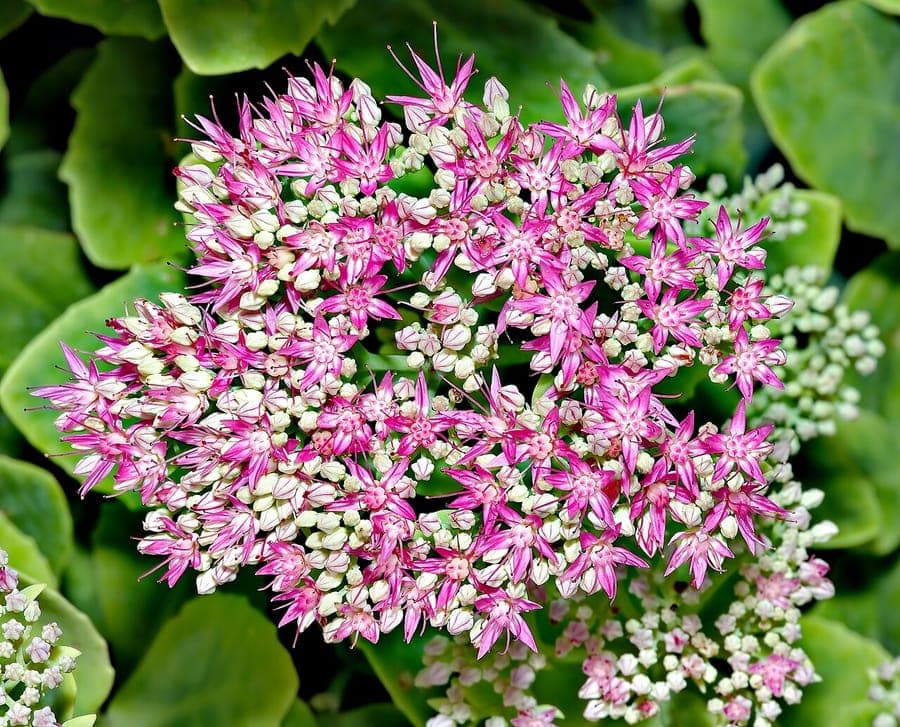
André Karwath aka Aka / CC BY-SA 2.5, via Wikimedia Commons
Showy stonecrop: complete guide
Hylotelephium spectabile
¿Quieres ver Showy stonecrop: complete guide en tu jardín?
1 minuto, sin tarjeta de crédito
Overview
Hylotelephium spectabile, commonly known as Showy stonecrop or Autumn sedum, is a spectacular hardy succulent originating from China, Korea, and Russia. This plant from the stonecrop family (Crassulaceae) is a must-have for those who love flowering succulents - its pink to red flower clusters appear from August to October precisely when many borders fade.
At gardenworld.app, we love Showy stonecrop in low-maintenance borders, drought-resistant landscapes, and even on roofs and in containers. The plant grows as a compact shrub reaching 40-60 cm and offers not only spectacular flowers but also attractive structural greenery.
Appearance and flowering period
Hylotelephium spectabile grows as a compact, densely branched shrub with fleshy green foliage. Leaves are lance-shaped, blue-green to dark green, and grow in opposite pairs along thick stems. During the growing period (May-September), large flat flower clusters form at the top of all stems, measuring 10-15 cm in diameter.
Flowers begin green (June-July), gradually turn pink (August), and reach peak red in September-October. Individual flowers are about 1 cm across, pink to red with yellow stamens, and very attractive to butterflies and bees. After frost the flower clusters turn chestnut-brown - still highly decorative through January.
Ideal location
Showy stonecrop thrives optimally in full sun with at least 6-8 hours of direct sunlight daily. Partial shade is possible but results in fewer blooms. The plant tolerates wind well and even grows on windy roofs. For garden design: place it in borders where autumn light turns gold-red - the contrast is spectacular.
The plant grows both in open borders and in large containers (at least 30 cm deep). For gardenworld.app designs, we love using it as a solitary accent or in groups of 3-5 specimens.
Soil and drainage
Showy stonecrop wants well-draining soil - this is critical. Heavy clay soils must be significantly lightened with sand, gravel, or potting soil. pH range: 6.0-7.5. The plant tolerates moderately fertile soils well; excess feeding leads to weak growth.
In containers: use cactus potting soil or a mixture of garden soil (1/3), sand (1/3), and perlite or gravel (1/3). Drainage must be ideal - rot is the biggest enemy.
Watering and feeding
Showy stonecrop is very drought-tolerant. During growth (May-October) water when soil surface feels dry. In summer: once weekly in normal summers, every two weeks in dry summers. In containers: check twice weekly in July-August.
Important: more water in autumn when plant grows toward bloom - underfeeding leads to fewer flowers. Feeding: once monthly (May-August) with light tomato or cactus fertilizer.
Diseño gratis
¿Quieres ver Showy stonecrop: complete guide en tu jardín? Crea un diseño gratis ahora.
Maintenance and pruning
Maintenance is minimal. Remove wilted leaves; peel dead leaf bases to prevent disease. After frost (February-March) cut the plant hard back to about 5-10 cm height - it will then grow bushy again.
Important: don't prune earlier (October-January) because the winter structure looks even better. Brown flower clusters in winter provide shelter for insects and look decorative.
Maintenance calendar
May: first inspection, remove loose leaves
June-July: monthly feeding, regular watering (not excessive)
August-September: increase feeding, abundant water during bloom
October: final feeding, water as needed
November-January: no maintenance, enjoy winter structure
February-March: hard prune back to 5-10 cm
Winter hardiness
Showy stonecrop is fully winter-hardy to USDA zone 3 (-40°C). The plant dies back aboveground in winter but regrows each spring from thick underground roots. First frost (October to -15°C) doesn't damage the plant; rather, frost gives the flowers even more color.
In extremely cold winters (continuous below -25°C) roots can freeze in poor drainage soil. Therefore: good drainage is essential for winter survival.
Companions and associations
Showy stonecrop makes a fine backdrop for other perennials. Combine it with:
- Asters (September asters, very small white or pink)
- Chrysanthemum (autumn chrysanthemum)
- Gaultheria (winter berries, red foliage)
- Grass species (Miscanthus, Panicum)
The combination of pink stonecrop with white asters and yellow chrysanthemum is a classic autumn border.
Propagation
Showy stonecrop propagates easily from cuttings: in May-June cut 5 cm stems, let them dry for a few hours, then plant in dry potting soil. After 2-3 weeks roots form; after 8-10 weeks plants are large enough to transplant.
Pests and diseases
The plant is very healthy. Occasional issues:
- Powdery mildew (rarely): prevent with good air circulation
- Root rot (poor drainage): unfortunately fatal - prevent with good drainage
- Slugs (young leaves): protect with copper wire or shields
Availability
Showy stonecrop is popular in the garden trade. Available at garden centers throughout Europe. Prices: 5-15 euros per plant (size 40-60 cm). For large orders, specialized succulent nurseries are options.
Longevity
Showy stonecrop is very durable for long periods. The same specimen can last 15-20+ years. After several years your plant may bloom less - regeneration via hard pruning (every 3-4 years) helps.
Conclusion
Showy stonecrop is the succulent for those wanting color and flowers without much work. With minimal maintenance, frost-hardiness, and beautiful autumn flower clusters, it offers everything you're looking for. Plant it this spring on gardenworld.app and enjoy next autumn a pink-red celebration in your garden.
¿Quieres ver Showy stonecrop: complete guide en tu jardín? Crea un diseño gratis ahora.
Sube una foto, elige un estilo y obtén un diseño fotorrealista con lista de plantas en menos de un minuto.
Más de 10.000 jardines diseñados
Sin tarjeta de crédito

