
Wikimedia Commons / CC BY-SA 3.0, via Wikimedia Commons
Houseleek: complete guide
Sempervivum tectorum
¿Quieres ver Houseleek: complete guide en tu jardín?
1 minuto, sin tarjeta de crédito
Overview
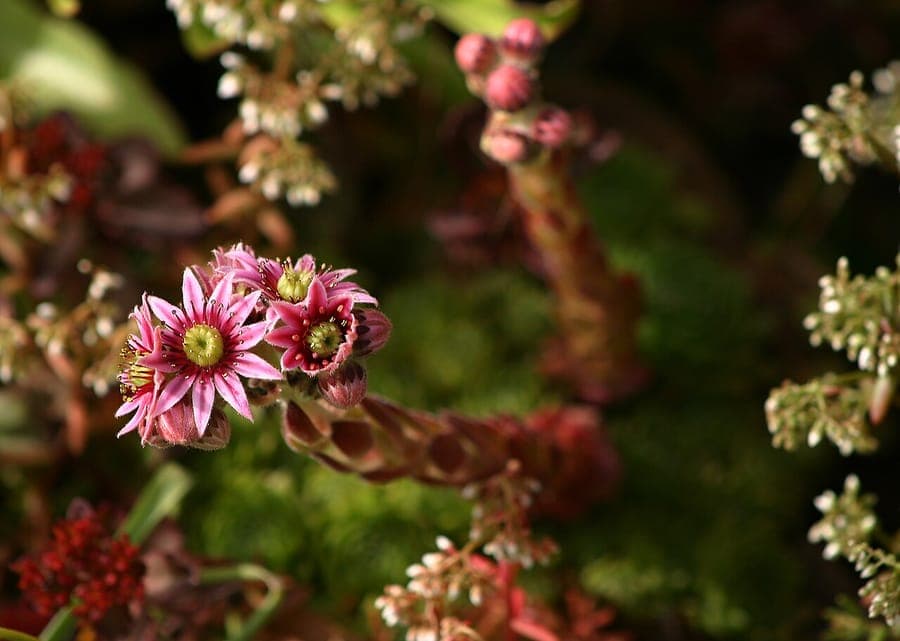
Houseleek (Sempervivum tectorum) is a legendary succulent with centuries of history. Literally planted on roofs as protective charms, this species remains the gold standard for rock gardens and extensive green roofs. Rosettes are substantial (5-8 cm diameter) with broad, thick leaves ranging from fresh green to deep crimson. July brings raspberry-red flowers on 20-35 cm tall stems.
Appearance and bloom cycle
Leaves are distinctly broader and more robust than relatives, with pronounced tips. Color ranges from chartreuse to deep burgundy, often tipped deep red. Foliage feels thick, smooth, and slightly waxy. Flowering runs July through August. Blooming rosettes produce sturdy stems densely packed with pink to coral-red flowers. The architecture is strikingly symmetrical and sculptural.
Ideal location
Full sun essential - minimum 6-8 hours direct daily light. More sunlight intensifies red pigmentation. Houseleek is absolutely hardy to -35°C (USDA zone 4) and tolerates heavy snow and frost without injury. Ideal for living roofs, green roof systems, rock garden walls, roof gutters, and exposed windswept positions. Established plants require virtually no aftercare.
Soil requirements
Poor soil is actually beneficial. Excellent drainage is mandatory: mix 50% coarse gravel, 30% sharp sand, 20% soil. On roofs: specialized green roof substrate with water-holding capacity but rapid drainage. Standard roof substrate works, enhanced with additional grit. pH 4-7 (acid to neutral) optimal. On clay-heavy sites, plant in raised beds with custom substrate.
Watering
Minimal water once established. During the first year after planting, maintain slight moisture for root establishment. After that, water withdrawal. Most moisture comes from dew and rainfall. Excessive watering causes root rot and death. Only in extreme drought (3+ weeks without rain) apply water once, cautiously.
Diseño gratis
¿Quieres ver Houseleek: complete guide en tu jardín? Crea un diseño gratis ahora.
Pruning
Pruning is unnecessary. Remove spent flower stems after bloom for tidiness. Old exhausted outer rosettes can gently be pulled away. Keep abundant offsets for density - Houseleek grows into dense mats of 30-50 cm diameter within several years.
Maintenance calendar
April-May: Growth season begins. Check roof drainage systems. Set individual offsets for propagation.
June-July: Pre-bloom vigor. Maximum growth activity. No watering needed.
July-August: Flowering period. Stunning pink-red flower clusters. No water.
September-October: Blooms fade. Plant prepares dormancy. No maintenance required.
November-March: Complete dormancy. Frost-hardiness activated. Overwinters unprotected.
Winter hardiness
One of the hardiest Sempervivum species: to -35°C (USDA zone 4). Houseleek overwinters flawlessly across the UK, Germany, France, and Benelux without protection. Heavy snow causes no damage. Good drainage remains key - standing water is the only threat.
Companion plants
Pair beautifully with S. montanum, S. arachnoideum, and diverse Sedum species. Small infill plants like Jovibarba and alpine Phlox fill gaps. For large roof applications, spacing 25-30 cm apart creates uniform coverage.
Closing
Houseleek is the workhorse of rock gardens and green roofs - dependable, permanent, and elegant. Traditional choice (genuine thatch-roof heritage) meets modern sustainability in contemporary roof greening. Quality specimens at major garden centers. To visualize Houseleek within a complete roof design or front garden scheme, use gardenworld.app to quickly prototype compositions showing multiple color varieties and companion combinations. The tool helps you see seasonal development and mature spacing patterns.
¿Quieres ver Houseleek: complete guide en tu jardín? Crea un diseño gratis ahora.
Sube una foto, elige un estilo y obtén un diseño fotorrealista con lista de plantas en menos de un minuto.
Más de 10.000 jardines diseñados
Sin tarjeta de crédito


Plantas similares
Sedum nevadense: complete guide
Sedum nevadense
Discover Sedum nevadense, the stunning alpine stonecrop from the Pyrenees. Expert care tips, growing requirements, and design ideas for rock gardens.
Aizoon stonecrop: complete guide
Phedimus aizoon
Everything about Phedimus aizoon - the frost-tolerant aizoon stonecrop from Siberia with bright yellow flowers. Planting, care and garden use.
Roseroot: complete guide
Rhodiola rosea
Everything about roseroot (Rhodiola rosea): a tough hardy succulent ideal for rock gardens, green roofs, and dry sunny positions.