
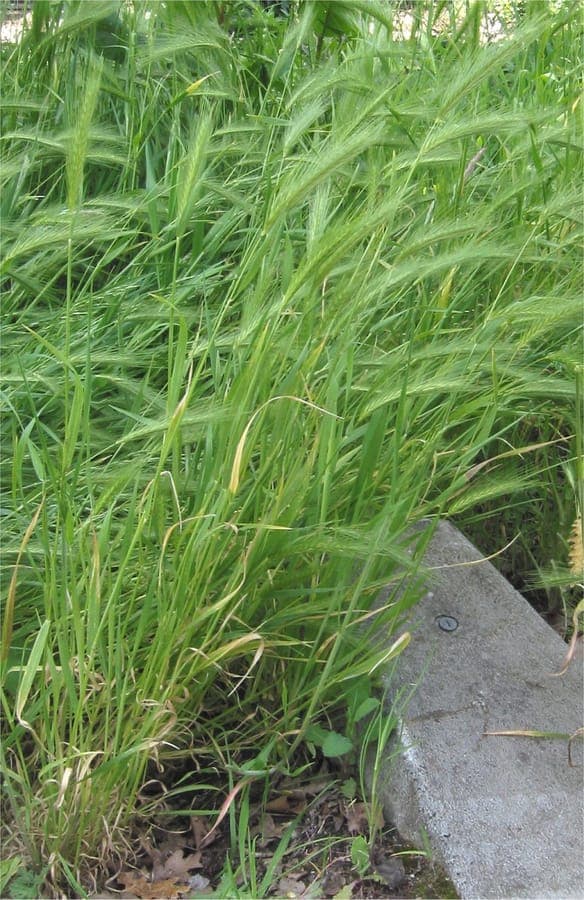
Rasbak / CC BY-SA 3.0, via Wikimedia Commons
False Barley: complete guide
Hordeum murinum
¿Quieres ver False Barley: complete guide en tu jardín?
1 minuto, sin tarjeta de crédito
Overview
False Barley, scientifically known as Hordeum murinum, is an annual grass from the Poaceae family. This wild grass species naturally grows in Mediterranean regions through Central Asia to West Himalaya. With its distinctive spiky ears resembling barbed wire and its resilience on poor soils, False Barley is an intriguing plant for wild gardens. This grass plays an ecological role in semi-arid landscapes.
Appearance and Bloom
False Barley reaches heights of 20-40 cm and forms tufted, light green to yellow-green vegetation. The leaves are narrow and pointed, typical for grasses. Distinctive ears appear from April to May and are clearly recognizable by their spiky appearance, similar to barley. Each ear is approximately 4-6 cm long and bears spikelets with long awns. This gives the plant a striking, almost architectural appearance.
Ideal Location
False Barley grows best in full sun and open, exposed locations. This grass thrives in dry and warm sites. Ideal for Mediterranean and continental areas, dry border edges and weed suppression in paved gardens. Winter-hardy to USDA 5, suitable for Southern Benelux and Central Europe. Plant it in windy places for dramatic effect.
Soil Composition
False Barley grows best on nutrient-poor, dry soils with excellent drainage. Sandy, gravelly and chalky soils are ideal. This grass avoids wet soils and standing water. Even very poor soils are suitable. Extra feeding is not needed and can stimulate overgrowth.
Diseño gratis
¿Quieres ver False Barley: complete guide en tu jardín? Crea un diseño gratis ahora.
Watering
Hordeum murinum has very low water needs. Once established, extra watering is not needed. During the first growing period (first 4 weeks), water moderately. Afterwards, completely self-reliant. Drought is no problem. In very wet periods, improved drainage can help.
Pruning and Maintenance
False Barley requires virtually no maintenance. The plant is annual and dies after seed set. As a self-seeder, it creates the next generation, so controlling seed dispersal may be needed. Dead remains in autumn can be removed. No regular pruning required.
Maintenance Calendar
March-April: Emergence and growth May: Peak flowering and ear development June-July: Seed maturation August-September: Seed dispersal, plant death October-November: Cleanup and preparation December-February: Winter period, no maintenance
Winter Hardiness
False Barley is winter-hardy to -15°C (USDA 5). As an annual grass, it does not survive winters. It renews itself through self-seeding in the following spring. In milder climates, spontaneous seed growth may occur.
Companion Plants
False Barley combines well with other drought-loving grasses and herbaceous plants. Ideal in wild borders, xeric gardens and Mediterranean planting schemes. Plant spacing: 20-30 cm. Creates natural-looking vegetation.
Closing
False Barley brings movement and wildness to gardens with dry, poor soils. With no maintenance and high ecological value, it's a great choice for natural gardens. Discover how to integrate wild grasses in your front yard on gardenworld.app. Create an authentic, semi-arid garden atmosphere with this distinctive grass via gardenworld.app.
¿Quieres ver False Barley: complete guide en tu jardín? Crea un diseño gratis ahora.
Sube una foto, elige un estilo y obtén un diseño fotorrealista con lista de plantas en menos de un minuto.
Más de 10.000 jardines diseñados
Sin tarjeta de crédito


Plantas similares
Sporobolus pungens: complete guide
Sporobolus pungens
Sporobolus pungens is a stoloniferous Mediterranean coastal grass with outstanding salt and drought tolerance, perfect for seaside and dry gardens.
Mediterranean aegilops: complete guide
Aegilops biuncialis
Everything about Aegilops biuncialis, a Mediterranean annual grass with ornamental spikes and outstanding drought tolerance for dry gardens.
Silver bluestem: complete guide
Bothriochloa saccharoides
Full guide to Bothriochloa saccharoides (silver bluestem): site, soil, watering, winter hardiness, pruning, and garden companions.