
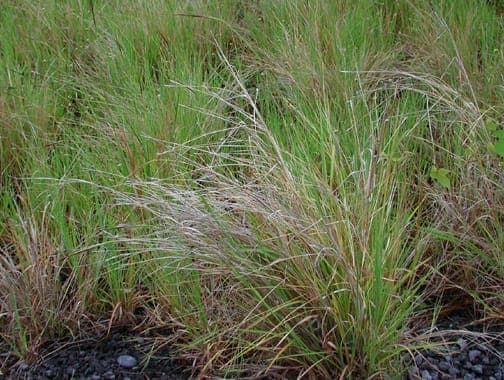
Wikimedia Commons / Public domain, via Wikimedia Commons
Heteropogon contortus: complete guide
Heteropogon contortus
¿Quieres ver Heteropogon contortus: complete guide en tu jardín?
1 minuto, sin tarjeta de crédito
Overview
Heteropogon contortus, commonly called black spear grass, is a warm-season ornamental grass native to tropical and subtropical climates worldwide, with distributions throughout much of Africa, Asia, Australia, and the Mediterranean region. This decorative grass species is prized for its fine foliage and distinctive twisted spikelets (seed heads) that range from black to reddish-brown.
In gardens, Heteropogon contortus provides elegant movement, texture, and extended seasonal interest in dry, sunny environments. It's a valuable plant for modern gardens, dry gardens, or xeriscape designs.
Appearance & bloom
Heteropogon contortus is an upright, tightly clumping ornamental grass reaching 60 to 100 centimeters in height. Fine, linear foliage forms a compact base, delicately similar to other decorative grasses. The foliage is usually green though it may develop bronze or purplish tones in full sun.
From August through October, characteristic spikelets appear on long, graceful stems. The spikelets are distinctly curved or twisted - the characteristic that gave the plant its "contortus" name. They're black to reddish-brown, highly decorative against the light foliage.
These twisted seed heads persist for months through fall and winter, providing extended seasonal interest. They attract birds and provide food and nesting material.
Ideal location
Heteropogon contortus thrives in full sun on warm, sunny sites. This is a warm-season grass that only truly develops well during extended, hot growing periods. A minimum of 6 to 8 hours of direct sunlight daily is necessary.
Plant in very sunny, warm spots: against south or west-facing walls, in the hottest portion of dry gardens, or on sunny slopes. The grass tolerates reflection from walls and paving, making it ideal for urban gardens.
In cold climates, this grass may struggle with short growing seasons. Plant in the warmest aspect of your garden or treat as an annual in very cold regions.
Soil
Heteropogon contortus thrives in well-draining, sandy to gravelly soil. This is a grass of dry savannas and grasslands, so excess water is worse than nutrient deficiency. Heavy clay requires substantial improvement with sand and gravel.
The plant is extremely unfussy about fertility and grows well in poor soil. Indeed, over-feeding can produce unwanted lush growth. A light, normal garden soil is suitable.
Soil pH can range from acidic to neutral to slightly alkaline. The plant tolerates diverse conditions provided water drains well. Drainage is absolutely essential.
Diseño gratis
¿Quieres ver Heteropogon contortus: complete guide en tu jardín? Crea un diseño gratis ahora.
Watering
Once established, Heteropogon contortus is very drought-tolerant. This is a grass from dry regions with deep roots. Water only during prolonged drought or during the first growing season.
For young plants, water regularly but moderately during the first season to secure root development. Subsequently, drastically reduce frequency. Check soil moisture - water only when soil feels dry to touch.
In very hot climates, the grass may occasionally benefit from water during exceptional drought periods, but this is rarely necessary. Overwatering is critical danger - ensure water drains away.
Pruning
Heteropogon contortus requires minimal pruning. Allow the plant to develop to its natural form. Remove dead or damaged foliage as needed.
In spring, after the cold season passes, you can remove damaged stems. Otherwise, let the grass maintain its natural form. The grass naturally creates attractive clumps.
After winter, cut back dead material. Some gardeners cut the grass in late spring back to a few centimeters for fresher growth, though this isn't necessary.
Maintenance calendar
Spring: check for winter damage; remove dead stems. Plant new specimens in May-June. Summer: water only in exceptional drought; enjoy developing grass. Autumn: bloom lasts August through October; enjoy twisted, blackish-brown spikelets. Winter: no maintenance; plant overwinters in mild to temperate climates; protect in extreme cold.
Winter hardiness
Heteropogon contortus is winter-hardy in zones 8-11 (down to approximately -5 degrees Celsius). In milder climates, it overwinters unprotected. In colder regions where temperatures drop below -10 degrees:
- Plant in sheltered, warm corners
- Mulch heavily in autumn
- Treat as annual in very cold zones
- Consider containers that can be moved indoors
Wet winters are more problematic than cold. Ensure perfect drainage.
Companion plants
Heteropogon contortus pairs well with:
- Other warm-season grasses like Panicum and Bouteloua
- Drought-tolerant shrubs like artemisia and sage
- Red or purple-foliaged plants for color contrast
- Warm-season flowering perennials like coreopsis and rudbeckia
- Rocky elements and dry stone paths
Works best in modern, minimalist designs with significant negative space. Group grass flowers for greater impact.
Closing thoughts
Heteropogon contortus is an elegant ornamental grass providing extended seasonal interest with minimal care. Its characteristic twisted spikelets and moving foliage offer years of beauty. Plant in full sun, well-draining soil, warm climate, and you've secured a self-sufficient plant that attracts birds and persists for years.
Available at specialized grass retailers and garden centers. For warm-season grasses, visit www.gardenworld.app.
¿Quieres ver Heteropogon contortus: complete guide en tu jardín? Crea un diseño gratis ahora.
Sube una foto, elige un estilo y obtén un diseño fotorrealista con lista de plantas en menos de un minuto.
Más de 10.000 jardines diseñados
Sin tarjeta de crédito


Plantas similares
Sporobolus pungens: complete guide
Sporobolus pungens
Sporobolus pungens is a stoloniferous Mediterranean coastal grass with outstanding salt and drought tolerance, perfect for seaside and dry gardens.
Mediterranean aegilops: complete guide
Aegilops biuncialis
Everything about Aegilops biuncialis, a Mediterranean annual grass with ornamental spikes and outstanding drought tolerance for dry gardens.
Silver bluestem: complete guide
Bothriochloa saccharoides
Full guide to Bothriochloa saccharoides (silver bluestem): site, soil, watering, winter hardiness, pruning, and garden companions.