
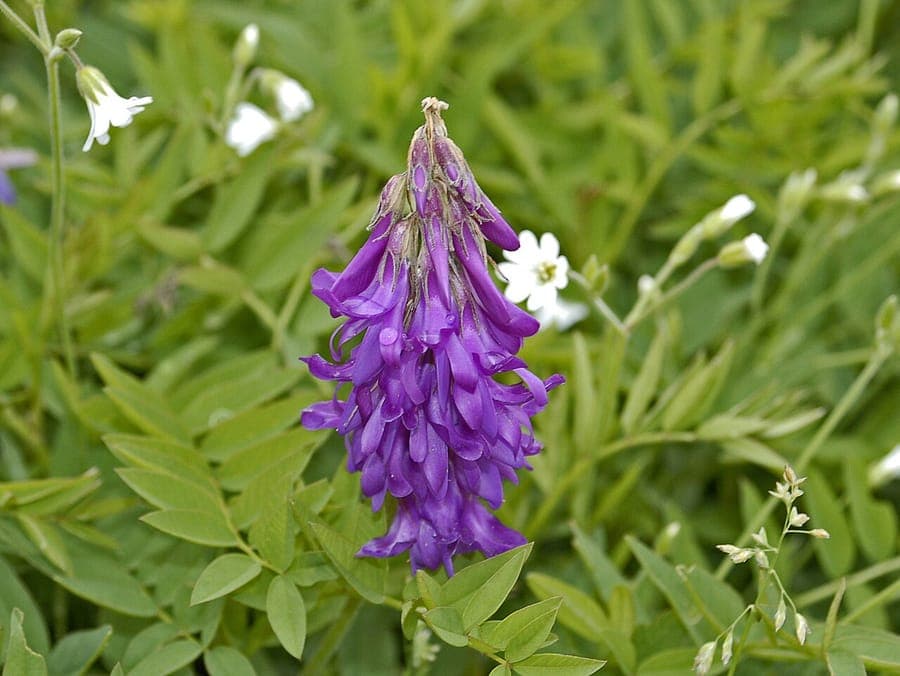
Hectonichus / CC BY-SA 3.0, via Wikimedia Commons
Alpine french-honeysuckle: complete guide
Hedysarum hedysaroides
¿Quieres ver Alpine french-honeysuckle: complete guide en tu jardín?
1 minuto, sin tarjeta de crédito
Overview
The Alpine French-Honeysuckle (Hedysarum hedysaroides) is a mountain legume from the Fabaceae family, distributed across subarctic and subalpine regions of Europe through Alaska. This hardy mountain herb grows on subalpine grasslands and rocky areas, playing an important role as nitrogen-fixer in lean mountain soils.
Appearance and bloom
Hedysarum hedysaroides reaches 40-60 cm height and forms extensive rosettes of pinnate leaves with small, oval leaflets. Purple to violet-purple flowers are borne in dense spike-like racemes, appearing June through August. Each flower crown reaches approximately 1 cm and is followed by wavy or notched pods.
Ideal location
This alpine legume thrives best on open, sunny locations with minimum 6 hours direct sunlight. Avoid shaded spots that restrict growth. In mountain areas it grows on ventilated slopes, protected from extreme winds by rocks or low shrubs.
Soil requirements
Alpine French-Honeysuckle proves highly flexible in soil composition, growing well in lean, well-draining soils. Optimal mix: 50% sand/grit, 30% peat moss, 20% horticultural lime. pH 7.5-8.0 preferred as legume. In containers use alpine mix with extra minerals. Artificial fertilizer unnecessary due to nitrogen-fixing capability.
Diseño gratis
¿Quieres ver Alpine french-honeysuckle: complete guide en tu jardín? Crea un diseño gratis ahora.
Watering regime
Once established, highly drought-tolerant. Water only during extreme dry periods or in containers. During growth season maintain moderately moist soil. Avoid waterlogging. Winter moisture minimal; plant loses leaves in deep dormancy.
Pruning
Minimal pruning needed. Remove dead stems in spring. Seed heads can be retained for self-seeding or removed for neater appearance. Avoid heavy cutting that damages the plant.
Maintenance calendar
May: Monitor first shoots. June-August: Regular inspection and watering during dry periods. September: Allow seed ripening. October-April: Minimal care.
Winter hardiness
Hedysarum hedysaroides proves extremely hardy to -40°C and grows in subarctic regions. No winter protection needed in temperate Europe. Plant survives under heavy snow cover.
Companion plants
Pairs well with alpine legumes: Astragalus species, Lupinus perennis. Also good with grasses: Festuca rubra, Carex species. All share preference for lean mountain soils.
Final thoughts
The Alpine French-Honeysuckle belongs among functional mountain plants offering both ecological and decorative value. Thanks to nitrogen-fixing ability and winter hardiness, it forms a valuable addition to alpine gardens. Available at specialty garden centers across Europe.
For more information visit gardenworld.app/en and gardenworld.app/en.
¿Quieres ver Alpine french-honeysuckle: complete guide en tu jardín? Crea un diseño gratis ahora.
Sube una foto, elige un estilo y obtén un diseño fotorrealista con lista de plantas en menos de un minuto.
Más de 10.000 jardines diseñados
Sin tarjeta de crédito


Plantas similares
Tall Silky Lupine: complete guide
Lupinus elatus
Tall silky lupine is a fast-growing Californian perennial with silvery foliage and blue-purple flower spikes, ideal for a prairie-style garden.
Garfield Lupine: complete guide
Lupinus garfieldensis
The Garfield lupine is a rare, fast-growing American perennial for alkaline, dry grassland gardens, with striking blue flower spikes.
Lupinus elegans: complete guide
Lupinus elegans
Lupinus elegans, the elegant lupine, is a spectacular blooming plant from Mexico with blue flower spikes. Care, cultivation and garden use.