
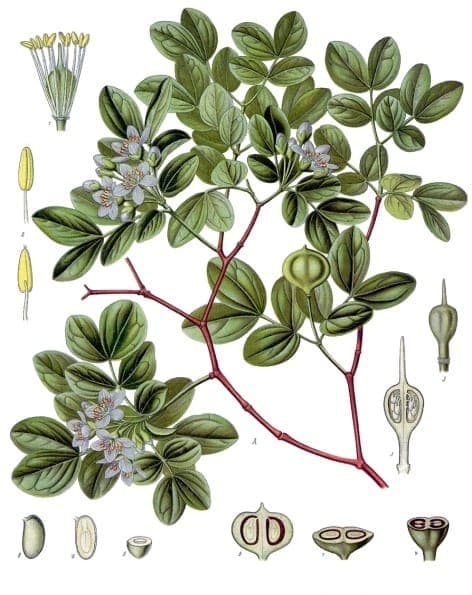
Franz Eugen Köhler, Köhler's Medizinal-Pflanzen / Public domain, via Wikimedia Commons
Guaiacum officinale: complete guide for holy wood
Guaiacum officinale
¿Quieres ver Guaiacum officinale: complete guide for holy wood en tu jardín?
1 minuto, sin tarjeta de crédito
Overview
Guaiacum officinale, commonly known as holy wood or lignum vitae, is a rare and valuable tree from tropical America. This tree is renowned for its unique resins and wood quality that were intensively used historically for medicinal purposes. Originating from the West Indian islands and northern coastal zones of South America, Guaiacum officinale is today a protected tree in many regions.
The tree is not widely cultivated outside its natural habitat, but deserves attention for its fascinating history and unique botanical properties. The resin extracted from this wood was used for centuries to treat syphilis and other conditions.
Appearance and Bloom
Guaiacum officinale grows as a medium-sized tree typically reaching 8 to 12 meters tall, though specimens in ideal conditions may grow taller. The trunk is relatively thick and the wood is extremely dense and valuable. The tree has a broad, compact crown with elegantly branched limbs.
The leaves are small, compound, and dark green, giving the tree fine texture. The flowers are spectacular, appearing in clusters during spring and early summer. They are brilliant blue to purple blooms with five petals, very striking against the green canopy.
After flowering, small pods develop, roughly the size of an almond. These contain several seeds. The wood itself is very dense and heavy, yellowish to brown in color with dark grain patterns.
Ideal Location
Guaiacum officinale requires a fully sunny location with at least 8 hours of direct sunlight daily. The tree grows best in warm, subtropical to tropical climates. In temperate zones, the tree can only survive in very protected, warm locations.
The tree is fairly wind-tolerant, though it grows best in sheltered locations. Protection against cold periods is essential in temperate zones.
Soil Requirements
Guaiacum officinale grows best in well-draining, lightly sandy or loamy soil. The tree is reasonably tolerant of various soil types as long as drainage is excellent. Water stagnation can cause serious problems.
The tree tolerates even poor or dry soils well. A pH of 6.0 to 7.5 is ideal. In containers, sandy potting soil with extra drainage can be added for optimal results.
Watering
During the first year, Guaiacum officinale requires regular watering until the tree is well-established. Once established, the tree is very drought-tolerant and requires little additional water except during extreme dry periods.
Ensure the soil feels slightly moist but not waterlogged. Excessive water can lead to root diseases. In container cultivation, monitor drainage carefully.
Diseño gratis
¿Quieres ver Guaiacum officinale: complete guide for holy wood en tu jardín? Crea un diseño gratis ahora.
Pruning
Pruning is rarely necessary if the tree grows well. You can remove damaged or dead branches throughout the year. Shape can be lightly adjusted during the growing season, but the tree maintains its attractive natural form without aggressive pruning.
Remove crossing branches to keep the crown open. In container cultivation, you can prune the tree to a more manageable size if necessary.
Maintenance Calendar
Spring (March-May): Check soil condition, water as needed, begin fertilizing. Summer (June-August): Water regularly during dry periods, monitor growth. Autumn (September-October): Reduce fertilizer, enjoy flowering. Winter (November-February): Minimal maintenance, protect from frost in temperate zones.
Winter Hardiness
Guaiacum officinale is not winter-hardy in temperate climates. The tree cannot survive at temperatures below 10-12 degrees Celsius. In the Netherlands and most European countries, you must grow this tree in containers and bring them indoors for winter.
In warm regions along the Mediterranean or in protected greenhouse conditions, the tree might survive outdoors in very sheltered microclimates. Otherwise, greenhouse cultivation is essential.
Medicinal Value
Guaiacum officinale is famous for the resins in the wood containing guaiacol. This substance was intensively used historically to treat syphilis. Today, the wood is sometimes processed for essential oils, though many species are now protected.
The medicinal applications have been largely replaced by modern medicines, but the tree remains botanically interesting and valuable from a historical perspective.
Wood Characteristics
The wood of Guaiacum officinale is incredibly dense, heavy, and durable. It was traditionally used for fine woodwork, navigation instruments, and historically for medicines. Due to conservation measures, many species are no longer available for commercial use.
Propagation
Guaiacum officinale can be grown from seeds, though germination is slow and irregular. Seeds can be pre-soaked in lukewarm water for 24 hours. Sow in seed compost or propagation medium and keep warm (minimum 20 degrees Celsius) and moist until germination occurs.
Cuttings are difficult to obtain. Seed sowing is the preferred method.
Status and Protection
Guaiacum officinale is protected by CITES and is listed as threatened in many regions. Trade in the wood is restricted. If you wish to grow a tree, ensure seeds and plants are legally available.
Conclusion
Guaiacum officinale brings a piece of tropical history into your garden or greenhouse. With its impressive blue flowers and renowned wood quality, it is a fascinating plant for those who appreciate cultural history and botany. Provide warmth, sun, and good drainage, and you will enjoy this rare tree for years to come.
¿Quieres ver Guaiacum officinale: complete guide for holy wood en tu jardín? Crea un diseño gratis ahora.
Sube una foto, elige un estilo y obtén un diseño fotorrealista con lista de plantas en menos de un minuto.
Más de 10.000 jardines diseñados
Sin tarjeta de crédito


Plantas similares
Desert Date: Complete Guide
Balanites aegyptiaca
Discover Balanites aegyptiaca, the desert date tree from Africa. Extreme drought tolerance and unique character - perfect for dry regions and arid gardens.
Guaiacum sanctum: complete guide
Guaiacum sanctum
Discover how to successfully grow Lignum vitae with this comprehensive guide. From basic care to maintenance planning - all you need for this unique tree.
Zygophyllum fabago: complete guide
Zygophyllum fabago L.
Discover the Syrian bean-caper, a unique xeric plant with delicate white flowers. Learn cultivation, care, and garden design strategies for this drought-loving specimen.