
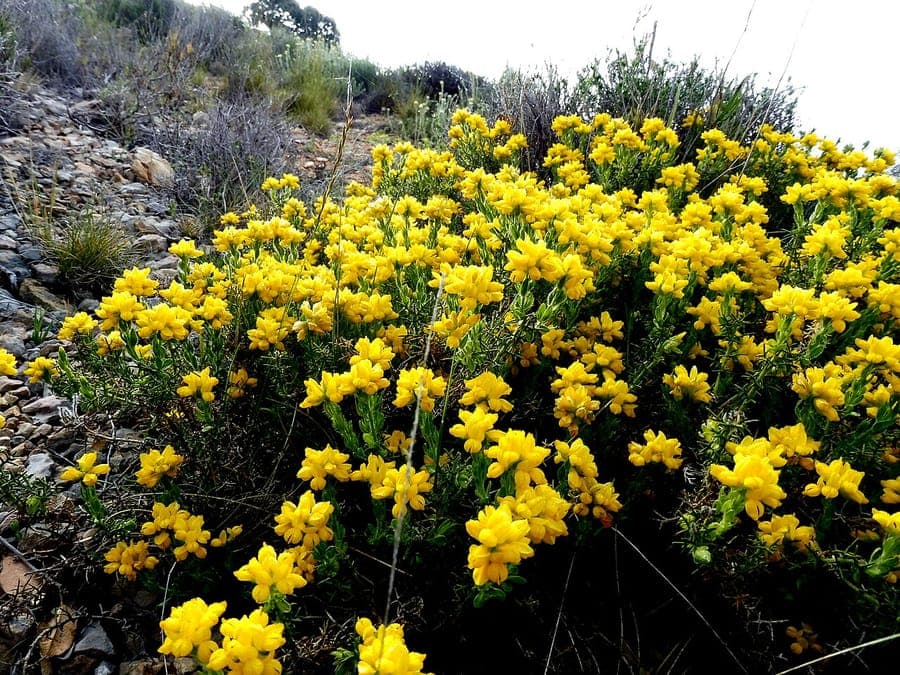
Isidre blanc / CC BY-SA 4.0, via Wikimedia Commons
Genista hispanica: complete guide
Genista hispanica
¿Quieres ver Genista hispanica: complete guide en tu jardín?
1 minuto, sin tarjeta de crédito
Genista hispanica: Complete Guide
Overview
Genista hispanica, the Spanish broom, is a magnificent low-growing shrub from the Fabaceae (pea) family. Native to southern France and northern Spain, this plant is celebrated for its spectacular yellow flowers in early spring and its compact, low-maintenance growth habit.
This shrub is perfect for gardeners seeking dramatic color effects without much effort. At gardenworld.app, we help you integrate this colorful plant optimally into your garden design.
Appearance and bloom
Genista hispanica forms a low, spreading shrub, typically 30-60 centimeters tall but often wider than it is high. The plant has small, stiffly protruding branches with minute linear leaves that remain green.
In April and May, just before most other plants flower, Genista hispanica explodes into a mass of intense golden yellow flowers. Each bloom is typical of the Fabaceae with characteristic pea-like flowers. The bloom period lasts three to four weeks and is spectacular.
After flowering, small seed pods develop. The plant maintains its compact form throughout the season and sometimes takes on reddish-brown tones in autumn.
Ideal location
Genista hispanica requires full sun, at least six hours of direct sunlight daily, though more is better. The plant produces far more flowers in full sun.
Select a very well-drained location on sunny slopes, in rock gardens, or along southwest-facing walls. The plant is extremely compact and perfect for borders, containers, and small gardens. Protect from strong cold north winds if possible.
Soil
Genista hispanica thrives in very dry, poor soils. The plant prefers sandy to loamy soil with a pH of 7.0 to 8.0. Moist, heavy soils must be absolutely avoided.
Ensure rapid drainage. Add sand to heavy soil. When planting in containers, use very good draining potting mix. Organic matter is not needed.
Diseño gratis
¿Quieres ver Genista hispanica: complete guide en tu jardín? Crea un diseño gratis ahora.
Watering
Once established, Genista hispanica is very drought-tolerant. During the first growing season, water to encourage establishment, then minimal water. Dry periods without water are highly beneficial.
Even in summer heat, seldom water. Excessive water will cause root rot.
Pruning
Genista hispanica maintains its compact form naturally. After flowering, light pruning can be applied to encourage bushier growth. Avoid heavy pruning on old wood.
The plant can live several years without any pruning.
Maintenance calendar
Spring (March-May): Water if establishment occurs. Enjoy intense flowers.
Summer (June-August): No maintenance. No water. Extremely rewarding.
Autumn (September-October): No maintenance.
Winter (November-February): In very cold climates, some protection is beneficial.
Winter hardiness
Genista hispanica is fairly cold-hardy, tolerating temperatures down to approximately -10 to -12 degrees Celsius, depending on origin. In temperate climates, usually hardy.
Companion plants
Genista hispanica combines beautifully with:
- Lavender (Lavandula angustifolia): Complementary purple flowers
- Sage (Salvia officinalis): Interesting foliage texture
- Cistus: Pink flowers, similar requirements
- Rosemary (Rosmarinus officinalis): Herbaceous settings
- Lithops or other succulents: Interesting forms
Closing thoughts
Genista hispanica is an unparalleled choice for gardeners seeking spectacular spring colors in low-maintenance settings. This is truly a plant-and-forget plant with great rewards.
Gardenworld.app can help you integrate this yellow beauty into your garden design. Design your garden today!
Want more information? Visit gardenworld.app/en for personalized garden advice!
¿Quieres ver Genista hispanica: complete guide en tu jardín? Crea un diseño gratis ahora.
Sube una foto, elige un estilo y obtén un diseño fotorrealista con lista de plantas en menos de un minuto.
Más de 10.000 jardines diseñados
Sin tarjeta de crédito


Plantas similares
Tall Silky Lupine: complete guide
Lupinus elatus
Tall silky lupine is a fast-growing Californian perennial with silvery foliage and blue-purple flower spikes, ideal for a prairie-style garden.
Garfield Lupine: complete guide
Lupinus garfieldensis
The Garfield lupine is a rare, fast-growing American perennial for alkaline, dry grassland gardens, with striking blue flower spikes.
Lupinus elegans: complete guide
Lupinus elegans
Lupinus elegans, the elegant lupine, is a spectacular blooming plant from Mexico with blue flower spikes. Care, cultivation and garden use.