
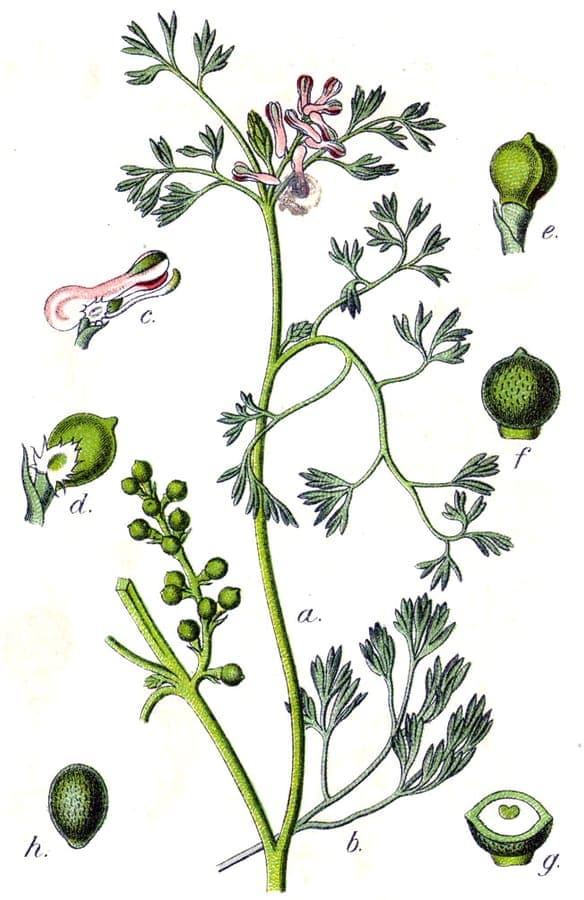
Johann Georg Sturm (Painter: Jacob Sturm) / Public domain, via Wikimedia Commons
Fumaria parviflora: complete guide
Fumaria parviflora
¿Quieres ver Fumaria parviflora: complete guide en tu jardín?
1 minuto, sin tarjeta de crédito
Overview
Fumaria parviflora, commonly known as fine-leaf fumitory, is a delicate annual that brings a charming, almost ephemeral presence to gardens. This plant originates from Western Europe and the Mediterranean and grows wild on wasteland and between stones. In gardens, it creates an airy, graceful accent.
Appearance and Bloom
Fine-leaf fumitory grows as a slender, branched plant reaching about 20-30 cm in height. The leaves are very fine, almost grassy, from which the name parviflora is derived (small flowers). Flowers appear from April to June and are pink to white with dark marks at the flower tips. Each flower is small (about 0.5 cm) but very numerous in short spikes. The plant looks delicate, as if it could blow away at any moment, but it's actually quite robust.
Ideal Location
Fine-leaf fumitory grows best in fully sunny spots. This is a true pioneer of open ground, so the more sun, the better the flowering. In partial shade, the plant continues to grow but flowers less abundantly. Plant gently as it has a delicate root system.
Soil Requirements
Fumaria parviflora grows in almost any soil type, as long as it drains well. Heavy clay shouldn't stay waterlogged. The plant thrives on poor, calcareous soil. Don't add fertilizer; this leads to too much leaf growth and fewer flowers. The plant thrives even on sparse, nutrient-poor ground.
Watering
Once established, fine-leaf fumitory needs little water. During dry periods, you can water, but the plant tolerates drought better than moisture. Too much water leads to mold. Mulching is not necessary. After blooming, you can let the plant self-seed for next year, or mow it down and collect the seeds.
Diseño gratis
¿Quieres ver Fumaria parviflora: complete guide en tu jardín? Crea un diseño gratis ahora.
Bloom and Seed Production
The blooming period is relatively short: about 6-8 weeks. After flowering, the plant produces small seed pods that turn red. Let the seeds ripen and fall to the ground, or collect them for next year. This is a plant that self-seeds very readily, so you don't need to do much.
Maintenance Calendar
March: Sow directly in garden border, press lightly into soil April-May: Flowering period begins; minimal maintenance June: Peak flowering; seeds begin to ripen July: Plant dies back; sow new seed or let it self-seed August-September: Seed self-sows naturally October-February: Winter dormancy; seed lies in ground
Winter Hardiness
Fine-leaf fumitory is an annual and doesn't survive winter. The seed, however, is extremely hardy and self-seeds in the ground. In warm autumns, a second generation may grow.
Companion Plants
Fine-leaf fumitory combines beautifully with other delicate annuals:
- Nigella damascena (love-in-a-mist)
- Eschscholzia californica (California poppy)
- Verbascum bombyciferum (silver mullein)
- Papaver rhoeas (common poppy)
- Cornflower cyanus (cornflower)
- Cosmos bipinnatus (cosmos)
This plant adds texture and movement to borders. Discover on gardenworld.app how to incorporate delicate annuals into your garden design. For advice on wild, unstructured borders, consult gardenworld.app.
Final Thoughts
Fine-leaf fumitory is perfect for anyone wanting to give their garden a somewhat wild, natural appearance. With minimal care and maximum charm, this is a plant that returns year after year without much effort. Let your garden grow wild and enjoy these delicate flowers.
¿Quieres ver Fumaria parviflora: complete guide en tu jardín? Crea un diseño gratis ahora.
Sube una foto, elige un estilo y obtén un diseño fotorrealista con lista de plantas en menos de un minuto.
Más de 10.000 jardines diseñados
Sin tarjeta de crédito

