
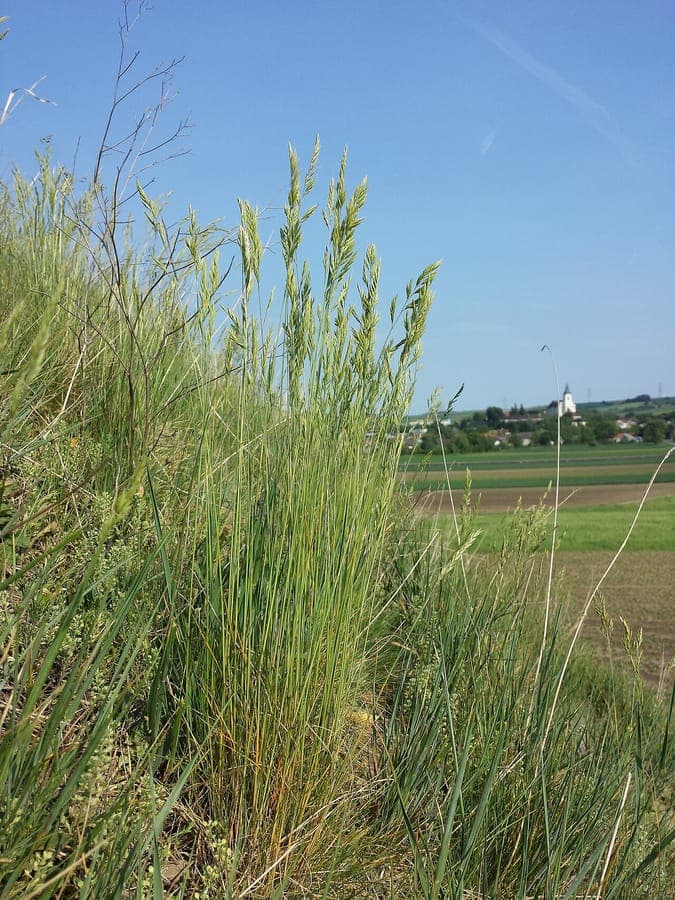
Stefan.lefnaer / CC BY-SA 4.0, via Wikimedia Commons
Rock fescue: complete guide
Festuca rupicola
¿Quieres ver Rock fescue: complete guide en tu jardín?
1 minuto, sin tarjeta de crédito
Overview
Rock fescue (Festuca rupicola) is an elegant, compact ornamental grass native to Europe and Mediterranean regions. This member of the Poaceae family is known for its fine, blue-green foliage that retains color year-round. At only 15-30 cm tall, it is ideal for rock gardens, borders, pots, and as ground cover. It requires minimal maintenance and grows well in dry, sandy soils.
This plant is highly valued by gardeners and professionals for its versatile properties.## Appearance & bloom
Rock fescue forms compact, spherical tufts with very fine, bluish-green leaves. The foliage has an elegant, needle-like appearance that retains color throughout the year. In May and June, slender flowering stems appear with subtle, brownish flowers. The flowering stems reach only slightly higher than the foliage and provide minimalist charm.
Ideal location
Choose a sunny spot for optimal blue-green color. The plant also tolerates partial shade, although compactness and color are less pronounced. Plant it in rock gardens, as a border front, in pots, or as ground cover. It grows excellent on slopes and rocky areas where drainage is essential.
Soil
Rock fescue grows best on very well-draining, poor to moderate soils. This plant is ideal for sandy, rocky, or gravelly soils. Avoid nutrient-rich soils, which cause broader, looser growth. A pH between 5.5-7.5 is acceptable. It even tolerates very poor, rocky soils.
Diseño gratis
¿Quieres ver Rock fescue: complete guide en tu jardín? Crea un diseño gratis ahora.
Watering
Once established, rock fescue is extremely drought-tolerant. During establishment (first summer), water regularly until roots are secure. After that, minimal water is needed, except during extreme drought. In regions with regular rainfall, supplemental watering is usually unnecessary. Avoid stagnation and excess water, which causes rot.
Pruning
Rock fescue requires minimal pruning. Withered flowering stems can be removed in late summer or autumn. In spring, you can remove dead material. The plant forms itself naturally into a perfect sphere without intervention.
Maintenance calendar
Spring: Spring growth begins. Summer: Flowers appear, minimal watering. Autumn: Plant prepares for winter, still looks good. Winter: Plant rests, remains green.
Winter hardiness
Rock fescue is extremely hardy to -20 degrees Celsius. In all temperate and colder climates, it can overwinter outdoors without protection. The foliage remains green year-round, making it ideal for all-season gardens.
Companion plants
Combine with other rock garden plants such as small sedums, thyme, and dianthus. Silver-foliaged plants like artemisia combine nicely. Purple-foliaged plants provide dramatic contrast. Plant groupings of 3-5 for visual impact.
Closing
Rock fescue brings elegant, fine texture to any rock garden. With its permanent blue-green color, compact form, and minimal care, it is a perfect choice for dry, low-maintenance gardens. Follow this guide for years of enjoying this versatile grass.
Available at leading garden centers. Visit gardenworld.app/en for designs featuring rock fescue for optimal effect in your garden.
¿Quieres ver Rock fescue: complete guide en tu jardín? Crea un diseño gratis ahora.
Sube una foto, elige un estilo y obtén un diseño fotorrealista con lista de plantas en menos de un minuto.
Más de 10.000 jardines diseñados
Sin tarjeta de crédito


Plantas similares
Sporobolus pungens: complete guide
Sporobolus pungens
Sporobolus pungens is a stoloniferous Mediterranean coastal grass with outstanding salt and drought tolerance, perfect for seaside and dry gardens.
Mediterranean aegilops: complete guide
Aegilops biuncialis
Everything about Aegilops biuncialis, a Mediterranean annual grass with ornamental spikes and outstanding drought tolerance for dry gardens.
Silver bluestem: complete guide
Bothriochloa saccharoides
Full guide to Bothriochloa saccharoides (silver bluestem): site, soil, watering, winter hardiness, pruning, and garden companions.