
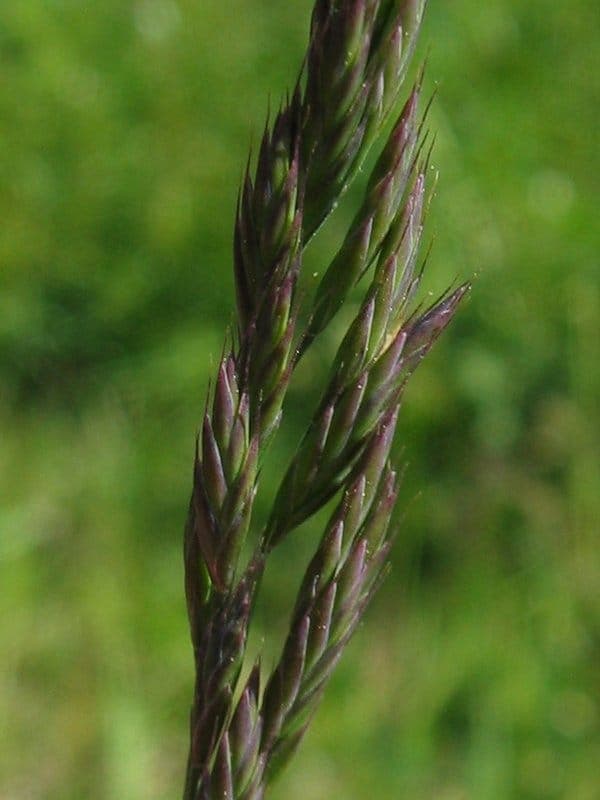
Kristian Peters -- Fabelfroh 12:31, 9 September 2006 (UTC) / CC BY-SA 3.0, via Wikimedia Commons
Red fescue: complete guide
Festuca rubra
¿Quieres ver Red fescue: complete guide en tu jardín?
1 minuto, sin tarjeta de crédito
Overview
Red fescue (Festuca rubra) is an elegant, fine-textured grass native across Europe and North America. Known for graceful tufts just 20-40 cm tall, it features blue-green foliage that assumes beautiful red-bronze tones in autumn and winter. This grass thrives in partial shade - even in dry locations where many grasses struggle - making it invaluable for challenging sites.
Appearance and growth cycle
Red fescue forms dense, fine tufts with narrow, delicate leaves arranged in attractive bundles. The foliage is refined and elegant, never coarse. From May to June, slender upright flower panicles develop in reddish-brown tones, persisting ornamentally for months. In autumn and winter, foliage assumes purple-red hues, especially in cold weather. The grass remains evergreen and decorative throughout all seasons, providing winter structure when deciduous plants have retreated.
Ideal location
Red fescue excels in partial shade, actually preferring 3-6 hours of daily light. It survives full sun but foliage lightens in colour. Avoid dense shade beneath deciduous trees; the grass requires some light. This grass is fully hardy throughout the UK and northern Europe (USDA 3-9), performing excellently in all temperate regions.
Soil requirements
Red fescue is remarkably adaptable, growing on moderately fertile to poor soils. It tolerates challenging ground types that defeat other grasses. Sandy, loamy, or even heavy clay soils are acceptable. It flourishes on dry sites - exactly where many grasses fail. For optimal growth: incorporate 30% compost into planting holes, though the grass performs acceptably on lean ground. Target pH 5.5-8.0. Even slightly saline soils are tolerated.
Watering
Minimal supplemental water required. Once established, regular watering is welcomed during extreme drought (July-August) but isn't necessary. Water newly planted specimens regularly (1-2 times weekly) until firmly rooted (4-6 weeks). Thereafter, supplemental water rarely needed. This grass tolerates drought superior to excessive moisture, so prefer slightly drier conditions.
Diseño gratis
¿Quieres ver Red fescue: complete guide en tu jardín? Crea un diseño gratis ahora.
Pruning
Simple maintenance. In early April, cut back the previous year's dead foliage close to ground (5 cm) - this stimulates fresh growth. Hand shears work, or carefully use a leaf-blower. After bloom (July), cut back faded flower panicles if neatness is priority, though the grass looks attractive with persistent panicles. Avoid autumn and winter pruning; preserve the red tones.
Maintenance calendar
- March-April: Clean up dead foliage, apply balanced fertiliser
- May-June: Flowering period, regular watering established plants
- July-August: Dry conditions; minimal supplemental water except extreme drought
- September-October: Red tones intensify; no maintenance required
- November-January: Full dormancy; no work necessary
- February: Address frost damage if evident
Winter hardiness
Red fescue is fully hardy to -25°C, surviving all temperate winters without risk. It enters dormancy, reshooting vigorously in April. The red-bronze winter tones add valuable colour to slumbering winter gardens. No frost protection whatsoever needed.
Companion plants
Red fescue combines superbly with other shade-tolerant species and woodland-edge plantings. Space plants 40-50 cm apart. Ideal companions:
- Helleborus niger (Christmas rose) for winter bloom
- Astilbe in pastel tones for texture
- Hosta varieties for foliage variation
- Bergenia (elephant ears) for architectural leaves
- Liriope for additional grass element
- Brunnera for autumn colour
Each shares red fescue's shade tolerance and combines into coherent planting schemes.
Closing
Red fescue is a content, reliable plant accepting partial shade and dry ground where many grasses surrender. Its evergreen character and autumn red tones make it invaluable for contemporary borders. Explore complementary ornamental grasses and shade-tolerant companions with Gardenworld.app, discovering combinations that showcase red fescue at its best. Use Gardenworld.app to craft woodland-style gardens with balanced, sophisticated plant associations.
¿Quieres ver Red fescue: complete guide en tu jardín? Crea un diseño gratis ahora.
Sube una foto, elige un estilo y obtén un diseño fotorrealista con lista de plantas en menos de un minuto.
Más de 10.000 jardines diseñados
Sin tarjeta de crédito


Plantas similares
Sporobolus pungens: complete guide
Sporobolus pungens
Sporobolus pungens is a stoloniferous Mediterranean coastal grass with outstanding salt and drought tolerance, perfect for seaside and dry gardens.
Mediterranean aegilops: complete guide
Aegilops biuncialis
Everything about Aegilops biuncialis, a Mediterranean annual grass with ornamental spikes and outstanding drought tolerance for dry gardens.
Silver bluestem: complete guide
Bothriochloa saccharoides
Full guide to Bothriochloa saccharoides (silver bluestem): site, soil, watering, winter hardiness, pruning, and garden companions.