
Wikimedia Commons / Public domain, via Wikimedia Commons
Bristle-tail grass: complete guide
Festuca incurva
¿Quieres ver Bristle-tail grass: complete guide en tu jardín?
1 minuto, sin tarjeta de crédito
Overview
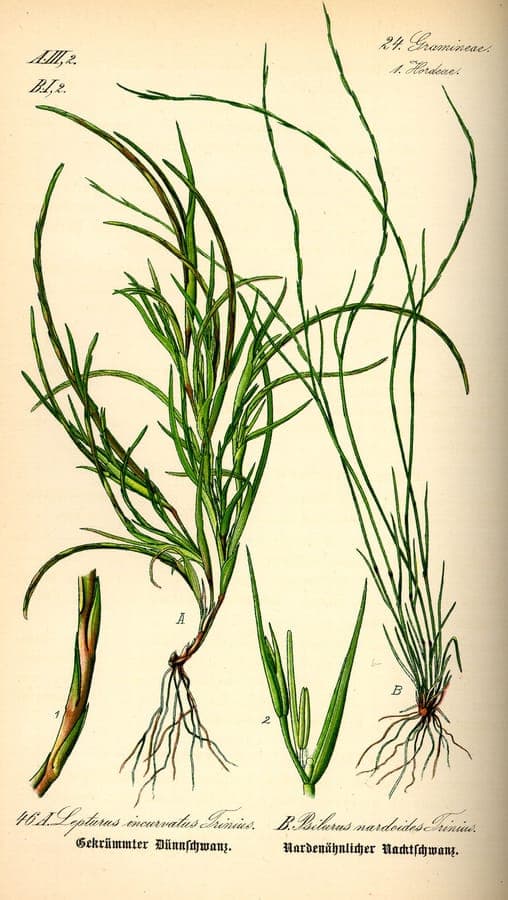
Bristle-tail grass (Festuca incurva, also known as Psilurus incurvus) is an exceptionally refined Mediterranean ornamental grass from Mediterranean through Central Asian regions. This seldom-seen grass belongs to Poaceae and is valued for its extraordinarily fine, needle-like foliage and elegantly curved flower spikes. At merely 20 to 40 centimeters height, it forms a perfect accent plant in rock gardens, contemporary Mediterranean gardens, and hyper-arid sites. This grass remains year-round ornamental and demands virtually zero maintenance.
Appearance and Bloom
Bristle-tail grass forms extremely compact, tightly mounding clumps approximately 15 to 30 centimeters diameter and 20 to 40 centimeters tall. Foliage is extraordinarily fine, thread-like, and distinctly curved or rolled in structure. Color ranges blue-green to gray-green depending on season and moisture. From May through July, delicate flowering stems produce very slender, elegantly curved spikes with minute flowers. This spike architecture is remarkably ornamental and highly characteristic of this exceptional grass.
Ideal Location
Full sun is absolutely essential. Aim for eight or more hours direct sunlight daily to produce the most compact, most characterful specimens. This grass excels in extremely hot, extremely arid sites where most plants fail. Steep slopes, south-facing rock beds, and coastal zones are ideal. Wind-exposed locations enhance growth pattern. Shade is unsuitable.
Soil
Extremely well-draining, sandy-gravelly soil is mandatory. This grass actually prefers poor, stone-rich substrates. pH between 6.0 and 8.0 is acceptable. Heavy clay is deadly without substantial sand and gravel amendment. Preparation formula: 20% garden loam, 60% coarse sand, 20% gravel. This grass tolerates salt-rich soils without complaint.
Diseño gratis
¿Quieres ver Bristle-tail grass: complete guide en tu jardín? Crea un diseño gratis ahora.
Watering
Once fully established, this grass requires virtually no water whatsoever. This is arguably the most drought-resistant ornamental grass available. During the planting year (initial growth), occasional moisture can help, but this must remain minimal. Mature specimens thrive essentially without supplemental moisture.
Pruning
Minimal pruning is required. Aged flower spikes can be removed post-seed-set (September-October) if desired. Any winter damage can be removed early spring (March). Otherwise, pruning is virtually unnecessary - this grass largely maintains itself.
Maintenance Calendar
March-April: Spring inspection for winter damage removal. May-October: Bloom and seed production occur. Zero maintenance required. November-February: Winter dormancy; minimal activity.
Winter Hardiness
Bristle-tail grass is winter hardy to approximately -10 degrees Celsius in average years. Throughout the Netherlands, Belgium, and France it thrives outdoors without protection. During extremely severe winters (below -15 degrees for extended periods), surface damage may occur, but plants recover. Snow cover actually provides helpful winter protection.
Companion Plants
This exceptional grass pairs pragmatically with:
- Alchemilla mollis (green-yellow contrast)
- Dianthus carthusianorum (low pink blooms)
- Heuchera 'Purple Palace' (dark purple foliage contrast)
- Sedum and Sempervivum species (gray-green texture)
- Salvia officinalis (green herb shrub)
Stone hardscape and gravel layers reinforce Mediterranean aesthetic significantly.
Conclusion
Bristle-tail grass is excellent for gardeners seeking extreme drought resistance without even minimal maintenance obligation. This grass thrives on benign neglect. Available through specialized grass nurseries. Explore design potential at gardenworld.app. Create ultra-sustainable, minimal-maintenance gardens at gardenworld.app.
¿Quieres ver Bristle-tail grass: complete guide en tu jardín? Crea un diseño gratis ahora.
Sube una foto, elige un estilo y obtén un diseño fotorrealista con lista de plantas en menos de un minuto.
Más de 10.000 jardines diseñados
Sin tarjeta de crédito


Plantas similares
Sporobolus pungens: complete guide
Sporobolus pungens
Sporobolus pungens is a stoloniferous Mediterranean coastal grass with outstanding salt and drought tolerance, perfect for seaside and dry gardens.
Mediterranean aegilops: complete guide
Aegilops biuncialis
Everything about Aegilops biuncialis, a Mediterranean annual grass with ornamental spikes and outstanding drought tolerance for dry gardens.
Silver bluestem: complete guide
Bothriochloa saccharoides
Full guide to Bothriochloa saccharoides (silver bluestem): site, soil, watering, winter hardiness, pruning, and garden companions.