
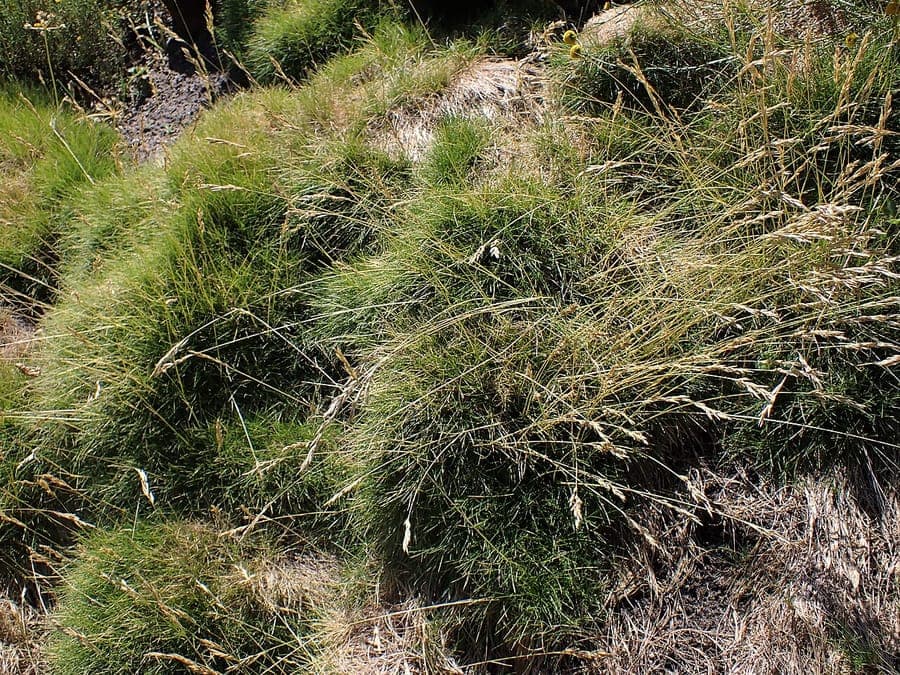
Krzysztof Ziarnek, Kenraiz / CC BY-SA 4.0, via Wikimedia Commons
Bearskin fescue: complete guide
Festuca gautieri
¿Quieres ver Bearskin fescue: complete guide en tu jardín?
1 minuto, sin tarjeta de crédito
Overview
Festuca gautieri, commonly known as bearskin fescue or spiky fescue, is a compact ornamental grass from the Poaceae family. Native to mountainous regions of France, Spain, Morocco, and Romania, this tiny grass thrives on dry, rocky slopes where few other plants can grow.
Festuca gautieri forms dense, grey-green tufts of only 15-25 cm in height. The stiffly upright, needle-like foliage gives it a distinctive, compact form. It is ideal for dry borders, alpine troughs, and rock gardens.
Appearance & Bloom Cycle
This grass grows in neat, rounded tufts with fine, grey-green, stiffly upright foliage. The leaves are extremely narrow (almost hair-like) and give the grass a unique, spiky appearance - hence the common name.
From May to July, subtle flower heads appear on long, slender stems rising above the foliage. The spikelets are yellowish-green and not particularly showy, but add textural interest.
The plant remains attractive year-round with its grey-green color and compact form. Even in winter, it stays evergreen and ornamental.
Ideal Location
Select a location in full sun. Minimum 6-8 hours of direct daily sunlight is essential. This grass tolerates shade poorly and becomes tall and lax in partial shade.
An open, windy location is not problematic; the grass is very wind-tolerant. Choose a spot where water drains freely after rain.
Soil Requirements
Festuca gautieri grows best in dry, lean soils. It tolerates even very poor, rocky soils where little else grows. Good drainage is essential; stagnant water is fatal.
Neutral to slightly acidic (pH 6.0-7.5) is ideal. Heavy clay soils should be improved with sand and gravel for better drainage. Feeding is unnecessary; this grass thrives on lean soil.
Watering
Festuca gautieri is very drought-tolerant once established. Regular watering during the first season aids root development. Thereafter, supplemental water is unnecessary.
Avoid waterlogged conditions, especially in winter. In wet seasons, rot can occur with poor drainage. This grass requires less water than many other grasses.
Diseño gratis
¿Quieres ver Bearskin fescue: complete guide en tu jardín? Crea un diseño gratis ahora.
Pruning
Pruning is not necessary. The grass naturally maintains its neat form. Dead foliage can be removed in spring by gently raking through the tuft.
After flowering, faded flower heads can be removed for tidiness, but this is optional.
Maintenance Calendar
March-April: Plant in prepared, well-drained soil. Water after planting.
May-July: Flowering period. Normal maintenance; water only in very dry spells.
August-October: Mature growth. Plant is self-sufficient. No maintenance needed.
November-February: Winter dormancy. Plant remains evergreen. No water needed.
Winter Hardiness
Festuca gautieri is winter-hardy to USDA zone 4 (-30°C). This is a very hardy grass suitable for all Dutch climate zones. Rarely needs protection.
In very wet winters, moisture excess in poorly drained soil can cause problems. Ensure good drainage.
Companion Plants
Festuca gautieri combines beautifully with other dry, alpine-like plants such as Dianthus, Sedum, Sempervivum, and Eryngium. Also good with lavender species and other grey foliage.
In rock gardens, perfect with other alpine grasses and dwarf conifers. Excellent planted in groups of 3-5 for dramatic effect. Does not combine well with vigorous perennials that might overwhelm it.
Availability & Purchase
Festuca gautieri is available through specialized alpine nurseries. Not always stocked in standard garden centers. Online ordering possible from specialty nurseries.
Obtain plants in 9-15 cm pots. Select compact, well-formed plants without yellowing foliage. Quality varies, so choose carefully.
Summary
Festuca gautieri is a valuable addition to dry, rocky gardens. This compact, evergreen grass requires minimal maintenance and water, perfect for modern, low-maintenance garden designs. Plant in groups for texture and movement.
Once established, this grass grows for years without care. Ideal for alpine troughs, dry borders, and rock gardens. Explore more drought-tolerant plant advice on gardenworld.app.
¿Quieres ver Bearskin fescue: complete guide en tu jardín? Crea un diseño gratis ahora.
Sube una foto, elige un estilo y obtén un diseño fotorrealista con lista de plantas en menos de un minuto.
Más de 10.000 jardines diseñados
Sin tarjeta de crédito


Plantas similares
Sporobolus pungens: complete guide
Sporobolus pungens
Sporobolus pungens is a stoloniferous Mediterranean coastal grass with outstanding salt and drought tolerance, perfect for seaside and dry gardens.
Mediterranean aegilops: complete guide
Aegilops biuncialis
Everything about Aegilops biuncialis, a Mediterranean annual grass with ornamental spikes and outstanding drought tolerance for dry gardens.
Silver bluestem: complete guide
Bothriochloa saccharoides
Full guide to Bothriochloa saccharoides (silver bluestem): site, soil, watering, winter hardiness, pruning, and garden companions.