
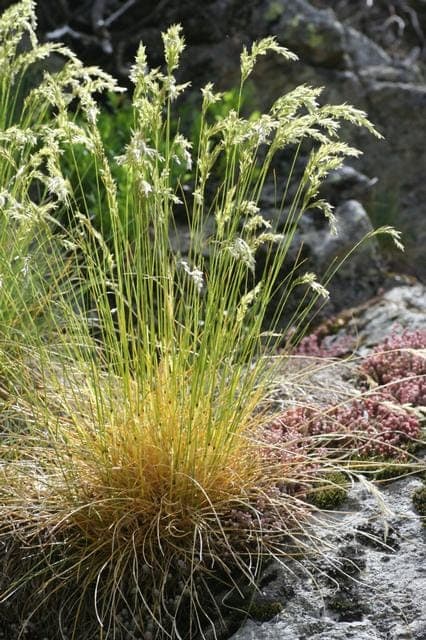
Henry Brisse (upload by user:Abalg) / CC BY-SA 3.0, via Wikimedia Commons
Festuca eskia: complete guide
Festuca eskia
¿Quieres ver Festuca eskia: complete guide en tu jardín?
1 minuto, sin tarjeta de crédito
Overview
Festuca eskia is a small but sturdy alpine grass native to the Pyrenees and northern Spain. This compact-growing grass belongs to the Poaceae family and is prized for its stiff, blue-green leaf cushions. With its compact habit and outstanding cold hardiness, Festuca eskia is perfect for rock gardens, alpine troughs, and scree beds.
Appearance & Bloom
Festuca eskia forms a stiff, tight cushion of blue-tinged green leaves, typically 10-15 cm across. The plant grows very slowly, retaining its form for years. Subtle flowers may appear in May-June but are unremarkable. The main appeal lies in the architectural leaf cushion.
Color is blue-green to silver-green, particularly striking in spring and full sun.
Ideal Location
Full sun to half-shade; this grass tolerates shadow but becomes looser and less colorful. For finest blue-green hue, aim for at least 6 hours direct daily sunlight.
As an alpine plant, Festuca eskia prefers elevated, cool locations. Rock gardens, alpine troughs, and raised beds are ideal.
Soil
Excellent drainage is absolutely critical. This plant grows on very lean, rocky soil in nature. In the garden: 70 percent sand/grit/gravel, 30 percent lean compost. Add coarse sand heavily to clay soils.
Festuca eskia tolerates chalk-rich soil very well. On clay, radical drainage amendments are essential.
Watering
Once established, Festuca eskia is very drought-resistant. Even during spring growth, water is rarely needed - only during extreme drought. Fall and winter: no water.
Young plants (first season) need consistent but well-drained moisture. Thereafter, keep completely dry.
Diseño gratis
¿Quieres ver Festuca eskia: complete guide en tu jardín? Crea un diseño gratis ahora.
Pruning
No shearing needed. Dead leaf matter can be gently removed from the cushion's center with a small rake, but typically unnecessary. The plant appears perpetually neat.
Maintenance Calendar
- March-April: Growth begins; water only in severe drought.
- May-June: Bloom; minimal water.
- July-August: Summer; keep completely dry.
- September-October: Rest period; keep dry.
- November-February: Winter dormancy; no water; plant tolerates frosts excellently.
Winter Hardiness
Festuca eskia is exceptionally winter-hardy, tolerating -15°C and below. In temperate regions, the challenge is winter moisture rather than frost. Ensure excellent drainage and avoid standing water during winter months.
In very rainy winters, excessive moisture can be problematic. On well-draining scree beds, no issue.
Companion Plants
Festuca eskia pairs beautifully with other alpine and drought-tolerant plants:
- Sempervivum (houseleeks)
- Sedum (stonecrops)
- Saxifraga (saxifrages)
- Armeria maritima (sea pink)
- Dianthus (pinks)
- Thymus (thyme)
- Geranium (hardy geranium)
Together they form a hardy, low-maintenance alpine tapestry.
Closing
Festuca eskia is a versatile alpine grass perfect for temperate gardens. Its compact form, blue-tinged color, and outstanding hardiness make it ideal for rock gardens and alpine beds. With minimal maintenance and water-free care, this grass thrives for years. Source through specialty nurseries and alpine plant suppliers.
Use gardenworld.app to integrate this alpine ornamental into harmonious garden designs.
¿Quieres ver Festuca eskia: complete guide en tu jardín? Crea un diseño gratis ahora.
Sube una foto, elige un estilo y obtén un diseño fotorrealista con lista de plantas en menos de un minuto.
Más de 10.000 jardines diseñados
Sin tarjeta de crédito


Plantas similares
Sporobolus pungens: complete guide
Sporobolus pungens
Sporobolus pungens is a stoloniferous Mediterranean coastal grass with outstanding salt and drought tolerance, perfect for seaside and dry gardens.
Mediterranean aegilops: complete guide
Aegilops biuncialis
Everything about Aegilops biuncialis, a Mediterranean annual grass with ornamental spikes and outstanding drought tolerance for dry gardens.
Silver bluestem: complete guide
Bothriochloa saccharoides
Full guide to Bothriochloa saccharoides (silver bluestem): site, soil, watering, winter hardiness, pruning, and garden companions.