
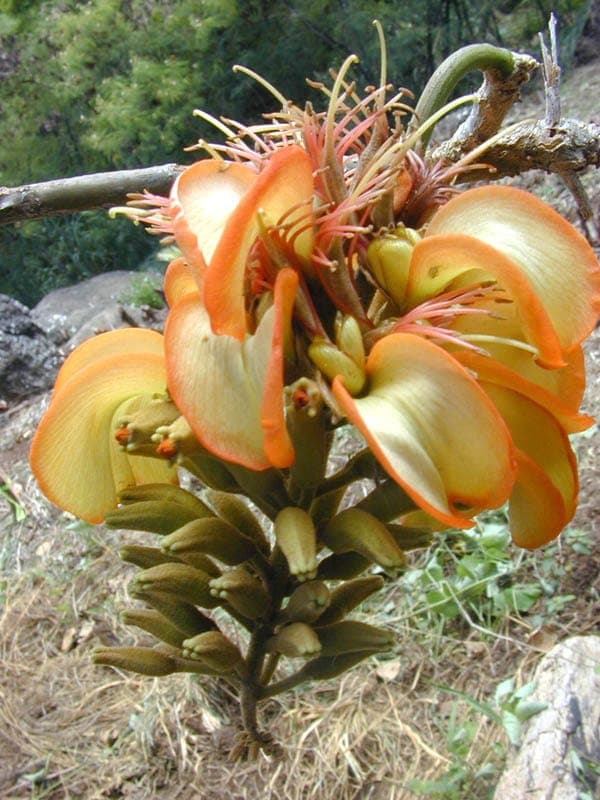
Marshman at en.wikipedia / Eric Guinther / CC BY-SA 3.0, via Wikimedia Commons
Erythrina sandwicensis: complete guide
Erythrina sandwicensis
¿Quieres ver Erythrina sandwicensis: complete guide en tu jardín?
1 minuto, sin tarjeta de crédito
Overview
Erythrina sandwicensis, known as wiliwili in Hawaiian tradition, is an elegant tree from the Fabaceae family (beans, lupines, acacias). This remarkable tree is celebrated for its brilliant red flowers that burst in dense clusters along bare branches in early spring. Wiliwili holds cultural significance in Hawaii as a symbol of courage and strength.
This is a medium-sized tree growing 8-15 meters tall under ideal conditions. The tree is semi-deciduous, shedding leaves in winter, particularly in drier climates.
Appearance and bloom
Wiliwili displays characteristic three-part leaves that emerge after flowering. The foliage is coarsely textured, bright green, and creates a pleasant spreading silhouette. The bark is pale and smooth on younger growth.
The bloom is spectacular: dense clusters of vivid red flowers (sometimes orange-red) appear at branch tips from January to March, depending on region and temperature. The flowers are tubular with prominent stamens that attract hummingbirds and other nectar-seeking birds. These are crucial for gardeners interested in bird watching.
Following pollination, long, hairy pods develop containing black seeds with red accents. These seeds are toxic and historically used in traditional crafts.
Ideal location
Wiliwili thrives in full sun on sheltered sites. Provide minimum 6-8 hours of direct sunlight daily. Wind can cause unwanted leaf shedding, so plant in relatively protected areas.
The tree is ideal for Mediterranean climates, protected south-facing walls, and large gardens. It adapts to large containers for warmer terraces, though growth slows in confined spaces.
Soil
Wiliwili performs in well-drained soils; waterlogged conditions are detrimental. The tree tolerates poor, sandy soil better than many ornamental trees.
Incorporate organic material at planting; this improves structure and water retention. Soil pH can range from 5.5 to 8.0. In containers, use potting mix with excellent drainage combined with coarse sand or perlite.
After planting, mulch the root zone with 5-8 cm of organic material (compost, shredded leaves) to regulate moisture.
Diseño gratis
¿Quieres ver Erythrina sandwicensis: complete guide en tu jardín? Crea un diseño gratis ahora.
Watering
Once established, wiliwili tolerates drought stress remarkably well. During the first two growing seasons, however, water regularly (2-3 times weekly) during dry periods until deep roots form.
In container culture, maintain light moisture during the growing season; reduce watering in winter when leaf drop occurs. Waterlogging causes root rot.
In arid regions, supplemental watering in youth aids establishment; mature trees tolerate extended drought.
Pruning
Pruning is not mandatory, but you may remove dead wood and shape the canopy. Make pruning cuts after flowering (March-April) to promote new growth. Avoid heavy pruning; wiliwili recovers slowly.
For a more compact form, light pinching of young shoots helps control size.
Maintenance calendar
Spring (March-May): Bloom peaks early in the season. Growth begins after flowering ends. Apply balanced fertilizer low in nitrogen (higher phosphorus and potassium). Watering increases as temperatures rise.
Summer (June-August): Full growth period. Regular watering during dry spells. Replenish mulch. No fertilizer needed.
Autumn (September-October): Growth slows. Reduce watering. No feeding.
Winter (November-February): Semi-dormancy. Leaf drop occurs. Minimal watering. Tree prepares for next bloom cycle.
Winter hardiness
Wiliwili is hardy to approximately 10degC (USDA zone 10). In temperate climates (Netherlands, Belgium), outdoor wintering requires frost protection. This demands wrapping with burlap or insulating material, or moving potted specimens to greenhouse/conservatory.
Protection strategies: plant against south-facing walls or under eaves. Heavily mulch roots. Young trees are more frost-vulnerable than mature specimens.
Companion plants
Wiliwili pairs beautifully with other sun-lovers and drought-tolerant garden plants. Combine with agapanthus, lavender, or other Mediterranean shrubs. In larger gardens, underplant with low-growing groundcovers.
Bird watchers appreciate wiliwili for attracting hummingbirds and other nectarivorous birds.
Conclusion
Erythrina sandwicensis brings tropical elegance and explosive red blooms to your garden. Though frost-sensitive in temperate zones, this rewarding tree suits warm terraces, conservatories, or protected gardens. Source young plants from local warm-climate nurseries or online specialists.
Design your complete tropical garden on gardenworld.app with species selected for your regional climate.
¿Quieres ver Erythrina sandwicensis: complete guide en tu jardín? Crea un diseño gratis ahora.
Sube una foto, elige un estilo y obtén un diseño fotorrealista con lista de plantas en menos de un minuto.
Más de 10.000 jardines diseñados
Sin tarjeta de crédito


Plantas similares
Tall Silky Lupine: complete guide
Lupinus elatus
Tall silky lupine is a fast-growing Californian perennial with silvery foliage and blue-purple flower spikes, ideal for a prairie-style garden.
Garfield Lupine: complete guide
Lupinus garfieldensis
The Garfield lupine is a rare, fast-growing American perennial for alkaline, dry grassland gardens, with striking blue flower spikes.
Lupinus elegans: complete guide
Lupinus elegans
Lupinus elegans, the elegant lupine, is a spectacular blooming plant from Mexico with blue flower spikes. Care, cultivation and garden use.