
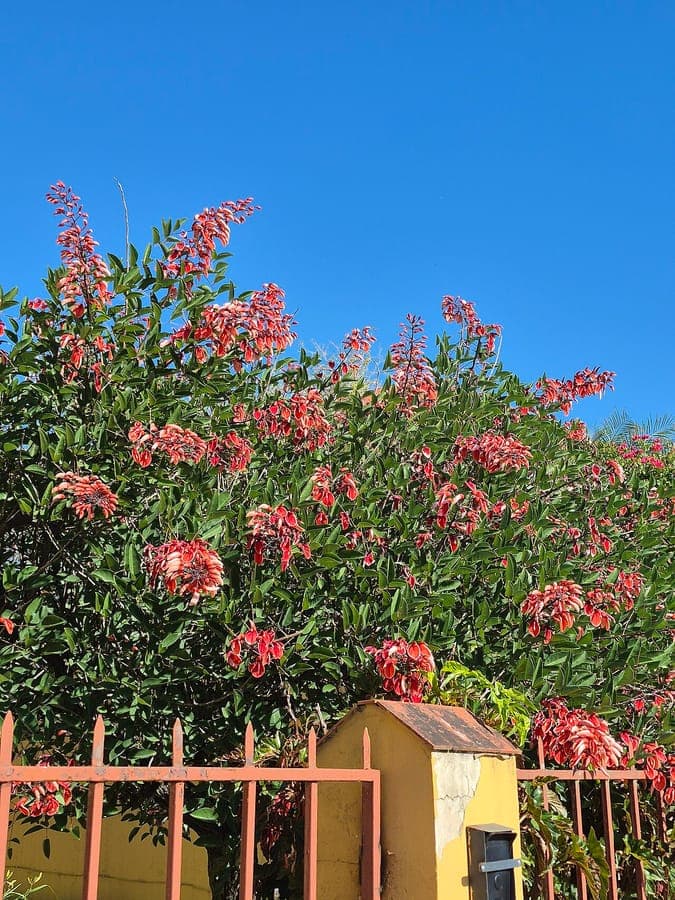
O Tupinólogo / CC BY 4.0, via Wikimedia Commons
Erythrina crista-galli: complete guide
Erythrina crista-galli
¿Quieres ver Erythrina crista-galli: complete guide en tu jardín?
1 minuto, sin tarjeta de crédito
Overview
Erythrina crista-galli, known as Cockspur Coraltree, Cry-Baby Tree, Ceibo, and Hahnenkamm, is a spectacular flowering shrub native to subtropical and tropical South America (Brazil, Paraguay, Uruguay, Argentina). This impressive plant naturally inhabits riverbanks and forests, growing 3-4 meters tall.
Belonging to the Fabaceae family (legumes), Erythrina crista-galli distinguishes itself through its dramatic, brilliant red-orange flowers with characteristic cockspur-shaped upper petals. In South America, this plant serves as the national symbol of Argentina and Brazil.
Appearance & Bloom
Cockspur Coraltree grows as an elegant shrub reaching 3-4 meters tall with feathery foliage. The plant produces from July through October spectacular, brilliant red-orange flowers in rich inflorescences. Each flower features a striking upper petal resembling a rooster's comb - hence the common name.
After blooming, the plant develops interesting elongated seed pods. The plant undergoes winter defoliation, creating a bare, skeleton-like appearance until spring.
Ideal Location
Give Erythrina crista-galli full sun and a sheltered, south-facing position. In Mediterranean or subtropical climates it thrives outdoors; in cool regions it functions as a container plant for garden and greenhouse.
The plant appreciates wind protection against strong gusts that can damage delicate flowers. Combine this plant with silver-foliage plants and dark green trees for maximum color contrast.
Soil Requirements
Erythrina crista-galli grows in virtually all well-draining soil types. Standard garden earth mixed with sand (in ratio 2:1) works well. The plant feels more comfortable in neutral to slightly acidic terrain (pH 6.5-7.5).
Ensure drainage is always good - the plant dislikes waterlogging. Add compost during planting for nutrients.
Diseño gratis
¿Quieres ver Erythrina crista-galli: complete guide en tu jardín? Crea un diseño gratis ahora.
Watering
Erythrina crista-galli demands regular water during the growing season (April-October). Water deeply and regularly, especially during dry spells. In winter when leaves fall, drastically reduce watering.
During very dry summers, daily watering may be necessary. Group the plant with moisture-loving companions to improve microclimate.
Pruning
Erythrina crista-galli can be aggressively pruned in early spring before leaf development. Remove dead, weak, or crossing branches neatly above a bud. This promotes vigorous new flowering growth.
After blooming, spent flowers may be gently pinched off, though many gardeners leave the interesting seed pods.
Maintenance Calendar
May: Begin watering as growth resumes. June-October: Water and fertilize regularly. July-October: Expect full bloom. November-April: Minimal water, dormancy with defoliation. April: Prune and restart.
Winter Hardiness
Erythrina crista-galli lacks frost tolerance and cannot endure temperatures below 5°C. In regions with winters colder than 10°C, grow this plant in containers outdoors and bring indoors for winter.
In temperate European climates, this plant may be grown as an annual replanted "tender shrub." Take cuttings in fall for next year.
Companion Plants
Pair Erythrina crista-galli with silver-foliage plants like Senecio, Artemisia, and Ballota, plus dark trees like Pittosporum. The red flowers leap out against silver and dark green.
Add low-growing ornamental grasses and asters for fall color when blooming fades. These combinations create dramatic, summer-flowering plant schemes.
Closing
Erythrina crista-galli brings South American drama into your garden - red-orange flowers that resemble bird-like roosters' combs. Seek this plant at tropical nurseries or online retailers. gardenworld.app helps you design an exotic garden. gardenworld.app offers personalized advice.
¿Quieres ver Erythrina crista-galli: complete guide en tu jardín? Crea un diseño gratis ahora.
Sube una foto, elige un estilo y obtén un diseño fotorrealista con lista de plantas en menos de un minuto.
Más de 10.000 jardines diseñados
Sin tarjeta de crédito


Plantas similares
Tall Silky Lupine: complete guide
Lupinus elatus
Tall silky lupine is a fast-growing Californian perennial with silvery foliage and blue-purple flower spikes, ideal for a prairie-style garden.
Garfield Lupine: complete guide
Lupinus garfieldensis
The Garfield lupine is a rare, fast-growing American perennial for alkaline, dry grassland gardens, with striking blue flower spikes.
Lupinus elegans: complete guide
Lupinus elegans
Lupinus elegans, the elegant lupine, is a spectacular blooming plant from Mexico with blue flower spikes. Care, cultivation and garden use.