
E Wusk / CC BY-SA 4.0, via Wikimedia Commons
Redstem stork's bill: complete guide
Erodium cicutarium
¿Quieres ver Redstem stork's bill: complete guide en tu jardín?
1 minuto, sin tarjeta de crédito
Overview
Redstem stork's bill (Erodium cicutarium), also known as pin clover or filaree, is a fascinating annual in the Geraniaceae family. This plant originates from the Mediterranean region and North Africa but now grows as an opportunistic plant in warm and temperate regions worldwide. The plant is particularly interesting due to its distinctive seed pods resembling a crane's or stork's bill.
Redstem stork's bill is ideal for gardeners seeking fast-growing, low-maintenance summer flowers. Through gardenworld.app, design gardens where this Mediterranean bloomer is gracefully employed alongside other drought-tolerant plants.
Appearance & bloom cycle
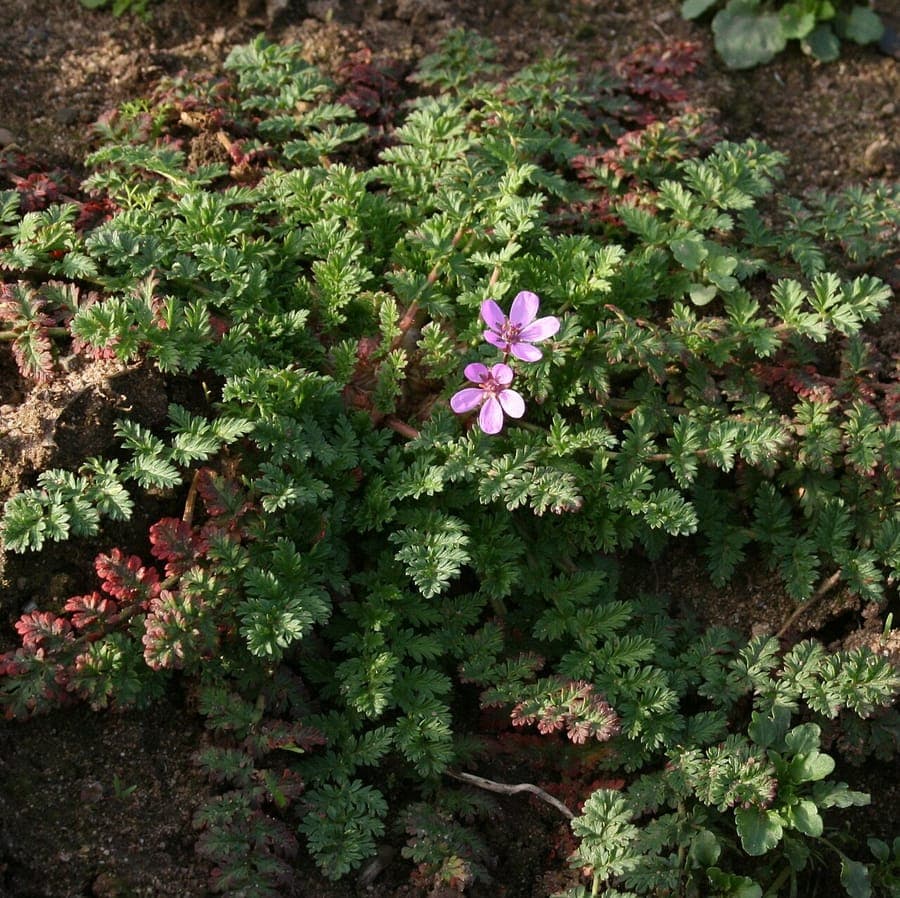
Redstem stork's bill grows as a compact, low-lying annual reaching 10-50 cm tall. Its distinctive foliage is extremely finely divided (cicutarium refers to resemblance to Cicuta species), light grey-green with often red tinges on stems and leaf veins.
Flowers are small but attractive: five pink to white-pink petals with darker veining, arranged in simple, regular structure. Flowers appear throughout virtually the entire summer season (May to October), providing nearly continuous bloom.
Most striking is the seed-dispersal mechanism: after flowering, extremely long, thin seed pods develop resembling a stork's bill. These pods have a spiral-twisted structure that unfolds in dry conditions, spreading seed far and wide - a fascinating botanical adaptation.
Ideal location
Redstem stork's bill thrives in full sun. Minimum 6-7 hours direct sunlight daily is ideal. The plant tolerates light shade but flowering is more abundant in sunny locations.
The plant is relatively hardy (USDA zone 6-9) as an annual but disappears in harsh winters or wet conditions. In Northern European gardens, it typically grows as an opportunistic summer emergence.
Soil & nutrition
Redstem stork's bill is highly adaptable, growing on virtually all soil types, from nutrient-poor to average soils. However, the plant thrives best in dry, nutrient-poor, lean soils. Heavy clay soils can cause problems from waterlogging.
Fertilization is usually unnecessary; the plant grows better in poor soils. In rich soils, excessive leaf growth at the expense of flowering may occur.
Diseño gratis
¿Quieres ver Redstem stork's bill: complete guide en tu jardín? Crea un diseño gratis ahora.
Watering
Redstem stork's bill is a true drought specialist. Once established, it readily tolerates dry conditions. Regular moisture during the seed/seedling stage promotes rapid growth, but thereafter water is usually unnecessary.
Excessive water can be harmful; good drainage is essential.
Pruning & shaping
Redstem stork's bill requires virtually no pruning. Natural form remains compact and neat. The plant doesn't grow wildly.
Removing faded flowers extends bloom but is unnecessary.
Maintenance calendar
April-May: Direct sow seed in prepared ground or containers May-October: Flowering period; extremely minimal maintenance October-November: Harvest seed for next season (distinctive stork's-bill seed holders) December-April: Plant is dormant (annual cycle)
Winter hardiness
Redstem stork's bill is annual and dies after autumn frost. In southern regions, the plant may occasionally overwinter during mild frost periods. Self-seeding ensures next generation in following season.
Companion plants
Redstem stork's bill pairs beautifully with:
- Other Mediterranean annuals (Calendula, Centaurea cyanus) for harvest landscape cohesion
- Lavender (Lavandula) for fragrant quality
- Mat-forming flowers (Alyssum, Lobularia) for low underpinning
- Sunflowers (Helianthus) for tall accents
- Grass-like structural plants
Final thoughts
Redstem stork's bill (Erodium cicutarium) is a fascinating plant with dual appeal: beautiful pink flowers and biologically intriguing seed-dispersal mechanisms. The characteristic "stork's bill" seed pods are educational subjects and children's attractions. Through gardenworld.app, design gardens where this Mediterranean bloomer functions optimally.
Whether establishing a small Mediterranean garden or planting dry sunny zones with low-maintenance species: Redstem stork's bill fully deserves inclusion. The plant demands virtually no attention while adding visual and biological interest to your garden.
¿Quieres ver Redstem stork's bill: complete guide en tu jardín? Crea un diseño gratis ahora.
Sube una foto, elige un estilo y obtén un diseño fotorrealista con lista de plantas en menos de un minuto.
Más de 10.000 jardines diseñados
Sin tarjeta de crédito


Plantas similares
Bloody cranesbill: complete guide
Geranium sanguineum
Bloody cranesbill offers intense magenta-pink flowers and fall color. This hardy plant blooms tirelessly from May through October.
Meadow cranesbill: complete guide
Geranium pratense
Meadow cranesbill offers large blue flowers in sunny meadows. This robust plant tolerates dryness and creates natural meadow landscapes.