
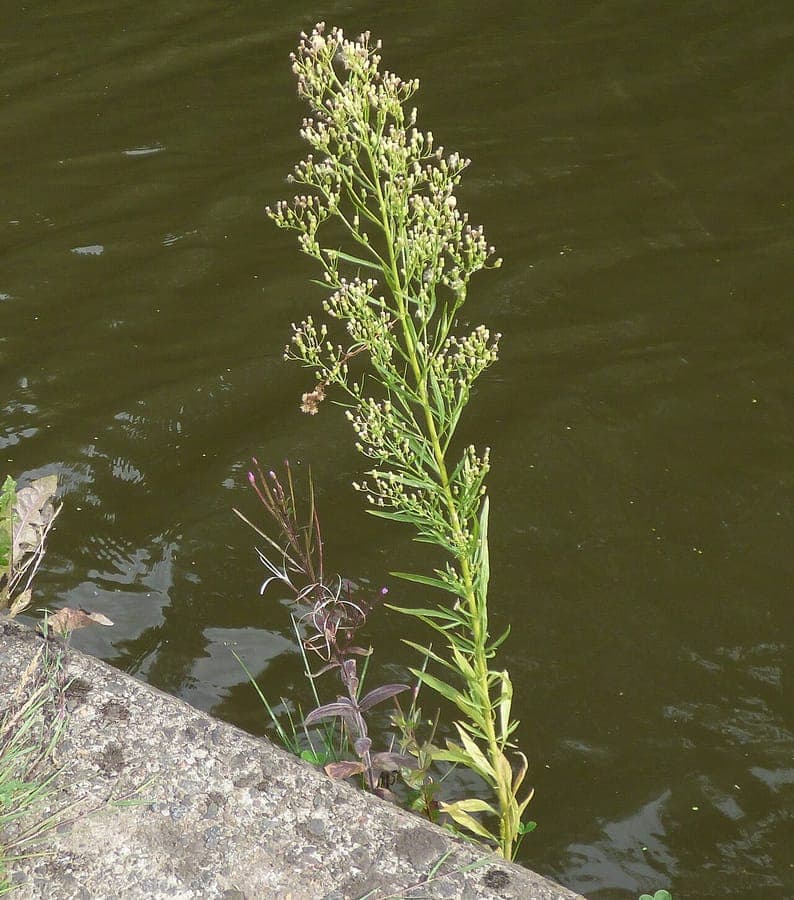
Meteorquake / CC BY 4.0, via Wikimedia Commons
Horseweed: complete guide
Erigeron canadensis
¿Quieres ver Horseweed: complete guide en tu jardín?
1 minuto, sin tarjeta de crédito
Overview
Horseweed (Erigeron canadensis), also known as Fleabane or Canada fleabane, is a versatile annual in the Asteraceae family originally from North America. Now distributed globally, this opportunistic plant often appears in gardens as a self-sown volunteer. However, intentional cultivation offers delicate, graceful flowers and valuable wildlife forage.
Horseweed is particularly valuable for gardeners seeking fast-growing summer bloomers without elaborate preparation. Through gardenworld.app, design gardens where this opportunistic plant is deliberately employed for summer color and insect pollination.
Appearance & bloom cycle
Horseweed grows as a slender, upright annual reaching 30-120 cm tall depending on growing conditions. Foliage is narrow, linear, and densely distributed along stems with minimal branching.
Flowers are tiny and numerous, arranged in loose, finely-branched flowering plumes. Individual flowers are extremely small (just millimeters), white to very pale pink, with delicate ray florets surrounding yellow disc florets. The volumetric bloom makes the plant visually significant despite tiny individual flowers.
Blooming begins in July and extends through October. The plant produces vast quantities of lightweight seeds dispersed by wind, demanding seed removal to prevent unwanted reseeding.
Ideal location
Horseweed grows almost anywhere with some sunlight, from full sun to lightly shaded positions. Minimum 3-4 hours daily sunlight suffices for acceptable bloom, though full sun is optimal.
The plant is fully hardy (USDA zone 2-11) as an annual but naturally dies after first frost. Winter protection is irrelevant.
Diseño gratis
¿Quieres ver Horseweed: complete guide en tu jardín? Crea un diseño gratis ahora.
Soil & nutrition
Horseweed grows on virtually all soil types, from very poor to rich soils. The plant is remarkably adaptable, even surviving in compacted, degraded ground. Excessive fertilization can promote unwanted vegetative growth at the expense of flowering.
In typical gardens, no supplemental feeding is required. In very poor soils, light feeding may benefit growth.
Watering
Horseweed is quite drought-tolerant once established. Regular moisture during the seed/seedling stage promotes rapid establishment. After growth, supplemental watering is only needed during severe drought.
The plant tolerates waterlogging poorly; good drainage is beneficial.
Pruning & shaping
Horseweed requires no pruning. Natural upright form is elegant. Deadheading extends bloom but isn't essential.
Seed heads must be removed BEFORE seed ripens if self-seeding is undesired.
Maintenance calendar
May-June: Direct sow seed in prepared ground July-October: Flowering period; minimal maintenance needed October-November: Harvest seed or remove before dispersal December-April: Plant is dormant (annual cycle)
Winter hardiness
Horseweed is annual and dies after first frost. Winter hardiness is irrelevant. Self-seeding ensures next generation in following growing season.
Companion plants
Horseweed pairs remarkably well with:
- Other annual composites (Cosmos, Centaurea) for flower abundance
- Summer flowers (Zinnia, Marigold) for color contrast
- Tall grass forms (Miscanthus) for background
- Wildlife food plants for ecological value
Final thoughts
Horseweed (Erigeron canadensis) is a remarkably adaptable plant demanding minimal attention. Delicate, numerous flowers provide excellent wildlife forage and insect support during summer months. Through gardenworld.app, design gardens where this fast-growing annual is deliberately employed as a low-maintenance summer bloomer. For wildflower lovers and wildlife gardeners: Horseweed fully deserves a place in your landscape.
¿Quieres ver Horseweed: complete guide en tu jardín? Crea un diseño gratis ahora.
Sube una foto, elige un estilo y obtén un diseño fotorrealista con lista de plantas en menos de un minuto.
Más de 10.000 jardines diseñados
Sin tarjeta de crédito


Plantas similares
Bitter daisy: complete guide
Erigeron acris
Discover all about Bitter daisy (Erigeron acris): a robust biennial with purple-pink flowers, perfect for dry sunny locations.
Daisy fleabane: complete guide
Erigeron philadelphicus
Daisy fleabane is a charming, free-flowering plant from North America. Learn how to grow and care for this beautiful native species in your garden.