
Wikimedia Commons / CC BY-SA 3.0, via Wikimedia Commons
Dark-red helleborine: complete guide
Epipactis atrorubens
¿Quieres ver Dark-red helleborine: complete guide en tu jardín?
1 minuto, sin tarjeta de crédito
Overview
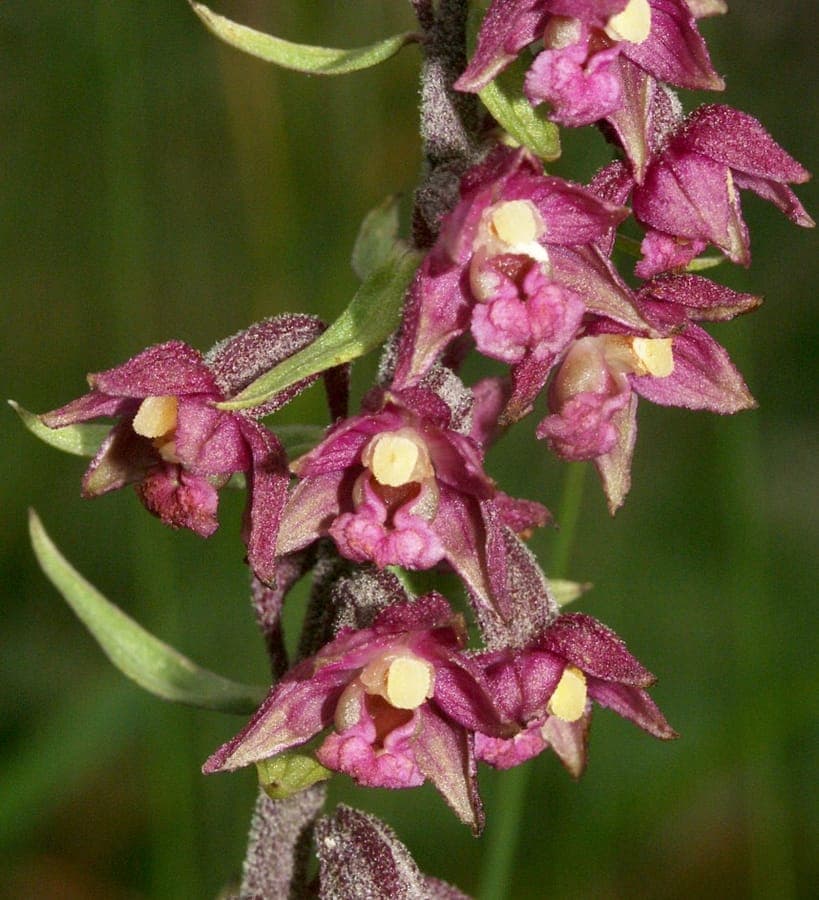
Dark-red helleborine (Epipactis atrorubens) is a fascinating wild orchid native from Europe to West Siberia and the Caucasus. This mysterious plant reaches 30-60 cm tall and produces from July through August striking flowers in deep purple-red, nearly black in shadowy forest light. The plant is a terrestrial orchid at home in half-shaded forest floors, becoming part of complex ecosystems.
Epipactis atrorubens is not your typical garden plant but rather an ongoing commitment for people with patience and ecological sensitivity. This orchid is completely dependent on soil mycorrhiza (fungi) for nutrient uptake, requiring highly specialized growing conditions. Through gardenworld.app, design exceptional gardens that can host wild orchids.
Appearance & Bloom
Leaves are grass-like, lance-shaped, approximately 10-15 cm long, arranged along the stem. Flowers are exceptional - deep purple-red to nearly black, with a lip (labellum) that is white to pink. Each flower is about 1-1.5 cm across. The inflorescence is a dense spike with many flowers.
The plant reproduces via extremely fine, dust-like seeds, but establishment requires the correct mycorrhiza fungus. This makes garden propagation extremely difficult.
Ideal Location
Dark-red helleborine thrives in half-shade to light shade, especially beneath deciduous and coniferous trees. The plant prefers sheltered sites with constant moist air circulation. In gardens: seek soils with rich humus layers and existing forest ecosystems.
Diseño gratis
¿Quieres ver Dark-red helleborine: complete guide en tu jardín? Crea un diseño gratis ahora.
Soil & Nutrition
The plant has very specific soil requirements: humus-rich, nutrient-rich forest soil with pH 6.0-7.0. The essential component is presence of the correct mycorrhiza network. Without mycorrhiza, no growth. Soil must not be disturbed, compacted, or chemically treated.
Watering & Moisture Requirements
Moderate moisture year-round is essential. The plant prefers moist forest soil without waterlogging. Regular, gentle irrigation helps, but compaction and runoff (e.g., hard watering) damages the mycorrhiza network.
Pruning & Maintenance
Absolutely no management desired! The plant requires a complete hands-off approach. Remove dead foliage in March only if necessary. No feeding, no pesticides, no soil disturbance.
Maintenance Calendar
- March-April: Bloom begins, growth occurs
- May: Full growth
- June-August: Flowering period
- August-October: Seed ripening and dispersal
- October-February: Dormancy period
Winter Hardiness
Epipactis atrorubens is hardy to USDA zone 5 (-20°C), adapted to temperate European forest regions.
Companion Plants
If you can establish this orchid, compatible shade plants include:
- Broad helleborine (Epipactis helleborine)
- Ophrys orchids (Ophrys species)
- Lungwort (Pulmonaria)
- Wood sedge (Carex sylvatica)
Conclusion
Dark-red helleborine is for the serious gardener - not for quick results, but for someone who can help wild orchids survive in cultivation. This plant represents the limits of gardening, where ecology weighs more than commercial utility. With gardenworld.app, we help design both modern gardens and ecological reserves.
¿Quieres ver Dark-red helleborine: complete guide en tu jardín? Crea un diseño gratis ahora.
Sube una foto, elige un estilo y obtén un diseño fotorrealista con lista de plantas en menos de un minuto.
Más de 10.000 jardines diseñados
Sin tarjeta de crédito


Plantas similares
Broadleaf helleborine: complete guide
Epipactis helleborine
Everything you need to grow Epipactis helleborine: ideal conditions, watering, soil needs, and companion plants. Perfect for shaded, moist garden spots.
White helleborine: complete guide
Cephalanthera damasonium
Everything you need to grow Cephalanthera damasonium: ideal spot, soil pH, watering tips and bloom care. Perfect for shaded woodland gardens.
Bird's-nest orchid: complete guide
Neottia nidus-avis
Learn about Neottia nidus-avis, the fascinating saprophytic orchid with roots like a bird's nest. Habitat, characteristics, and conservation tips.