
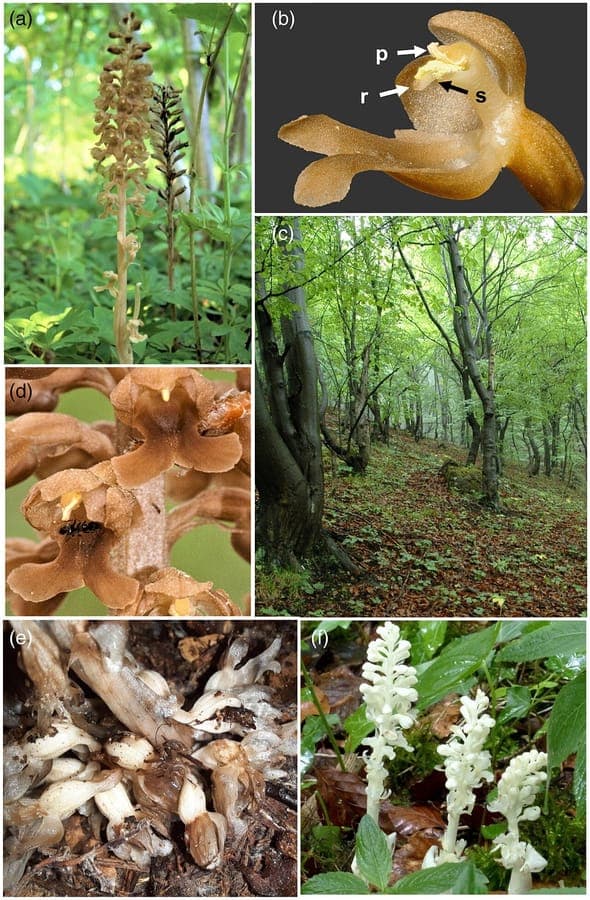
Jana Jersáková, Julita Minasiewicz & Marc-André Selosse / CC BY 4.0, via Wikimedia Commons
Bird's-nest orchid: complete guide
Neottia nidus-avis
¿Quieres ver Bird's-nest orchid: complete guide en tu jardín?
1 minuto, sin tarjeta de crédito
Overview
The bird's-nest orchid, scientifically known as Neottia nidus-avis, is one of the most intriguing and enigmatic wildflowers of European forests. This orchid earned its common name from its remarkable root system, which forms an intricate tangle of fine rootlets that genuinely resembles a bird's nest. This unique adaptation allows the plant to thrive in the darkest corners of dense deciduous forests, where most plants struggle to survive. Unlike parasitic plants, Neottia nidus-avis is a saprophyte, deriving all its nutrients from decaying organic matter in the forest floor rather than producing its own through photosynthesis. This remarkable lifestyle makes it entirely independent of sunlight, a trait that fascinates botanists and plant enthusiasts worldwide.
The bird's-nest orchid inhabits a vast range extending from western Europe to Iran and northwestern Africa. Its presence in a forest indicates a healthy, undisturbed ecosystem rich in mycorrhizal fungi and decomposing organic matter. The plant's success depends entirely on its relationships with the microscopic fungal networks in the soil, making it an indicator species for forest health. In many European countries, this rare beauty is protected by law, recognizing both its ecological importance and its scarcity in the modern landscape.
What makes this orchid so special is not merely its unusual flowers or saprophytic lifestyle, but what it teaches us about forest ecology. The bird's-nest orchid cannot survive in conventional gardens because it requires the complex, undisturbed soil microbiota of ancient forests. Observing this plant in its natural habitat is a privilege that reminds us of nature's intricate complexity and interdependence.
Appearance and bloom cycle
The bird's-nest orchid typically reaches heights of 20 to 30 centimeters, and its appearance differs dramatically from most orchid species. The plant features a simple, unbranched stem covered with small, scale-like leaves that lack green coloration because the entire plant lacks chlorophyll. The stem itself is distinctly brownish, allowing it to blend seamlessly with the dark forest floor. This camouflage is no accident but rather a sophisticated adaptation to life without sunlight.
The flowers are small yet distinctive, measuring approximately 1 to 1.5 centimeters across, arranged in a dense, unbranched inflorescence containing 10 to 20 individual blooms. Flower color ranges from pale yellow-white to warm brown, sometimes with pinkish tinges depending on growing conditions and population variation. Unlike many showy orchids, these flowers appear relatively inconspicuous, with tepals and petals that seem almost fused together. The flowering period occurs in May and June, coinciding with the most vibrant time in the forest canopy above. This timing is not arbitrary but carefully synchronized with the emergence of the pollinating insects that visit the forest floor.
Fruit set is rare in nature, though cross-pollination occurs through small beetles and other forest-floor insects. The seeds are microscopically small, mere tenths of a millimeter, and rely entirely on wind dispersal and specific fungal relationships for germination.
Diseño gratis
¿Quieres ver Bird's-nest orchid: complete guide en tu jardín? Crea un diseño gratis ahora.
Ideal location
The bird's-nest orchid is exclusively a forest-floor dweller, thriving beneath beeches, oaks, maples, and other deciduous hardwoods. The shade requirement is absolute and uncompromising: the plant demands 90 to 98 percent shade, meaning only the tiniest fragments of direct sunlight can reach the forest floor where it grows. Replicating this in a garden setting is nearly impossible without establishing a dense, mature woodland. The plant grows optimally on gentle forest slopes and stream banks where natural drainage prevents waterlogging while moisture remains constant.
Temperature conditions must be mild and stable throughout the year. The bird's-nest orchid thrives in USDA hardiness zones 4 through 7, encompassing temperate forests from Scandinavia through most of Central and Western Europe. Excessive heat is detrimental; this is genuinely a cool-forest specialist that abhors warm, dry conditions.
Soil requirements
Soil quality is perhaps the most critical factor determining success. The bird's-nest orchid requires deeply organic, forest-floor substrate with a pH between 5.5 and 7.0, preferably slightly acidic. This soil must be teeming with mycorrhizal fungi, bacteria, and other microorganisms essential for the plant's nutrition. The soil composition resembles well-aged compost, abundant in decomposed leaves, woody debris, and partially decayed organic matter. The mycorrhizal associations are not merely beneficial; they are absolutely essential for survival.
Drainage must be impeccable yet paradoxically, constant moisture is essential. Waterlogging is fatal, yet desiccation is equally destructive. Natural forest floors achieve this delicate balance through permanent leaf litter cover that insulates and moderates both moisture and temperature.
Watering
In its natural habitat, the bird's-nest orchid receives moisture through forest rainfall and groundwater. Artificial watering becomes irrelevant because this plant cannot be cultivated in conventional garden settings. In their native forests, these orchids depend upon consistent groundwater levels and high ambient humidity maintained by the dense forest canopy.
Pruning
Pruning is unnecessary and inappropriate for this species. In nature, the plant completes its growth cycle independently, investing energy into flowers and seeds without intervention. The entire plant withdraws underground after fruiting, requiring no maintenance or cutting.
Maintenance calendar
May-June: Flowering period June-July: Seed development August-September: Seed dispersal and ripening October-April: Dormancy and underground vegetative growth
Winter hardiness
The bird's-nest orchid is exceptionally cold-hardy, thriving in USDA zones 4 through 7 and beyond. It survives Scandinavian and Russian winters without protection, overwintering entirely below ground as a dormant rhizome complex. No winter protection is needed in temperate climates.
Companion plants
In its natural habitat, the bird's-nest orchid grows alongside other shade-loving forest specialists including wood anemones, lily-of-the-valley, bluebell, and various ferns. These plants share preference for the cool, moist, nutrient-rich forest floor and create a diverse understory community. Visit gardenworld.app to learn more about recreating natural shade gardens with native forest plants. For additional resources about woodland ecology and conservation, gardenworld.app offers comprehensive guides.
Closing
The bird's-nest orchid represents nature's astonishing diversity and adaptation. This plant belongs in the wild forest, not in cultivated gardens, reminding us that conservation of intact forest ecosystems is paramount. If fortune allows you to witness its delicate brown flowers in their native woodland setting, you will understand why this humble orchid captivates botanists and naturalists worldwide.
¿Quieres ver Bird's-nest orchid: complete guide en tu jardín? Crea un diseño gratis ahora.
Sube una foto, elige un estilo y obtén un diseño fotorrealista con lista de plantas en menos de un minuto.
Más de 10.000 jardines diseñados
Sin tarjeta de crédito


Plantas similares
Ram's-head lady's slipper: complete guide
Cypripedium arietinum
Everything you need to know about growing Cypripedium arietinum, a rare woodland orchid for cool, moist garden settings. Soil, care and planting tips.
Sparrow's-egg lady's slipper: complete guide
Cypripedium passerinum
Everything about growing Cypripedium passerinum, a cold-hardy subarctic orchid suited to cool, moist, shaded garden spots. Soil, care and companion plants.
Algerian Butterfly-orchid: complete guide
Platanthera algeriensis
Everything about Platanthera algeriensis, the rare Mediterranean orchid with greenish flowers native to Algeria, Morocco, Corsica and Spain.