
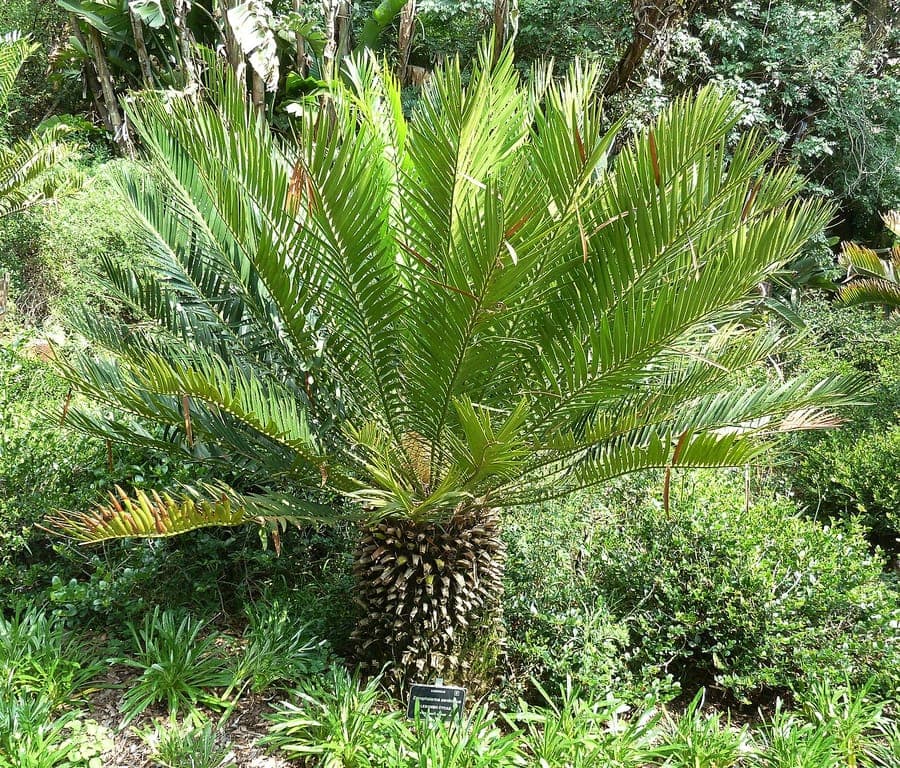
JMK / CC BY-SA 3.0, via Wikimedia Commons
Encephalartos senticosus: complete guide
Encephalartos senticosus
¿Quieres ver Encephalartos senticosus: complete guide en tu jardín?
1 minuto, sin tarjeta de crédito
Overview
Encephalartos senticosus, known as the Jozini cycad or Lebombo cycad, is one of the most fascinating and primitive plant species in the world. This remarkable plant belongs to the Zamiaceae family and is native to the border between Eswatini (formerly Swaziland) and KwaZulu-Natal in South Africa.
Cycads are among the oldest seed plants on Earth - they were flourishing when dinosaurs walked the planet. Encephalartos senticosus is a rare, slow-growing cycad appreciated for its architectural, feathery leaves and its status as a living fossil.
This is not a plant for the impatient gardener, but for those who enjoy slow growth and exotic, primitive beauty.
Appearance and Bloom
Encephalartos senticosus grows extremely slowly, with mature plants reaching only a few meters. The plant does not form a true trunk, but grows as an underground caudex - a thickened, underground stem structure.
The leaves are the most striking feature. They are large, pinnate (feather-like), and can reach 1-2 meters long. They grow in a dense rosette on top of the caudex. The leaves are green with some gray-waxy coating, especially at the base.
The individual leaf stalks have thick, sharp spines at the base - from which the name 'senticosus' (spiky) derives. This is an adaptation that helps protect the plant against overgrazing by wild animals.
The reproductive structures are cones rather than flowers. Male and female cones grow on separate plants. The cones are red to orange and very striking. Seeds are produced after pollination and can be used for propagation.
Ideal Location
Encephalartos senticosus grows best in fully sunny, dry locations. The plant tolerates drought very well and thrives on slopes and rocky steep places where water drains quickly.
Provide protection against very strong winds, especially when the plant is young. The leaves can be damaged by strong winds.
In Europe, this plant can only grow outdoors in very warm, dry gardens in southern Spain, southern France, or southern Portugal. In temperate climates, it must grow in containers and be moved indoors in winter.
Soil
Encephalartos senticosus prefers very well-draining, poor soil. A mixture of:
- 50% sand or perlite
- 30% coarse gravel or stone fragments
- 20% universal potting soil
The plant accepts acidic to neutral pH (5.5-7.0). Crucial element: good drainage is absolutely essential. This plant will quickly rot in wet soil.
When growing in containers, add even more mineral - up to 70% of the soil mix can consist of sand, perlite, and gravel.
Diseño gratis
¿Quieres ver Encephalartos senticosus: complete guide en tu jardín? Crea un diseño gratis ahora.
Watering
Encephalartos senticosus is very drought-tolerant once established. In fact, overwatering is a much bigger problem than drought.
During the growing season (spring and early summer), water only when the soil feels completely dry. This may be two to four weeks between waterings.
In autumn and winter, reduce water drastically. In these seasons, it can go months without water, especially in temperate climates where growth stops.
When growing in containers, it is better to keep the plant on the dry side. A drop of water is better than overwatering.
Pruning
Encephalartos senticosus requires no pruning. The plant grows slowly and naturally maintains a beautiful form.
Only remove old, yellow, or damaged leaves at the base by gently pulling them off. This helps prevent disease and keeps the plant neat.
Do not prune the central growing point - this can damage or kill the plant.
Maintenance Calendar
Spring (March-May): Moderate watering as growth begins. No fertilizer needed - cycads prefer poor soil. Check for mold and fungal infections.
Summer (June-August): Minimal watering in very dry periods. Shading from extreme afternoon sun can be beneficial. Male and female plants may form cones.
Autumn (September-October): Gradually reduce watering. No fertilizing.
Winter (November-February): Hardly any watering. Plant is dormant.
Winter Hardiness
Encephalartos senticosus tolerates temperatures down to about -5 to -10°C, especially in dry conditions with good drainage. It can survive outdoors in very sheltered South African gardens.
In temperate European climates, it must grow in containers and be moved indoors in winter, where it can grow in a cool room (5-10°C) with minimal light and water.
Companion Plants
In dry, sunny gardens, Encephalartos senticosus combines well with:
- Other South African succulents such as Aloes and Euphorbia
- Drought-tolerant grasses
- Rock plants such as Sempervivum and Sedum
- Stones and gravel mulch for texture
The architectural leaves of the cycad stand out beautifully as a focal point surrounded by more compact plants.
Closing
Encephalartos senticosus is not for every garden or gardener. It demands patience, minimal care, and an appreciation for primitive, slow-growing beauty. But for those who enjoy growing exotic, highly rare plants, it is a true jewel - a living fossil that has remained virtually unchanged for millions of years.
For purchase: Intratuin (rare plants section), Gamma, and gardenworld.app. Warning: These are sensitive species. Make sure you buy from a responsible, legal source, not from wild populations.
¿Quieres ver Encephalartos senticosus: complete guide en tu jardín? Crea un diseño gratis ahora.
Sube una foto, elige un estilo y obtén un diseño fotorrealista con lista de plantas en menos de un minuto.
Más de 10.000 jardines diseñados
Sin tarjeta de crédito


Plantas similares
Ground cycad: complete guide
Encephalartos villosus
Ground cycad (Encephalartos villosus) is a rare South African cycad. Discover care, growth, and the distinctive appearance of this primeval plant.
Natal grass cycad: complete guide
Stangeria eriopus
Discover the Natal grass cycad (Stangeria eriopus), a rare ornamental plant from South Africa. Learn all about caring for, growing and maintaining it indoors and outdoors.
Dioon edule: complete guide
Dioon edule
The Mexican cycad is a majestic, slowly-growing palm fern with feathery fronds. Learn about cultivation, care, and creating a tropical atmosphere indoors.