
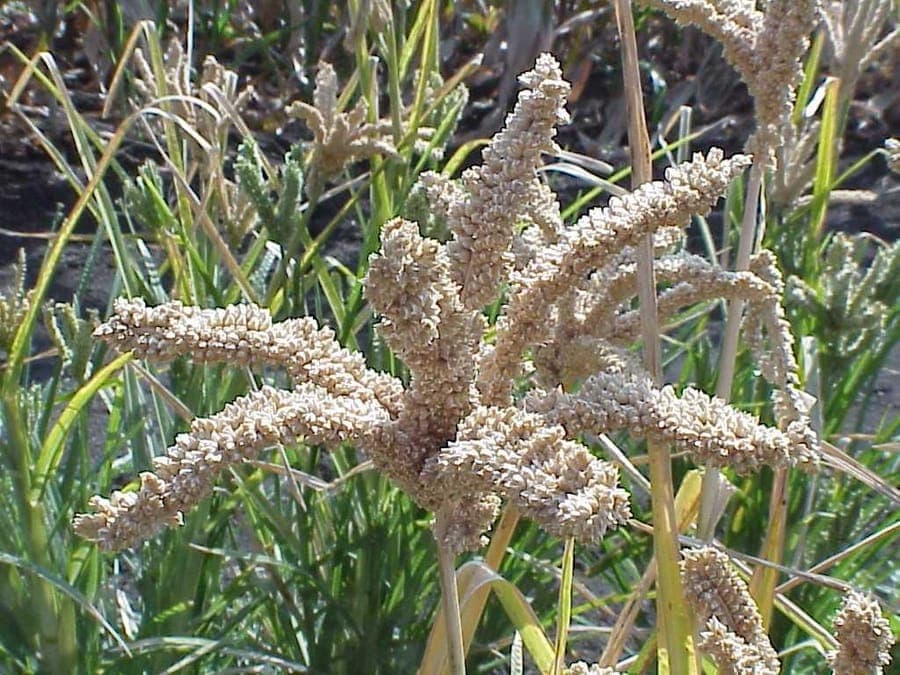
mage taken by J. Wilson, USDA-ARS while in Ethiopia in 2002. / Public domain, via Wikimedia Commons
Finger millet: complete guide
Eleusine coracana
¿Quieres ver Finger millet: complete guide en tu jardín?
1 minuto, sin tarjeta de crédito
Overview
Eleusine coracana, commonly known as finger millet or ragi, is a significant cereal crop cultivated for thousands of years in tropical and subtropical regions worldwide. This grain belongs to the Poaceae family and serves as an essential staple food in many African and Asian communities. The plant is renowned for its exceptional nutritional value and remarkable drought tolerance.
The common name "finger millet" derives from the distinctive seed heads that resemble fingers. These heads emerge at the stem's terminal end and contain thousands of tiny seeds ready for harvest. Plants typically reach heights of 60 to 90 centimeters and produce three to ten finger-like panicles per plant.
Appearance and bloom
Finger millet is an annual plant with an erect growth habit. The stems are sturdy and capable of supporting numerous long, narrow leaves typical of cereal grains. The plant develops a fine root system that efficiently extracts moisture even from drier soils.
Flowering and seed setting occur toward the growing season's end, typically two to four months after sowing depending on variety and climate conditions. The panicles are densely packed with small florets that develop into minute seeds approximately 2 to 3 millimeters across. Seeds exhibit red, brown, or yellow coloration depending on the cultivar.
Ideal location
Finger millet thrives in locations receiving abundant direct sunlight. The plant requires at minimum six to eight hours of full sun daily to achieve optimal growth and seed production. In warm regions, the plant can tolerate partial shade but performs best with full sun exposure.
The plant demonstrates exceptional tolerance for hot conditions and exhibits remarkable drought resistance. This makes it ideal for gardening in arid climates or for sustainable agricultural practices requiring minimal water input. In temperate regions, finger millet functions as a summer crop.
Soil
Finger millet shows considerable tolerance for diverse soil types but performs optimally in well-draining soil with neutral to slightly acidic pH between 5.5 and 7.5. The plant can succeed in poor soils requiring minimal fertilization, which represents a significant advantage for farmers with limited resources.
Optimal growth requires soil preparation incorporating compost or organic matter. This improves both moisture retention and soil aeration. The plant can thrive in sandy, clay-loam, or clay soils, though it performs better with some organic material incorporated.
Watering
Although finger millet demonstrates drought tolerance, regular irrigation produces superior harvests. During the growing season, the plant benefits from consistent moisture, particularly during early growth and flowering-to-seed-set phases. However, avoid waterlogged conditions, as these promote fungal diseases.
Once established, the plant can endure significant dry periods. In arid regions, drip irrigation or mulching helps minimize water loss. Under normal conditions, weekly watering typically suffices.
Diseño gratis
¿Quieres ver Finger millet: complete guide en tu jardín? Crea un diseño gratis ahora.
Pruning
Finger millet requires minimal pruning attention. The plant grows as a compact, upright crop with limited branching. However, weed removal around young plants is essential, as competition for water and nutrients can reduce yields significantly.
Toward season's end, foliage typically browns and desiccates, indicating readiness for harvest. Panicles can be cut once they turn yellow-brown.
Maintenance calendar
March-April: Prepare soil by incorporating compost. Sow seeds directly into prepared fields.
May-June: Ensure young plants receive adequate moisture. Remove weeds regularly.
July-August: First flowers emerge. Continue weed management and maintain consistent irrigation.
September-October: Harvest panicles once they turn yellow-brown. Process and store seeds appropriately.
Winter hardiness
Finger millet is a tropical to subtropical crop and extremely frost-sensitive. The plant cannot survive outdoors in regions experiencing freezing winter temperatures. It functions as a purely seasonal summer crop in temperate climates, where seeds must be sown after the final spring frost.
In regions with mild winters, occasional overwintering may occur, but results remain unreliable. Treating it as a true annual crop with fresh spring seeding proves most practical.
Companion plants
Finger millet performs well in intercropping systems with other crops, a practice integral to traditional African and Asian cultivation methods. Excellent companion plants include other grains and legumes, which return nitrogen to the soil. Beans and peas work particularly well alongside finger millet.
In gardens, finger millet can be combined with vegetables such as squash, maize, or peanuts in polyculture systems, maximizing land utilization and improving soil fertility.
Conclusion
Eleusine coracana, or finger millet, represents a remarkable nutritional crop containing high levels of proteins and minerals, particularly iron and calcium. This makes it invaluable for food security across much of the developing world. With appropriate care and conditions, this plant delivers reliable harvests.
Whether you are a farmer pursuing sustainable food production or a gardener wishing to cultivate authentic heritage crops, finger millet presents a fascinating choice. With adequate sunlight, well-draining soil, and consistent moisture, you will achieve healthy harvests of nutritious grain. Discover gardenworld.app for additional plant advice and garden design inspiration for sustainable cultivation.
¿Quieres ver Finger millet: complete guide en tu jardín? Crea un diseño gratis ahora.
Sube una foto, elige un estilo y obtén un diseño fotorrealista con lista de plantas en menos de un minuto.
Más de 10.000 jardines diseñados
Sin tarjeta de crédito


Plantas similares
Sporobolus pungens: complete guide
Sporobolus pungens
Sporobolus pungens is a stoloniferous Mediterranean coastal grass with outstanding salt and drought tolerance, perfect for seaside and dry gardens.
Mediterranean aegilops: complete guide
Aegilops biuncialis
Everything about Aegilops biuncialis, a Mediterranean annual grass with ornamental spikes and outstanding drought tolerance for dry gardens.
Silver bluestem: complete guide
Bothriochloa saccharoides
Full guide to Bothriochloa saccharoides (silver bluestem): site, soil, watering, winter hardiness, pruning, and garden companions.